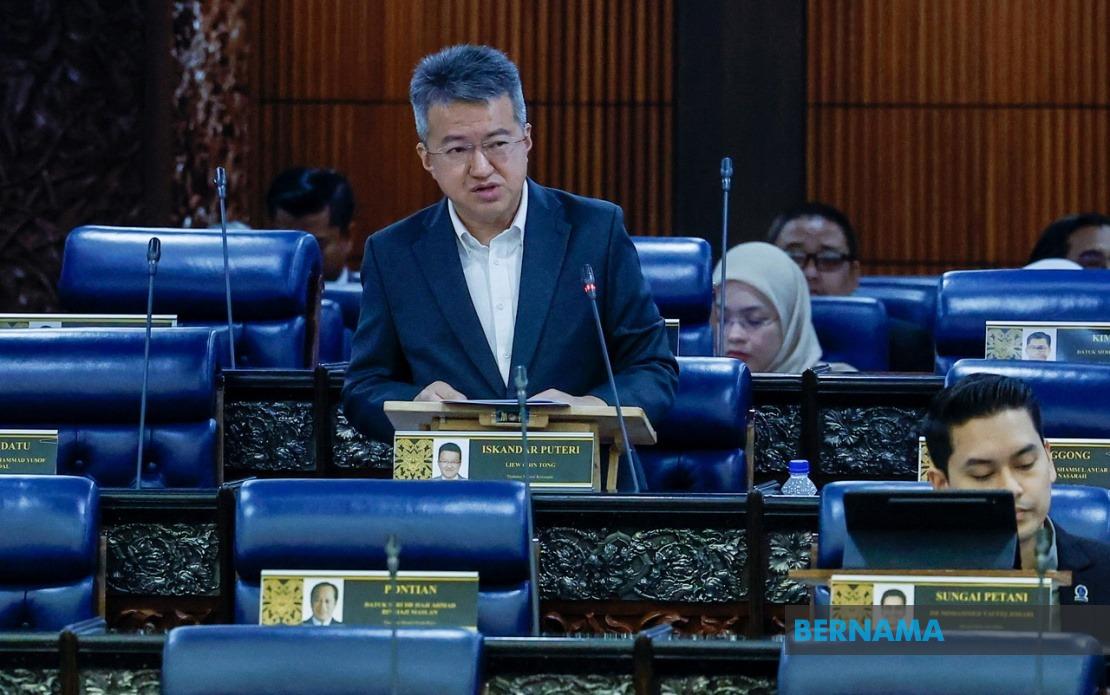
The federal government has moved to allay concerns in Sabah by guaranteeing that a RM1.5 billion boost to the state's interim special grant announced by Prime Minister Datuk Seri Anwar Ibrahim in May will operate independently of existing development and operating budgets. Deputy Finance Minister Liew Chin Tong made the clarification during parliamentary proceedings, responding to questions about how the additional funding would be administered and its constitutional underpinnings under Article 112C of the Federal Constitution.
The assurance carries particular significance for Sabah, which has long navigated complex constitutional arrangements regarding federal fiscal transfers. The state's special grant mechanism, enshrined in the Federal Constitution, represents a distinctive provision reflecting Sabah's agreement to join the Malaysian federation in 1963. Understanding how new allocations integrate with existing budget ceilings directly impacts state-level planning for infrastructure and service delivery, making the government's explicit commitment to maintain separate budget lines a material reassurance for policymakers in Kota Kinabalu.
To illustrate the government's commitment, Liew detailed the scope of Sabah's development expenditure, noting that allocation increased from RM6.7 billion to RM6.9 billion this financial year. This expansion funds a diverse portfolio spanning major initiatives such as the Pan Borneo Highway—a transformative infrastructure project linking the state's interior regions—alongside smaller but essential investments in rural connectivity. The funding also supports basic service infrastructure including water and electricity supply to remote communities, medical facilities, and educational institutions requiring rehabilitation.
Beyond capital projects, the federal government has maintained sector-specific subsidies recognising Sabah's particular circumstances. Despite transferring regulatory authority over electricity supply to the state government in 2024, the federal government continues underwriting power supply costs, with the subsidy allocation projected to reach RM880 million by 2026. This arrangement reflects acknowledgment that Sabah's geographic dispersal and lower population density render electricity provision more costly than in more densely settled regions, making federal cost-sharing essential for affordability.
Water infrastructure has emerged as another priority area, with rural supply allocations expanding substantially to RM143 million this year from RM103.5 million in 2025. For a state where geographic and demographic factors complicate service delivery, this increase addresses persistent gaps in piped water access across rural communities. The expansion represents federal recognition that achieving basic service parity between peninsular and East Malaysian states requires disproportionate investment.
Beyond infrastructure, the federal government channels support through direct assistance schemes designed to ease living costs. Sabah residents benefit from targeted cash assistance programmes including Sumbangan Tunai Rahmah and Sumbangan Asas Rahmah, with combined allocations estimated at RM1.2 billion. These transfers represent the federal government's approach to addressing household economic pressures while maintaining centralised budget control and ensuring transparent distribution mechanisms.
Liew emphasised that administration of the new special grant follows constitutional procedures specified under Article 112D, mirroring processes implemented during previous allocations in 2022, 2023, and 2025. This procedural consistency seeks to establish predictable mechanisms and reduce uncertainty surrounding grant disbursement timing and conditions. For state governments dependent on federal transfers, predictability facilitates medium-term budgeting and strategic planning.
Underscoring the government's constitutional position, Liew reiterated federal respect for the special grant principle established under Article 112C despite the federal government's decision to lodge an appeal against certain aspects of the Kota Kinabalu High Court's interpretation of the matter. The apparent tension between honouring the constitutional obligation while contesting judicial interpretation reflects competing fiscal interests, with the federal government seeking to establish clearer parameters for determining future grant amounts even as it affirms the fundamental obligation itself.
Looking ahead, Liew flagged the federal government's commitment to negotiating with Sabah's state administration to develop revised mechanisms for calculating special grant allocations in accordance with the Federal Constitution. These negotiations represent an attempt to move beyond ad-hoc annual determinations toward a more systematic, formulaic approach. For Sabah, securing agreement on predictable calculation methodologies would provide greater budget certainty; for the federal government, such arrangements would constrain open-ended fiscal obligations.
The dialogue around Sabah's special grant reflects broader federalism questions relevant throughout Malaysia. How federal resources distribute across states, and whether distribution mechanisms adequately account for geographic and demographic variation, shape development outcomes and regional equity. The government's efforts to maintain development allocations while increasing the special grant attempt to signal that additional transfers need not come at other states' expense—a politically important message in a federal system where regional disparities in resource allocation generate recurring tensions.
For Sabah specifically, the combined effect of increased special grants, sustained development allocations, continued electricity and water subsidies, and direct assistance schemes represents substantial federal commitment measured in billions of ringgit annually. Whether these commitments, implemented through multiple channels and programmes, prove sufficient to address Sabah's development gaps relative to more industrialised peninsular states remains an ongoing policy question that extends beyond individual budget cycles. The government's multi-layered approach suggests recognition that no single transfer mechanism adequately addresses the state's varied needs, yet leaves open questions about coordination effectiveness and whether parallel funding streams optimally deploy resources.

