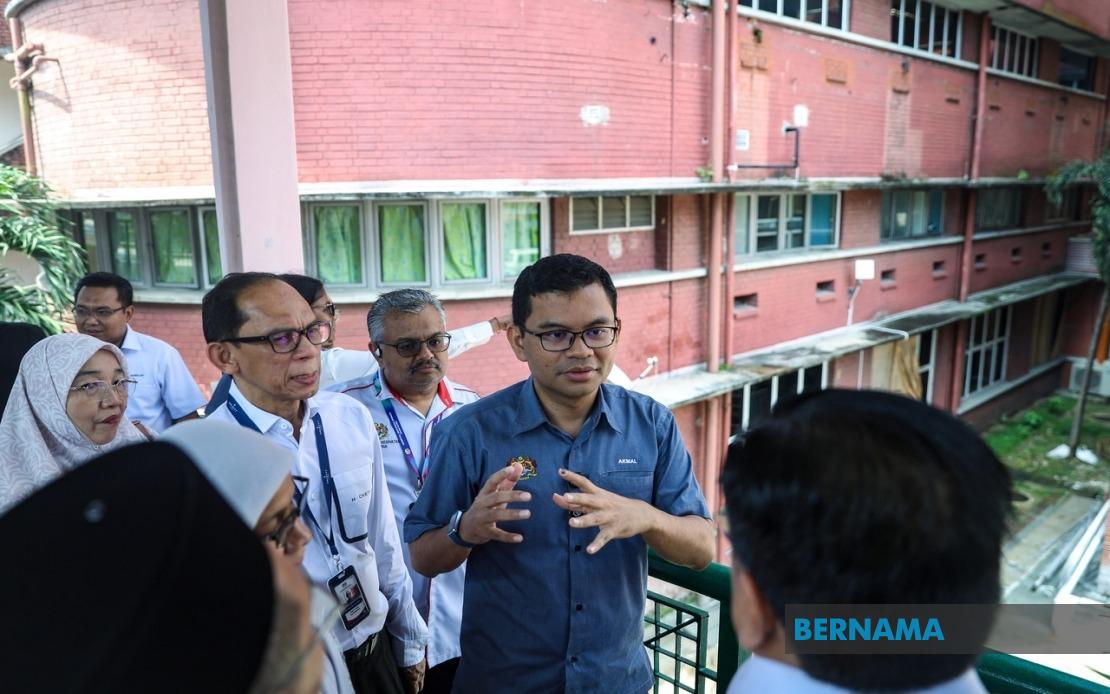
Seven major infrastructure projects valued at RM1.139 billion are reshaping healthcare delivery at Sultanah Aminah Hospital (HSA) in Johor Bahru, with works progressing across multiple fronts to enhance both capacity and service quality. The comprehensive development programme, overseen by the Economy Ministry, marks one of the largest healthcare facility investments in the state and signals the federal government's commitment to strengthening medical infrastructure in Johor, Malaysia's second-most populous state.
Economy Minister Akmal Nasrullah Mohd Nasir disclosed the portfolio of improvements during an inspection visit, emphasising that the hospital's expansion directly addresses growing demand for specialist services in the southern region. The project encompasses critical infrastructure modernisation alongside purpose-built new facilities, reflecting a holistic approach to upgrading the institution rather than simply adding capacity. Among the initiatives is a RM159 million overhaul of the hospital's main electricity supply systems and mechanical infrastructure, which has already achieved 76.49 per cent completion. This foundational work is essential for supporting the additional medical equipment and systems that new facilities will require, ensuring the hospital operates safely and efficiently at higher capacity.
The most substantial component involves constructing a Day Care Centre alongside a multi-storey parking facility and the HSA Specialist Clinic Complex, spanning both Phase 1 and Phase 2 implementations. These interconnected projects carry a combined value of RM877.54 million and represent the operational heart of the expansion strategy. The specialist clinic complex will consolidate outpatient services and allow HSA to treat a significantly larger number of patients without requiring overnight hospitalisation, a model increasingly adopted across Southeast Asia's healthcare systems to maximise resource efficiency while reducing bed occupancy pressures.
The multi-storey parking structure addresses a practical constraint facing modern hospitals in congested urban areas. Adequate parking has become integral to patient access and staff retention, with insufficient facilities driving patients toward alternative healthcare providers. By integrating parking into the development scheme, planners have acknowledged that healthcare infrastructure extends beyond clinical spaces to encompass the entire patient journey and user experience. The Day Care Centre will similarly provide flexible treatment options for procedures not requiring inpatient admission, reducing overall bed demand while expanding service reach.
Akmal Nasrullah outlined the staggered timeline for project delivery, acknowledging that coordination remains challenging when major construction proceeds simultaneously with active hospital operations. The ministry has prioritised minimising disruption to existing services—a critical consideration given HSA's role as a tertiary referral centre serving southern Peninsular Malaysia. The Letter of Acceptance for contractors managing the Day Care Centre, parking facility, and specialist clinic complex is targeted for February next year, suggesting that detailed design work and tender processes are advancing according to schedule.
An immediate operational enhancement involves the addition of three new operating theatres, which will increase surgical capacity from twelve to fifteen operating rooms. This expansion directly enables HSA to handle more elective procedures and accommodate emergency surgery without queue backlogs—a perennial challenge in Malaysian public hospitals where surgical waiting lists sometimes extend beyond clinically acceptable timeframes. The additional theatres will also allow specialisation and dedicated scheduling for different surgical disciplines, improving efficiency and clinical outcomes.
Beyond the HSA-specific initiatives, Akmal Nasrullah contextualised the investment within Johor's broader development trajectory. Since 2000, the state has absorbed 613 development programmes and projects valued at RM56.12 billion, representing sustained federal investment across economic, infrastructure, and social sectors. This year alone, RM4.95 billion was allocated for implementation, with RM2.5 billion—approximately 50.51 per cent—spent by late July. The spending pace indicates that project execution is tracking reasonably well despite pandemic-related delays and supply chain disruptions that have affected construction nationwide.
The portfolio comprises 154 entirely new projects alongside 459 extensions of existing facilities, demonstrating that development policy balances new initiatives with consolidation and improvement of established assets. For healthcare specifically, this mixed approach suggests the government is not simply expanding physical footprint but systematically upgrading and modernising facilities that may have aged beyond optimal functionality. HSA's renovation exemplifies this philosophy: the hospital, while historically significant, required substantial systems modernisation to meet contemporary clinical and safety standards.
For Malaysian healthcare observers, the HSA investment carries broader implications regarding federal health infrastructure strategy. The scale of commitment—over RM1 billion for a single hospital—reflects confidence in Johor's demographic trajectory and economic importance. The southern corridor, spanning Johor, Negeri Sembilan, and Melaka, is increasingly integrated with Singapore's healthcare economy, with cross-border patient flows and workforce movements creating demand for internationally competitive medical facilities. HSA's expansion positions it to capture regional demand and reduce patient leakage to private hospitals or overseas providers.
The project also illustrates evolving healthcare delivery models within Malaysia's public health system. The emphasis on specialist clinics and day care reflects recognition that many patients require specialist expertise without necessarily needing inpatient beds. This outpatient-focused expansion is more financially sustainable than expanding bed capacity alone, as it maximises throughput without proportionately increasing nursing, housekeeping, and support service costs. For patients, improved specialist services closer to home potentially reduces treatment delays and burden on families.
Implementation challenges should not be underestimated. Concurrent construction across multiple sites within an operating hospital requires meticulous planning, robust communication between contractors and clinical staff, and contingency protocols for emergencies. Johor's climate—hot, humid, and subject to seasonal flooding in low-lying areas—adds complexity to construction scheduling. Material costs and contractor availability remain potential pinch points given ongoing global supply disruptions and Malaysia's competitive demand for skilled tradespeople across multiple infrastructure mega-projects.
From a fiscal perspective, the RM1.139 billion expenditure at HSA forms part of national healthcare investment that has accelerated since 2020. The pandemic exposed capacity constraints in public hospitals, spurring policymakers to prioritise modernisation and expansion. Investing in specialist facilities and enabling infrastructure like parking and day care also supports broader Malaysia My Second Home and medical tourism initiatives, as international patients increasingly choose facilities that combine clinical excellence with modern amenities. HSA's upgraded specialist complex could attract regional patients seeking quality care at costs below Singapore or Western benchmarks.
The minister's emphasis on timely completion and service continuity reflects political awareness that healthcare infrastructure projects capture public attention intensely. Any significant disruption or delay becomes visible to constituents immediately. Successfully delivering this portfolio would strengthen confidence in government project management and generate tangible evidence of development benefits for Johor residents. Conversely, cost overruns or extended timelines could undermine public perception of governance effectiveness and fiscal responsibility.

