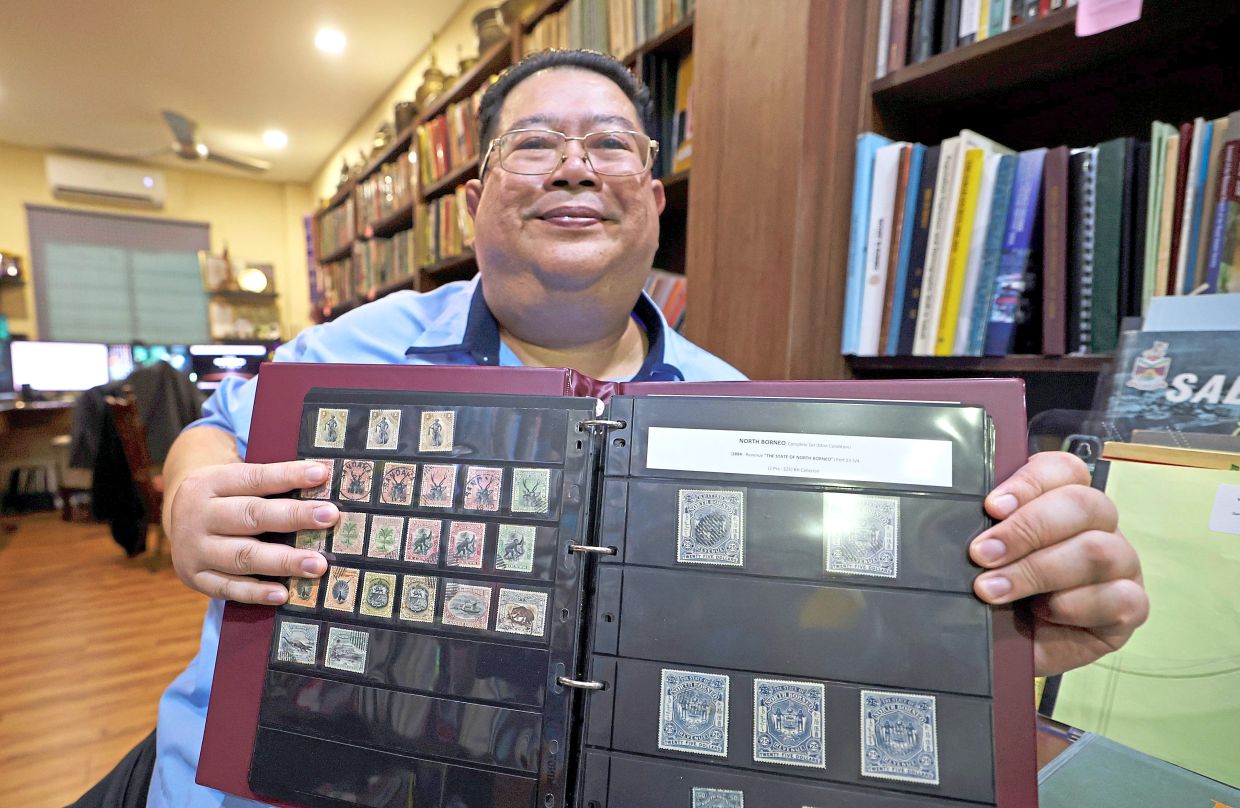
The stamps issued over North Borneo's colonial and early independence period represent far more than ordinary postage—they constitute a tangible chronicle of a territory's transformation, yet these fragile historical documents are increasingly vanishing from circulation as traditional stamp collecting fades from public consciousness. With many original stamps now over a century old and becoming scarcer in the antique market, custodians of this heritage are sounding alarms about the risk of permanent loss to future generations of Malaysians seeking to understand Sabah's past.
Dr Shari Jeffri, a 56-year-old founder and president of the Borneo History Association, frames these philatelic treasures as a "living archive" that demands active stewardship and systematic preservation. His perspective reflects growing concern within heritage circles that the generational transmission of stamp-collecting knowledge and passion has broken down, leaving few qualified enthusiasts to appreciate or maintain these artefacts. The modern shift toward digital communication and away from letter-writing has compounded this decline, severing the everyday connection between people and the postal system that once made stamp collecting a natural pursuit.
A recent Bernama survey documenting antique dealers across Kota Kinabalu revealed that genuine North Borneo stamps have become substantially harder to source, with valuations fluctuating significantly based on factors including issue date, physical condition, and scarcity status. Recent acquisitions examined in the survey included a specimen album housing a six-cent stamp from the 1954-1961 era depicting Queen Elizabeth II alongside a Dusun woman—an image reflecting Sabah's indigenous heritage—alongside a ten-cent denomination showing logging operations that underscore the territory's resource-dependent economy during that period. Such specific iconography embedded within these stamps offers researchers concrete visual evidence of how colonial and post-colonial authorities sought to represent the territory's identity and economic foundations.
Jeffri's own journey into philately exemplifies how family inheritance has traditionally been the primary vector for perpetuating stamp-collecting knowledge in Malaysian communities. He inherited his initial collection from his grandfather, who worked at the Recreation Club Jesselton during the 1920s and became entranced by the hobby after observing British officers engaged in the pursuit. Though exposed to stamps from childhood, Jeffri's serious engagement with collecting commenced during his secondary schooling, a formative period when adolescents typically develop sustained intellectual interests. His decades-long commitment to preserving and studying his inherited collection ultimately motivated him to research the broader historical narratives embedded within North Borneo's postal systems.
Among Jeffri's most prized holdings are two specimens from the inaugural 1883 issue—two-cent denominations bearing a brown sailing boat design with complete postmarks intact. For serious philatelists, obtaining examples from this foundational series constitutes a collector's milestone, as these inaugural stamps carry heightened historical weight and rarity value. The significance of possessing stamps with legible cancellation marks cannot be overstated; such marks record precise information about postal routing, including the specific post office, date, and time of mailing, creating micro-archives of administrative and logistical practice within the territory's nineteenth-century infrastructure.
As a philatelist with nearly four decades of experience, Jeffri provides authoritative context on the evolution of North Borneo's postal identity. The British North Borneo Chartered Company introduced stamps in 1883, and these remained in use for approximately 52 years, spanning the entire chartered company period through the early twentieth century. The design schemes changed substantially over this span, with the 1935 series representing a critical inflection point where artistic choices more deliberately reflected Sabah's territorial character through representations of local geography and culture. This series circulated in denominations extending from two cents to one dollar, providing varied denominations for different classes of correspondence and commerce.
The earliest stamp designs prominently featured European heraldic symbols—lions, tigers, and sailing boats—alongside the Latin motto Pergo et Perago, meaning "I undertake and I achieve." These selections conveyed messages about the chartered company's ambitions and its vision of introducing the territory to international audiences. However, from 1894 onwards, artistic direction shifted decidedly toward celebrating Borneo's biological distinctiveness, with designs increasingly showcasing indigenous flora, fauna, and distinctive wildlife that distinguished the region from other British colonial possessions. This visual pivot reflected evolving approaches to territorial promotion and simultaneously documented the natural environment as nineteenth and early twentieth-century administrators understood it.
Preservation methodology represents another critical dimension of this heritage work, and Jeffri emphasizes that proper storage conditions determine whether these artefacts survive to serve future historians. Stamps must be housed in acid-free albums specifically designed to prevent chemical degradation, oxidation, and fading that would render century-old colours indecipherable and compromise their research value. The adhesive and paper composition of stamps function as authenticating markers—specialists examine these material properties to distinguish genuine issues from forgeries and to date stamps within narrower chronological windows. Stamps bearing complete postal cancellations command particular collector premium precisely because cancellation marks provide verifiable evidence of usage and create multiple layers of historical documentation within single physical objects.
Jeffri's own expertise deepened through formal study under recognized philatelic authorities, including Singaporean specialists Voon Kyam Foh and Tan Chun Lim, while simultaneously consulting technical reference works such as the Commonwealth & British Empire Stamps catalogue. This combination of mentorship and systematic reference consultation demonstrates how serious collectors build expertise through engagement with both human knowledge networks and documentary resources. The relative scarcity of such qualified mentors in Malaysia underscores the urgency of knowledge transfer, as the retirement or departure of senior collectors without adequate succession planning risks creating genuine expertise gaps.
The tension between North Borneo stamps' historical importance and their material vulnerability becomes especially acute when considering that alternative documentary evidence of colonial postal administration, commercial networks, and territorial representation may not survive in equivalent forms. While government archives potentially preserve administrative records, the stamps themselves constitute unique artifacts encoding visual, material, and contextual information unavailable through textual sources alone. Malaysian historians and curators increasingly recognize that heritage preservation extends beyond grand monuments to encompass objects like these stamps—ordinary-seeming items that nonetheless encapsulate crucial evidence about how communities understood themselves and communicated with the wider world during formative historical periods.

