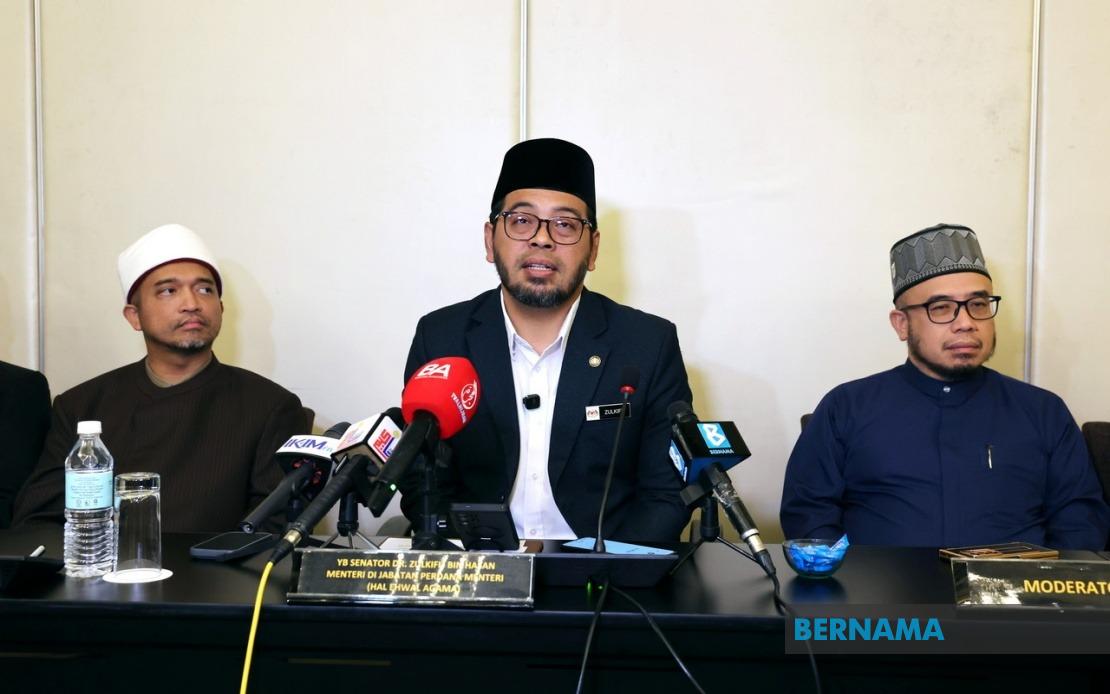
Malaysia's Minister in the Prime Minister's Department (Religious Affairs), Dr Zulkifli Hasan, has stated that the Islamic theological term "kafir harbi" is inappropriate for application to Malaysian citizens, emphasising that the country's constitutional framework and multicultural fabric render such labelling fundamentally incompatible with national identity and cohesion.
The pronouncement emerged following a dedicated roundtable discussion convened in Putrajaya to examine the contentious terminology and its implications for Malaysian society. The forum, titled "'Kafir Harbi' in Malaysia: A Discussion," brought together stakeholders to deliberate on the appropriateness and potential consequences of deploying this classical Islamic jurisprudential concept within a modern, constitutionally plural state. The discussions encompassed presentations, detailed exchanges of perspective, and consensus-building on the matter's broader ramifications.
At the heart of the minister's position lies a fundamental constitutional argument: all Malaysian residents, regardless of faith, are bound by the Federal Constitution and therefore possess equal standing as citizens within a shared political and social order. This framing directly challenges the utility of a term historically used in Islamic scholarship to denote adversaries or non-believers in conflict situations. Dr Zulkifli asserted that such categorisation fundamentally misrepresents the relationship between Malaysia's diverse population and the state, which rests on mutual rights, obligations, and belonging rather than adversarial religious postures.
The term "kafir harbi" derives from classical Islamic jurisprudence, where it denotes a non-believer from a warring nation or state in active conflict with an Islamic polity. The theological construction presumes a context of interstate or sectarian warfare, creating a binary division between believers and non-believers on opposing sides. In recent years, the phrase has occasionally surfaced in Malaysian public discourse, prompting concern among religious scholars, constitutional experts, and civil society actors about its potential to inflame communal tensions and undermine social cohesion in a nation where approximately 70 per cent of the population adheres to Islam while significant Christian, Hindu, Buddhist, and other faith communities coexist.
Dr Zulkifli's declaration reflects an official stance that contemporary Malaysia transcends the historical contexts from which such terminology emerged. Rather than residing in separate warring states, Malaysians of all faiths inhabit a single constitutional order with shared responsibilities for national defence, economic development, and institutional governance. This structural reality renders the theological premise underlying "kafir harbi" categorisation obsolete in the Malaysian setting, where citizens of different religions serve together in the military, judiciary, civil service, and parliament, united by oath to the Federal Constitution.
The minister articulated a vision of national integration predicated on mutual respect, cultural understanding, and recognition of shared homeland. He emphasised that strengthening unity requires Malaysian society to consciously cultivate closer bonds of brotherhood across religious lines, deepen appreciation for diverse traditions, and commit to collective nation-building. This positive framing positions the rejection of divisive terminology as foundational to Malaysia's capacity to develop as a cohesive, prosperous nation rather than merely a territorial arrangement of competing communities.
Implementing this consensus requires sustained institutional engagement beyond the religious sector alone. The Department of Islamic Development Malaysia (JAKIM) will spearhead collaborative efforts with other government agencies and ministries to disseminate clarification, strengthen public awareness, and provide religious and legal context regarding the inappropriateness of the term. Such a coordinated governmental approach signals that the matter transcends Islamic theological discourse to become a question of constitutional governance, national identity, and state responsibility for social harmony.
The decision to mobilise multiple agencies underscores recognition that terminology debates at the grassroots level often reflect broader anxieties about communal relations, minority rights, and majoritarian power dynamics. By centralising clarification efforts across sectors, the government aims to ensure that refutation of the term reaches diverse audiences through varied institutional channels—schools, civil service training programmes, media platforms, and community forums—thereby reinforcing consistent messaging and forestalling alternative interpretations that might proliferate in fragmented information environments.
For Malaysian society, the minister's pronouncement carries several implications. First, it represents official rejection of theological framings that could be weaponised to delegitimise citizens on the basis of religious identity. Second, it affirms the constitutional commitment to equality and non-discrimination, signalling that religious autonomy operates within constraints imposed by fundamental law. Third, it invites Islamic religious scholars and teachers to engage with classical jurisprudence in ways sensitive to contemporary constitutional contexts, modelling how traditional knowledge traditions can be reinterpreted to support rather than undermine pluralism.
Regionally, Malaysia's explicit positioning against such terminology may influence discourse in neighbouring countries grappling with similar tensions between classical Islamic concepts and modern religious pluralism. The approach demonstrates that Muslim-majority nations need not choose between religious authenticity and constitutional secularism; instead, they can cultivate distinctly Islamic arguments for pluralism and coexistence grounded in faith-based reasoning rather than imposed external frameworks.
Implementation success will depend on whether JAKIM and partner institutions can translate the minister's statement into sustained education and engagement. The challenge lies partly in reaching communities where the term has gained traction through social media or grassroots preaching, where counter-messaging requires patient dialogue rather than authoritarian suppression. The collaborative approach Dr Zulkifli outlined acknowledges that genuine integration demands not merely governmental declaration but active participation by religious leaders, educators, and community figures in reshaping how Malaysians understand religious belonging and national citizenship.

