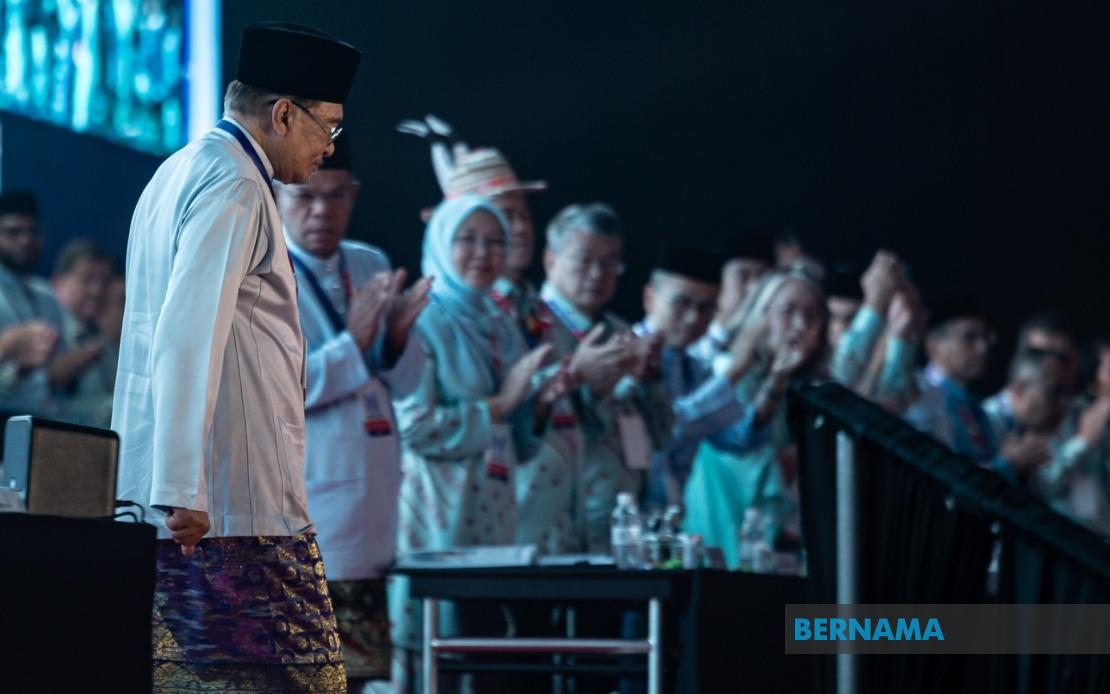
Prime Minister Datuk Seri Anwar Ibrahim has mounted a vigorous defence of his administration's reform record, arguing that the substantial progress achieved under his leadership should not be discounted simply because activists and political observers are demanding even more sweeping changes. Speaking at the 2026 PKR National Congress in Melaka on August 15, Anwar acknowledged the tension between those pushing for rapid systemic transformation and his government's more gradual approach, but insisted that the foundation laid over nearly three years in office represents genuine progress on issues neglected for decades.
The Prime Minister, who leads both the PKR party and the Finance portfolio alongside his executive duties, outlined a comprehensive list of legislative reforms implemented since taking office. These include amendments to the Audit Act 1957 and the Parliamentary Service Act, the Public Finance and Fiscal Responsibility Act 2023, the establishment of the Special Task Force on Agency Reform, and new legislation governing consumer credit and protections for gig economy workers. Each of these measures addresses specific governance gaps that had persisted through previous administrations, and together they form what Anwar characterises as a coherent reform agenda dubbed MADANI.
Crucially, Anwar framed the challenge facing his government as one of realistic expectations and political mathematics. The formation of the Unity Government following the 2022 general election required negotiation and compromise among multiple coalition partners, each bringing their own policy priorities and red lines. As the principal party within the government, PKR and its Pakatan Harapan alliance have had to balance their own reform ambitions against the interests and sensitivities of their coalition partners—a reality that inevitably slows the pace of change but ensures broader political stability and sustainability.
The Prime Minister's defence reveals a deeper tension within Malaysia's political landscape. Reform advocates and civil society groups often push for wholesale institutional transformation, particularly on matters of accountability, transparency, and anti-corruption enforcement. Yet governing requires navigating coalitional politics where different parties hold different positions on contested issues. Anwar's point is that some progress, delivered through legislation and policy change, is preferable to the deadlock that might result from pursuing an ideological maximalist agenda that alienates coalition partners or provokes institutional backlash.
Anwar also emphasised that meaningful institutional change requires more than legislative action—it demands that reforms take root across the bureaucracy, courts, and public consciousness. This cannot happen overnight. The amendments to the Audit Act, for instance, represent a significant expansion of the Audit Office's powers to scrutinise government spending, but embedding such powers into institutional practice and overcoming bureaucratic inertia takes time. Similarly, establishing the Special Task Force on Agency Reform signals commitment to overhauling how government functions, but the actual restructuring and retraining of personnel occurs gradually.
The contrast Anwar drew with the six decades preceding his administration is analytically important for Southeast Asian readers assessing governance trajectories. Malaysia's institutional reforms have historically moved slowly, often blocked by ruling coalitions reluctant to empower oversight bodies or strengthen transparency mechanisms. The MADANI reforms, whatever their limitations, represent a departure from this pattern. Whether the pace is adequate remains contested, but the direction has shifted measurably.
Anwar acknowledged that neither his government nor individual ministers have executed their reform agenda perfectly. This candour is notable for a sitting Prime Minister addressing a party congress, and it suggests internal awareness that some reform initiatives have stalled or underperformed. The Gig Workers Bill, for example, has faced implementation challenges, and labour advocates argue that protections remain inadequate. Similarly, enforcement of the Consumer Credit Act has been uneven, with reports of loopholes benefiting lenders over vulnerable borrowers. By acknowledging these imperfections, Anwar avoids appearing defensive while subtly signalling that fine-tuning and second-generation reforms remain possible.
The staged approach Anwar advocates echoes classic development policy thinking: foundational reforms must be established before ambitious new initiatives can succeed. Yet critics argue this logic can become a permanent excuse for inaction, with each new phase perpetually deferred. The challenge for the Malaysian government lies in demonstrating that staged implementation has clear timelines and measurable milestones, rather than becoming an indefinite placeholder.
For Malaysia's business community and international investors, Anwar's reform agenda addresses legitimate concerns about institutional credibility. The Public Finance and Fiscal Responsibility Act 2023, in particular, constrains fiscal deficits and ties government spending to legislated targets, providing predictability for long-term planning and potentially stabilising borrowing costs. Such reforms benefit ordinary Malaysians through more stable macroeconomic management, even if they receive less media attention than headline-grabbing anti-corruption initiatives.
Anwar's insistence that critics should "accept the fact that change has already taken place" reflects growing political confidence following his survival of numerous challenges to his leadership and the government's stability through successive parliamentary crises. Yet this confidence must be tempered by recognition that many reform agendas—particularly on judicial independence, electoral fairness, and media freedom—remain incomplete or contentious within the coalition. The Unity Government's durability depends partly on avoiding these most sensitive institutional questions.
Looking forward, the question for Malaysian voters and regional observers is whether Anwar's reform trajectory represents a genuine foundation for further systemic change or a plateau that successive governments will prove reluctant to advance. The answer will likely determine whether the MADANI framework is remembered as a significant turning point in Malaysian governance or as a modest corrective that preserved existing power structures while offering cosmetic adjustments. For now, Anwar's defence at the PKR Congress signals that his administration intends to continue expanding the reform agenda, albeit at a pace constrained by coalition politics and institutional capacity—a characteristically pragmatic but potentially frustrating approach for those demanding more fundamental transformation.

