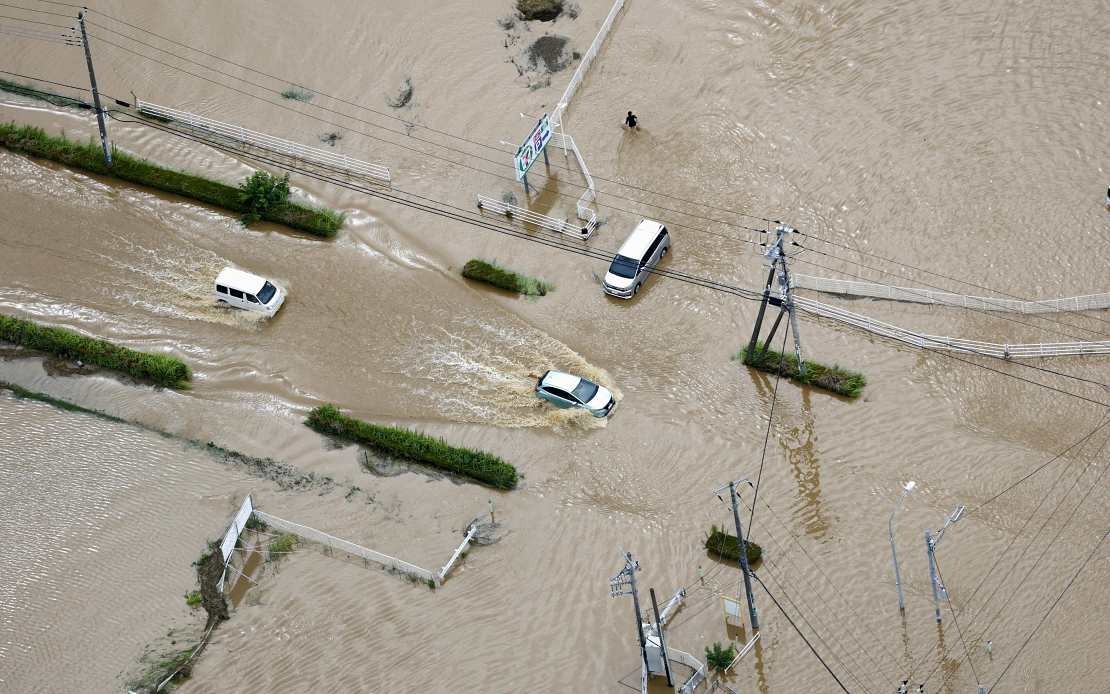
A devastating weather system sweeping across eastern Japan has left eight people dead in Chiba Prefecture, with authorities confirming fatalities across multiple cities as record-breaking rainfall persisted through Friday morning. The deaths were recorded in urban and suburban centres including Chiba City, Kashiwa, Ichikawa, Sakura and Yachiyo, while four additional people sustained minor injuries requiring medical attention. The scale of the disaster underscores the region's vulnerability to extreme precipitation events, a pattern increasingly recognised across Asia's densely populated lowlands vulnerable to climate-related weather extremes.
The meteorological impact was extraordinary by local standards. Chiba City's weather stations recorded 348 millimetres of rain within a twelve-hour window ending at 1:40 am on Friday—a quantity representing approximately three times the entire month's average rainfall concentrated into a single half-day period. Such compressed precipitation events create cascading hazards: waterlogged soil becomes unstable, drainage systems become overwhelmed, and flash flooding develops with minimal warning. The Japan Meteorological Agency had initially issued its highest-level emergency alert—designated Level 5—specifically targeting heavy rain and landslide risks across vulnerable areas of the prefecture, reflecting the exceptional nature of the atmospheric conditions developing.
Emergency response authorities faced significant operational challenges managing the immediate humanitarian fallout. As of Friday morning, approximately 102,600 residents remained under formal evacuation orders across Chiba Prefecture, representing a substantial displacement of the local population requiring temporary shelter, supplies and welfare support. This mass relocation reflects standard precautionary protocols when communities face immediate danger from flooding, saturated slopes prone to sliding, and swollen waterways. The scale of evacuations indicates how severely the disaster impacted residential and commercial zones, forcing authorities to implement large-scale logistics operations to move vulnerable populations to safety.
Transportation networks experienced widespread disruption as the deluge overwhelmed infrastructure systems designed for normal weather patterns. Narita Airport, one of Japan's major international aviation hubs serving the Tokyo metropolitan region and beyond, saw approximately 7,000 passengers stranded overnight after train and bus services collapsed under weather stress. Such disruptions have ripple effects through regional and international travel networks, affecting not only Japanese tourists but also business travellers and visitors throughout Asia and beyond. The airport's operator confirmed that precipitation-induced failures across multiple transit modalities left thousands with no viable transport options, highlighting how integrated transport systems become fragile during extreme weather events.
The meteorological agency's alert system demonstrated adaptive management, downgrading all warnings to Level 4 or below by Friday morning as precipitation rates eased. However, officials simultaneously cautioned that additional heavy rainfall remained a genuine possibility, urging residents and workers to maintain heightened awareness despite the formal downgrade. This measured approach reflects standard meteorological practice: while initial peak danger subsided, saturated ground and swollen waterways posed continued risks even as fresh precipitation rates declined. The warning structure—descending from Level 5 through intermediate stages—provides communities with graduated information helping families and authorities calibrate response efforts appropriately.
For Malaysian and Southeast Asian observers, the Chiba Prefecture disaster illustrates vulnerabilities shared across the region's monsoon zones and tropical coastal areas. Japan, despite its advanced infrastructure and early warning systems, could not entirely prevent loss of life when precipitation reached record proportions. Similar extreme rainfall events have repeatedly affected Malaysia, Thailand, Indonesia and the Philippines, where topography and development patterns create particular flood and landslide risks. The incident serves as a sobering reminder that even wealthy, technologically sophisticated societies face genuine peril when atmospheric conditions breach historical precedent, challenging assumptions about infrastructure resilience.
Climate scientists increasingly recognise that warming atmospheric conditions influence precipitation extremes across temperate and tropical zones alike. When air masses contain elevated moisture content due to higher ocean temperatures, rainfall events can intensify beyond previous historical records. Chiba Prefecture's 348-millimetre deluge reflects this dynamic: the Japan Meteorological Agency confirmed it as a record-breaking amount, meaning historical data spanning decades provided no precedent for such concentrated precipitation. For regions across Southeast Asia already familiar with monsoon flooding, such intensification trends carry profound implications for urban planning, infrastructure design and disaster preparedness strategies.
The economic and social cascades from such disasters extend well beyond immediate casualty figures. Eight deaths represent individual tragedies with profound human cost, but the broader impact encompasses disrupted supply chains, damaged property, displaced economic activity, and stretched emergency services. The 102,600 evacuees faced temporary homelessness during the crisis, requiring rapid deployment of shelter, food, water and sanitation facilities. International airports like Narita serve as economic anchors for their regions; prolonged disruptions from weather events cascade through tourism, business travel and cargo operations affecting multiple countries across the Asia-Pacific.
Japan's response capabilities, refined through decades of earthquake and typhoon management, mobilised effectively despite the unprecedented precipitation totals. The disaster management framework enabling rapid evacuation orders and coordinated emergency response reflects institutional learning from previous crises. However, no amount of preparedness can entirely mitigate impacts when weather patterns exceed historical baselines. For Malaysian policymakers and regional planners, the Chiba Prefecture event reinforces the imperative for continuous updating of flood models, expansion of early warning capabilities, and recalibration of infrastructure standards to account for potential climate-driven changes to extreme weather characteristics.

