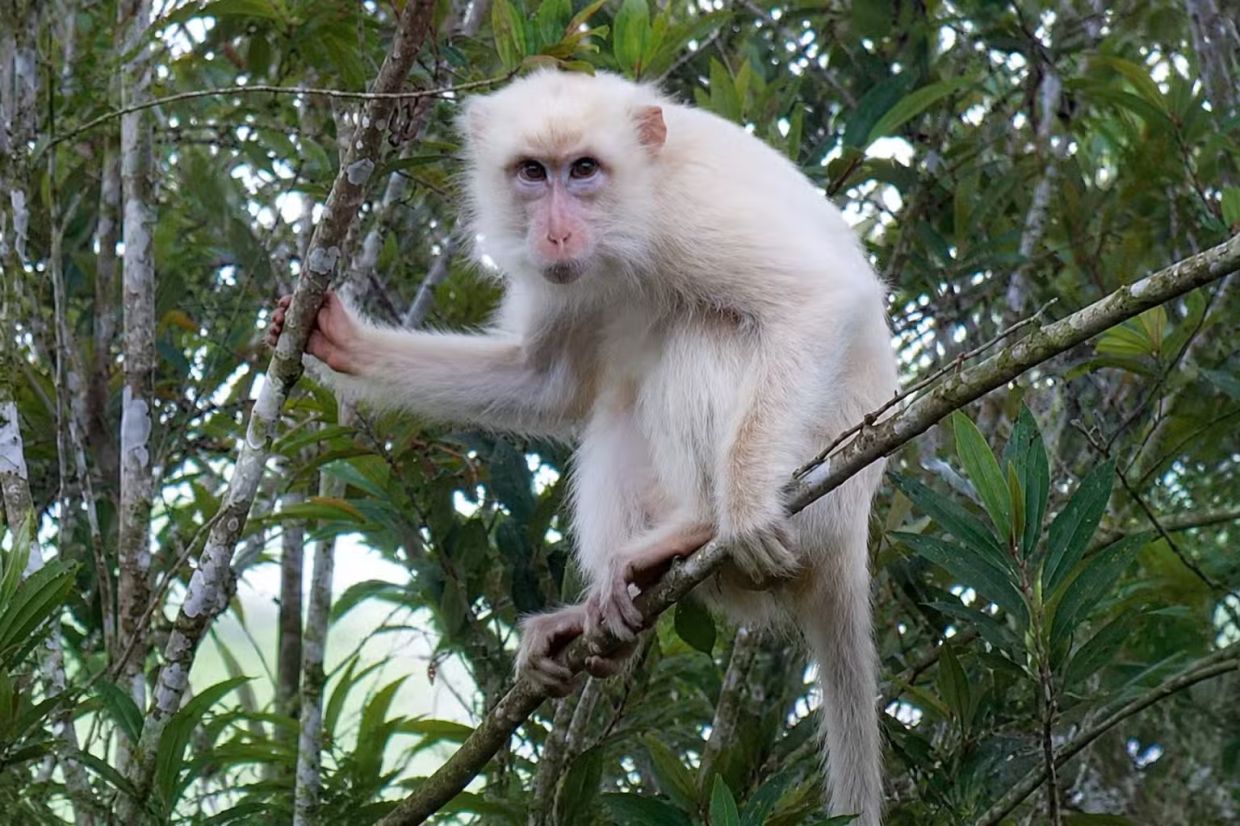
A strikingly pale macaque that has inhabited forested regions of Sultan Kudarat province for roughly nine years has suddenly become the focal point of a significant wildlife protection campaign, triggered by the explosive spread of images and videos across social media platforms. The animal's distinctive appearance — markedly different from the typical colouration of its species — long remained known primarily to nearby residents before internet attention transformed it into a conservation priority requiring immediate government intervention and community-based safeguarding measures.
The specimen belongs to the Philippine long-tailed macaque (Macaca fascicularis philippensis), a native species widely distributed across the archipelago. However, this particular individual displays an unusual pigmentation anomaly that has captivated public interest and raised scientific questions. Initial assessments suggested the monkey might have albinism, a complete absence of pigmentation; however, a composite field validation team from the Department of Environment and Natural Resources Region XII identified brown to dark brown eyes during their investigation, indicating the condition may instead be leucism or another related pigmentation disorder. Definitive identification awaits formal scientific verification by qualified wildlife specialists, yet the anomaly itself remains biologically significant regardless of its exact classification.
Local resident Armando reported that the macaque had been regularly observed roaming the vicinity since 2016, suggesting the animal has successfully survived and adapted within its forest habitat for an extended period. The monkey's longevity in the area demonstrates that such pigmentation variations do not necessarily impair survival in natural conditions, though the creature undoubtedly faces challenges that more typically coloured congeners might not encounter. The presence of a single long-lived individual with such a rare characteristic naturally draws scientific curiosity and presents opportunities for studying how pigmentation anomalies affect animal behaviour, social integration within groups, and fitness in tropical forest ecosystems.
The sudden amplification of visibility through social media has created a double-edged situation for conservation efforts. While public awareness can theoretically support protection initiatives, the geolocation information shared online and the concentration of human attention pose serious threats to the animal's safety and wellbeing. Environmental authorities specifically warned that heightened visibility increases vulnerability to disturbance, illegal capture, poaching, and integration into the wildlife trafficking network — criminal industries that remain persistently active across Southeast Asia despite enforcement efforts. The macaque's rarity makes it particularly attractive to collectors and traffickers who view unique specimens as valuable commodities.
In response to these emerging threats, the Department of Environment and Natural Resources Region XII partnered with the local government of Senator Ninoy Aquino municipality to implement immediate protective measures. The most direct action involved temporarily closing the area where the white macaque is frequently observed, effectively restricting public access and creating a buffer zone around the animal's core habitat. This closure strategy aims to minimize human disturbance while simultaneously preventing unauthorised wildlife collection and other anthropogenic threats that could harm the individual or disrupt the broader macaque population inhabiting the forest.
Fieldwork conducted during the validation exercise documented that the macaque's immediate environment remains ecologically sound for continued occupation. The presence of secondary forest vegetation and natural food sources continues sustaining the resident monkey population, suggesting that habitat degradation has not yet compromised the area's carrying capacity. This positive ecological assessment provides a foundation for longer-term conservation planning, as authorities can focus protection efforts on maintaining existing habitat quality rather than undertaking costly restoration across degraded landscapes.
Barangay Bugso has advanced plans to institutionalise protection through an ordinance specifically addressing the white macaque, its habitat, and the surrounding forest ecosystem. This legislative approach represents a significant step toward embedding conservation principles into local governance structures, ensuring that protection measures persist beyond temporary administrative decisions. Pending the ordinance's formal enactment, unauthorised entry into the macaque's immediate vicinity remains prohibited through interim enforcement mechanisms. The barrio government simultaneously plans comprehensive tree-planting and habitat-restoration activities designed to strengthen broader biodiversity conservation outcomes and establish frameworks for responsible ecotourism that could generate sustainable economic benefits for communities while protecting wildlife.
The Department of Environment and Natural Resources emphasised that all wildlife in the Philippines benefits from statutory protection under Republic Act No. 9147, the Wildlife Resources Conservation and Protection Act. This legislation explicitly prohibits hunting, capturing, collecting, possessing, transporting, trading, or disturbing protected species without authorised permits — violations carry penalties designed to deter wildlife crime. Yet enforcement remains challenging across dispersed forest areas where monitoring capacity is limited and criminal networks operate with sophistication. The agency appealed directly to content creators, photographers, journalists, social media users, and residents to exercise restraint in sharing wildlife sightings, particularly avoiding geotagged content or precise location information that could enable exploitation.
The documentation of this macaque's existence and characteristics will be submitted to the Biodiversity Management Bureau for technical evaluation and inclusion in national biodiversity records. This systematic approach to recording and studying the specimen ensures that scientific knowledge accumulates, contributing to broader understanding of pigmentation variation in Philippine primates and informing future conservation strategies. Simultaneous commitments to continued habitat monitoring, strengthened coordination among local stakeholders, and intensified public education campaigns on wildlife protection reflect a holistic conservation philosophy addressing biological, social, and institutional dimensions of species preservation.
The white macaque case illustrates contemporary conservation challenges across Southeast Asia, where rapid information dissemination through digital platforms can simultaneously raise protective awareness and generate threats through poaching networks. The Philippines' response demonstrates how coordinated action by national environmental agencies, municipal governments, and barangay administrations can translate concern into concrete protective measures. For Malaysian policymakers and conservation professionals, the Sultan Kudarat example offers instructive lessons about managing rare wildlife discoveries in an era of viral social media, emphasising the critical importance of rapid institutional response, community engagement, and careful calibration of public communication to maximise conservation benefits while minimising exposure to exploitation. As the white macaque continues inhabiting its forest home, it now does so under formal watch and protection — a rare but valuable instance of wildlife conservation moving quickly from discovery to active safeguarding.

