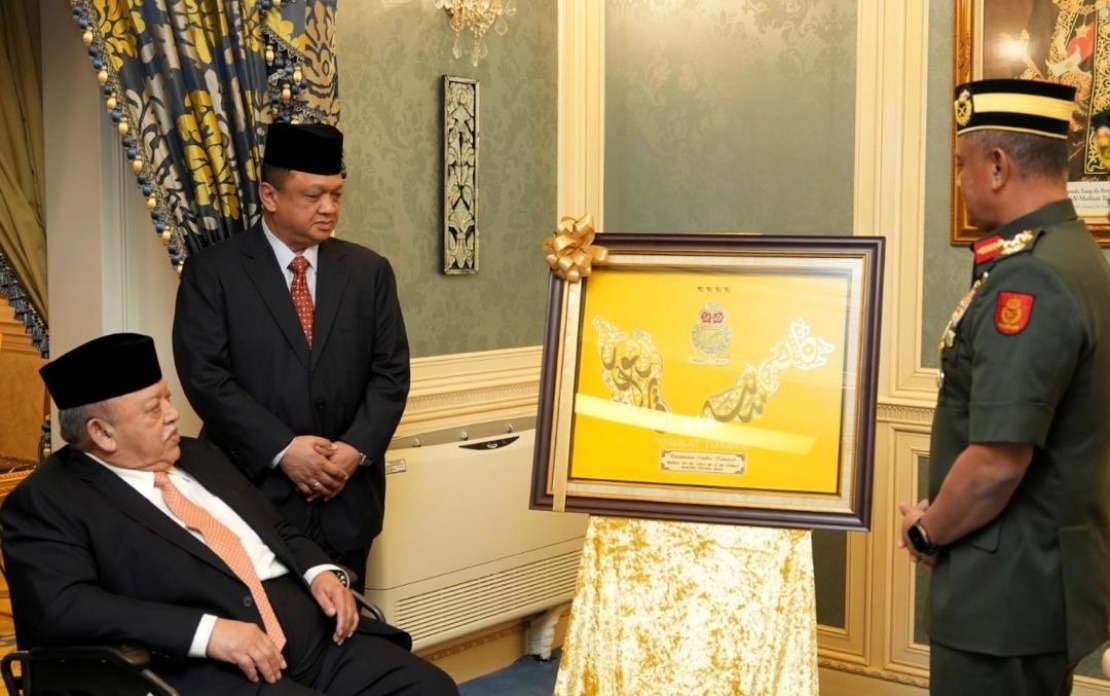
The Raja of Perlis, Tuanku Syed Sirajuddin Jamalullail, hosted a formal reception for the nation's top military commander on July 29 at the Balai Menghadap Biru within the grounds of Istana Arau in Arau. The ceremonial audience with Army Chief General Tan Sri Azhan Md Othman marked a significant engagement between Perlis's royal leadership and the country's defence establishment, underscoring the institutional partnership that underpins Malaysia's security architecture.
Present alongside the Raja during the meeting was the Raja Muda of Perlis, Brigadier General Tuanku Syed Faizuddin Putra Jamalullail, whose military rank reflects the deep integration of the Perlis royal family within the armed forces hierarchy. The Raja Muda currently commands the 504th Territorial Army Regiment, a unit stationed at Kem Bukit Keteri in the Padang Besar area, positioning him at the nexus of state and military governance in the northern state.
According to Istana Arau's official statement, the audience functioned as an occasion to deepen the historically close relationship between Perlis's royal institution and the Malaysian Army. The palace particularly emphasised the significance of acknowledging the military's unwavering dedication to preserving national sovereignty and maintaining the security framework that protects Malaysian citizens. This recognition reflects the constitutional role that the armed forces play in safeguarding the realm under the oversight of the Yang di-Pertuan Agong and state rulers.
The timing and nature of such ceremonial audiences carry particular weight in Malaysia's constitutional monarchy system. The Raja of Perlis holds formal military appointments that extend beyond symbolic recognition, serving as Colonel-in-Chief of both the Royal Ranger Regiment and the Royal Military Police Corps. These appointments embed the state ruler within the defence establishment's command structure, creating institutional channels through which royal and military leaderships can coordinate on matters affecting national security and regional stability.
The palace's statement stressed that the meeting represented more than a courtesy exchange, instead functioning as a platform for substantive dialogue on strategic cooperation between the army's command structure and Perlis's state leadership. The discussion encompassed security concerns, public welfare initiatives, and broader national development priorities, indicating that such audiences address the multifaceted dimensions of governance rather than ceremonial formalities alone.
For Malaysia's defence policy in the northern region, such meetings carry operational implications. Perlis's geographic position as the nation's northernmost state places it at the frontline of border security concerns, particularly regarding the maritime boundaries in the Strait of Malacca and terrestrial interfaces with Thailand. The regular engagement between state rulers and military command ensures that regional security challenges receive integrated attention combining royal prerogative, state administration, and defence capabilities.
The emphasis placed by Istana Arau on preserving national peace, stability, and prosperity through defence-royal institutional cooperation reflects a fundamental principle of Malaysia's governance model. The armed forces operate under civilian and constitutional oversight, with state rulers serving as custodians of their respective jurisdictions' security interests. The formal audience mechanism provides structured opportunities for these institutions to align strategies and address emerging security dynamics.
Brigadier General Tuanku Syed Faizuddin's position as both an active military officer and royal heir apparent illustrates how Perlis maintains continuity in these institutional relationships across generational transitions. His command of the territorial regiment demonstrates that the state's military contributions extend into the reserve and territorial components of the defence force, essential for sustaining the distributed network of security capabilities across Malaysia's geography.
The army chief's visit to Perlis follows a pattern of engagement whereby senior military leaders traverse Malaysia's peninsula and east coast states, reinforcing the institutional bonds between federal defence structures and state authorities. These visits enable military command to maintain awareness of local security conditions, coordinate with state administrations on civil-military matters, and demonstrate the institutional respect that the armed forces maintain toward constitutional monarchies and their holders.
From a broader Southeast Asian perspective, Malaysia's demonstration of stable civil-military relations and strong royal-defence institution partnerships contributes to regional security architecture stability. In a region where civil-military tensions occasionally emerge, Malaysia's model of a professional military operating under constitutional constraints and royal oversight presents a governance framework that other nations sometimes study for institutional insights.
The audience also reflects the continuity of Malaysia's security posture during a period when regional geopolitical tensions have heightened. The partnership between royal institutions and the military remains foundational to how the nation conceptualizes and executes defence policy, particularly as emerging security challenges—from maritime concerns to transnational issues—demand integrated approaches combining political leadership, military expertise, and regional coordination.
For Malaysian citizens and Southeast Asian observers, such ceremonial engagements might appear merely procedural, yet they embody substantive institutional relationships that shape the country's security governance. The respect shown by the military leadership toward the Raja of Perlis, and the Raja's formal recognition of the army's vital role, reflects mutual acknowledgment of constitutional duties that have served Malaysia's security interests since independence.

