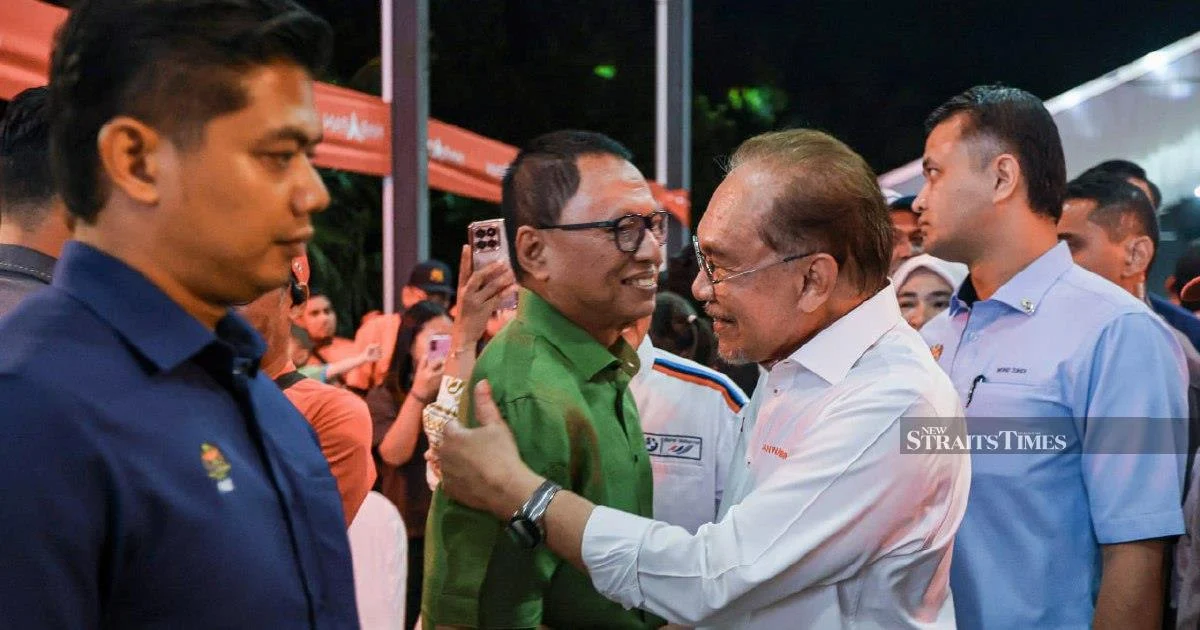
Bersama leader Datuk Seri Rafizi Ramli has weighed in on Datuk Dr Mohd Puad Zarkashi's conspicuous public embrace with Prime Minister Anwar Ibrahim, offering a pointed commentary through measured humour that reflects deeper currents within Malaysia's evolving political landscape. The Johor Baru-based observation came after a Saturday encounter between Puad and the Prime Minister that was sufficiently noteworthy to draw immediate commentary from senior coalition figures, suggesting the moment carried symbolic weight beyond a routine political greeting.
Rafizi's remark, characterised as a jest about Puad switching his "portfolio" from Umno to PKR, operates on multiple levels within Malaysian political discourse. The wordplay hinges on the dual meaning of portfolio—both a ministerial or party responsibility and a metaphorical holding of allegiances—making the comment a sophisticated critique wrapped in apparent levity. Such exchanges have become increasingly common in the fractious landscape of Malaysian coalition politics, where public gestures and carefully staged appearances often telegraph significant shifts in political positioning and factional alignment.
The timing and nature of this commentary reflects the broader uncertainty characterising Malaysia's ruling coalition architecture. Since the formation of the current government under Anwar Ibrahim, questions have persisted about the stability and true ideological coherence of Pakatan Harapan and its associated partners. Political figures at various levels have tested boundaries, explored alternative alignments, or signalled their receptiveness to overtures from competing blocs, creating an atmosphere where seemingly minor public interactions become subjects of intense scrutiny and interpretation.
Puad's background as a former Umno figure operating within a coalition government anchored by PKR provides the essential context for understanding why his public display of warmth with Anwar might be deemed noteworthy. The historical tension between Umno and PKR, rooted in decades of opposition politics followed by their complex alliance in the current government, means that expressions of solidarity between these camps do not go unremarked. For observers tracking the political temperature and potential realignments, such moments serve as data points suggesting either consolidation of existing partnerships or preliminary positioning ahead of anticipated shifts.
Rafizi's intervention as a Bersama leader carries its own political significance. Bersama, formed as a political vehicle distinct from but operating within the broader PKR ecosystem, represents a particular faction and generational perspective within the Anwar Ibrahim political sphere. By commenting on Puad's political movements, Rafizi implicitly signals watchfulness regarding coalition dynamics and readiness to engage in the ongoing calibration of political relationships that characterises Malaysian governance.
The reference to a portfolio switch, whether intended with or without humorous intent, touches on genuine concerns about political loyalty and party coherence. In the Malaysian context, where floor-crossing and party-switching have historically been significant phenomena, any movement toward the governing coalition or away from Umno carries implications for parliamentary arithmetic and factional balance. Whether Puad has genuinely shifted his primary affiliation or simply adopted a pragmatic posture of accommodation toward the current Prime Minister remains an open question that such interactions invite but do not necessarily answer.
The incident also illustrates how Malaysian political commentary frequently operates through coded language, innuendo, and seemingly lighthearted remarks that carry substantive implications for coalition positioning. Rafizi's quip, rather than being dismissed as mere banter, likely circulates among party insiders as a signal about the extent to which Puad's movements are being monitored and the degree to which shifts in his positioning register as politically significant. This form of communication serves important functions within elite political networks, allowing figures to express concerns, stake claims, or register disapproval without engaging in overt confrontation.
For Malaysian observers attempting to understand current coalition dynamics, this exchange underscores the continued centrality of personality-driven politics and intra-coalition manoeuvre. Despite rhetorical commitments to institutional stability and programmatic governance, much of Malaysian political life continues to revolve around individual positioning, factional advantage, and the constant recalibration of relationships among senior figures. The weekend embrace between Puad and Anwar, whatever its actual significance or innocence, served as catalyst for precisely the kind of commentary that these dynamics generate.
The broader implications extend beyond personalities to questions about coalition viability and durability. If senior figures within the government are engaging in public repositioning and drawing commentary about political loyalty from coalition partners, this suggests an underlying instability requiring constant management. The energy devoted to interpreting gestures and public appearances represents resources that might otherwise be directed toward programmatic governance or substantive policy initiatives.
Rafizi's remark ultimately functions as both observation and warning—acknowledgment that political movements are occurring and implicit suggestion that such movements are being noted and will inform future coalition calculations. Whether this portends significant realignments or represents the normal friction of coalition governance remains to be determined by subsequent political developments.

