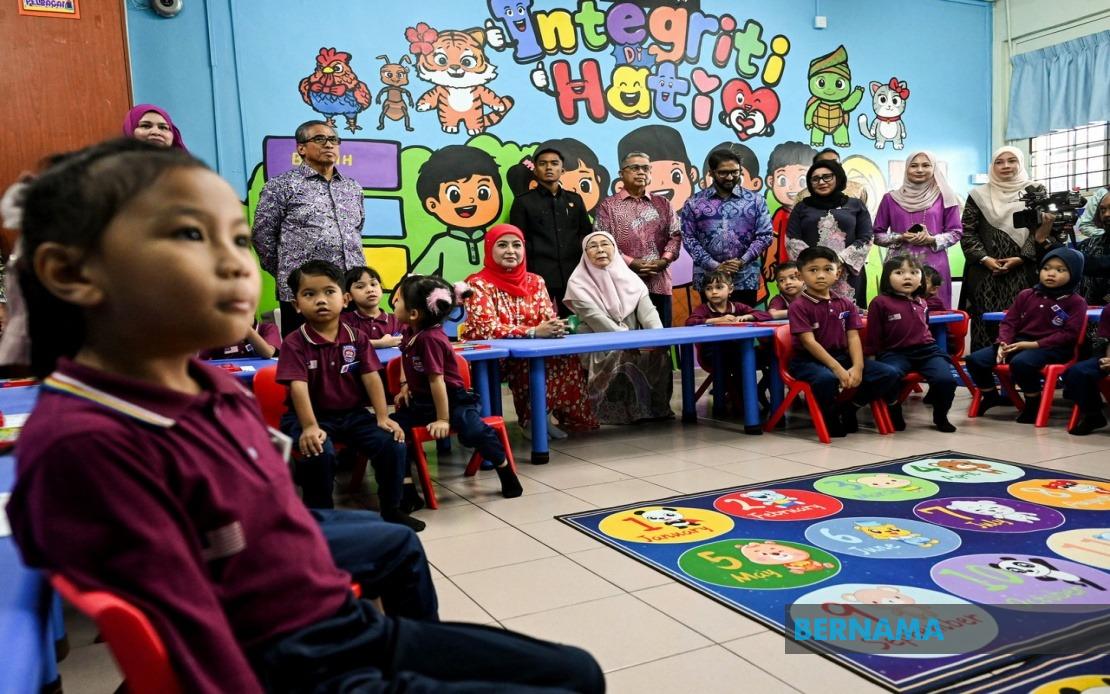
Her Majesty Raja Zarith Sofiah, Queen of Malaysia, officially inaugurated the Children's Integrity Module (MIKa) on August 27 at Tabika Perpaduan Taman Bukit Cheras in Kuala Lumpur, underscoring the royal family's commitment to fostering ethical foundations in the nation's youngest citizens. The ceremony, attended by National Unity Minister Datuk Aaron Ago Dagang and Bandar Tun Razak Member of Parliament Datuk Seri Dr Wan Azizah Wan Ismail, reflects a growing governmental emphasis on preventive character education as a counterbalance to enforcement-based anti-corruption measures.
The MIKa programme represents a departure from traditional integrity-building approaches that typically target older populations through compliance frameworks and legal penalties. Instead, the Malaysian Institute of Integrity (IIM) has conceptualised a developmental strategy that begins during the critical formative years, when children's values systems are still malleable and susceptible to positive influence. This pedagogical shift acknowledges a fundamental truth long recognised in educational psychology: habits formed early in life tend to persist into adulthood, making early childhood an optimal window for embedding ethical principles.
Chief Secretary to the Government Tan Sri Shamsul Azri Abu Bakar, who chairs the IIM, articulated the underlying rationale during the launch ceremony. He emphasised that integrity cannot be legislated into existence through statutes and enforcement mechanisms alone; rather, it must be cultivated as an intrinsic value system beginning in the preschool years. By establishing trustworthiness and righteous conduct as habitual responses rather than externally imposed obligations, the module seeks to create citizens whose ethical behaviour flows from internal conviction rather than fear of consequences.
The development of MIKa has involved substantial institutional coordination and expert engagement. The Malaysian Institute of Integrity collaborated with thirty-five early childhood education specialists throughout 2024 to craft curriculum materials and pedagogical approaches appropriate for the two-to-six age bracket. This multidisciplinary team drew upon research in child development, moral psychology, and educational theory to ensure the module's content was age-appropriate, culturally sensitive, and pedagogically sound. Support from multiple government ministries, higher education institutions, and civil society organisations underscores the cross-sectoral recognition of early integrity formation as a national priority.
The scale of the intended rollout demonstrates governmental ambition in reshaping Malaysia's educational landscape. By 2030, the IIM targets implementation across Malaysia's entire early childhood education ecosystem, encompassing more than 31,000 childcare centres, kindergartens, and preschools operating nationwide. Such comprehensive coverage would represent one of the region's most expansive integrity education initiatives and would potentially position Malaysia as a leader in preventive anti-corruption strategy rather than reactive enforcement. This timeline allows for phased implementation, pilot testing, and refinement based on early outcomes.
During her visit, Queen Zarith Sofiah observed practical applications of the MIKa curriculum in a live classroom simulation, directly witnessing how instructors translate integrity concepts into age-appropriate learning activities. This hands-on engagement transcends ceremonial function; the Queen's participation lends institutional legitimacy and cultural weight to the initiative, signalling to educators, parents, and society that integrity formation carries royal and national endorsement. Such visible patronage can catalyse institutional adoption and parental support across diverse socioeconomic communities.
The programme's emphasis on parental involvement recognises that institutional education, however robust, cannot succeed without reinforcement in domestic settings. The launch ceremony highlighted parents' role as primary moral exemplars whose conduct and values directly shape children's emerging ethical frameworks. This acknowledgment reflects growing consensus within educational and developmental literature that family environment remains the most powerful predictor of children's character outcomes. By positioning parents as integral partners rather than peripheral stakeholders, MIKa attempts to create consistency between institutional and familial value transmission.
For Malaysia, this initiative carries particular significance given the nation's recent engagement with high-profile corruption cases and governance challenges that have prompted soul-searching about institutional and cultural factors enabling unethical conduct. Rather than exclusively targeting current office-holders and enforcement mechanisms, the Integrity Module represents a generational investment in preventing corruption before it takes root. This preventive approach acknowledges that genuine institutional transformation requires cultivating new cohorts of citizens whose baseline ethical expectations differ from previous generations.
The regional context further illuminates MIKa's importance. Southeast Asian countries collectively grapple with corruption indices that undermine development efforts, investor confidence, and public trust. Malaysia's deliberate investment in early-stage integrity formation positions it as a potential model for neighbouring nations considering similar approaches. Should the 2030 targets materialise and produce measurable improvements in ethical behaviour among cohorts influenced by the programme, the evidence could influence policy frameworks across ASEAN economies.
Practical implementation challenges remain substantial. Training thirty thousand-plus early childhood educators to deliver integrity modules consistently demands significant resource allocation, curriculum standardisation, and ongoing professional development. Ensuring that wealthy private institutions and resource-constrained rural facilities both implement MIKa with comparable fidelity requires careful attention to equity and access. Furthermore, measuring integrity formation in young children presents methodological complexities; outcomes may only become observable years after initial exposure.
The initiative also reflects evolving understanding of governance reform. Contemporary anti-corruption strategies increasingly recognise that legal frameworks and institutional oversight, while necessary, prove insufficient without corresponding shifts in civic culture and individual values. By investing in the next generation's character formation, Malaysia signals that sustainable governance improvement requires patient, long-term cultivation of ethical citizenship alongside institutional reform. This dual approach—simultaneous action on multiple timeframes—offers a theoretically sound foundation for comprehensive governance transformation.
As implementation proceeds through 2024 and beyond, the Malaysian Institute of Integrity will face the dual challenge of maintaining programme quality across thousands of institutions while gathering rigorous data on effectiveness. The involvement of academic institutions in evaluation can generate evidence about whether children exposed to MIKa demonstrate measurable differences in ethical reasoning, prosocial behaviour, and integrity-related attitudes compared with control groups. Such rigorous assessment would contribute valuable insights to global conversations about early childhood moral education and prevent-oriented anti-corruption strategy.
Ultimately, Queen Zarith Sofiah's launch of the Children's Integrity Module signals a governance philosophy that views corruption prevention and integrity formation as civilisational projects requiring sustained institutional commitment and cultural transformation. By beginning with Malaysia's youngest citizens and embedding ethical values within the foundational years of education, the nation undertakes a generational bet that integrity cultivated early will compound across decades, gradually reshaping institutional norms and citizen expectations. Whether this ambitious vision materialises depends on persistent implementation, adequate resources, and genuine cultural shifts extending far beyond the ceremonial launch.

