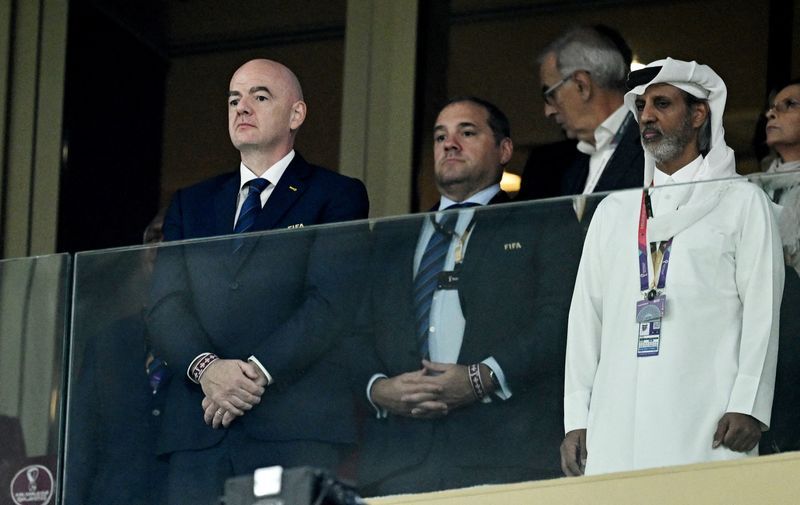
The Qatar Football Association has escalated its dispute with the Asian Football Confederation's top leadership, maintaining that the AFC violated proper procedure when it endorsed a joint statement with UEFA and CONCACAF that criticised FIFA President Gianni Infantino without seeking approval from member nations. The row, which has played out across three letters circulated among football's elite circles, marks an unusually public disagreement within an organisation that traditionally conducts sensitive business away from public scrutiny. The exchange reveals deep divisions over governance, authority, and how continental football bodies should navigate disputes involving the sport's global governing body at a time when Infantino is preparing to seek reelection next year.
At the heart of the contention lies Infantino's controversial proposal known as the FIFA Forward Enterprise, a bid to attract private investment into World Cup operations that he championed without what critics argue was adequate consultation with football's confederations. That proposal itself became the flashpoint for wider concerns about Infantino's leadership style and decision-making processes. The three-letter correspondence now underway reflects deeper anxieties within Asian football about how their confederation conducts itself on the world stage and whether individual member associations have sufficient say in decisions made ostensibly on their behalf.
Qatar Football Association President Hamad bin Khalifa Al-Thani, who is known to support Infantino, fired back at the AFC's defence by arguing that leadership's justification merely confirmed the original accusation. In his recent communication, Al-Thani asserted that the AFC's response amounted to an acknowledgment that absolutely no consultation occurred, whether among the executive committee, with individual member federations, or through any other mechanism before the joint statement was released under the AFC's name. He posed this as a matter of fundamental constitutional principle: whether the confederation's president possessed the unilateral authority to commit all 47 member associations to a public position of such significance without their knowledge or consent.
The Qatari official's argument hinges on a crucial procedural distinction. While acknowledging that the AFC president may hold certain powers, Al-Thani contends these authorities exist only within boundaries established by the executive committee itself. He emphasised that his position as a FIFA Council member sitting on the AFC executive committee gave him standing to challenge how those powers were exercised. The letter stressed that no amount of substantive discussion about the FIFA Forward Enterprise proposal, FIFA's conduct, or the AFC's historical public statements could address what he framed as the narrow but fundamental question of whether proper process was followed.
AFC President Sheikh Salman bin Ebrahim Al-Khalifa responded with unusual forcefulness for such a senior confederation figure, categorically denying that he had overstepped his authority. The Bahraini administrator asserted he possessed both the constitutional right and the responsibility to act decisively in protecting Asian football's interests. Sheikh Salman appeared to view the dispute primarily through a substantive lens, arguing that the joint letter addressed matters of genuine concern to the confederation and its members. His position suggests that when issues of sufficient magnitude arise, the AFC president's mandate extends to speaking for the confederation without requiring advance member approval, at least for matters within his purview.
Sheikh Salman drew on historical precedent to support his position, noting that AFC presidents have previously issued significant public statements on matters affecting the confederation's interests, including expressions of support for Qatar hosting the 2022 World Cup despite international criticism. These statements, he implied, demonstrated an established practice of confederation leadership acting with the necessary authority to address matters of continental importance. The reference to Qatar's World Cup hosting proved somewhat ironic given that the nation's football association now challenged his authority, though for different reasons at that earlier moment.
Qatar's counterargument distinguished between those earlier statements and the Infantino letter. Al-Thani contended that previous AFC declarations regarding the 2022 World Cup were made to advance the confederation's own institutional interests as an organisation in seeing a World Cup successfully hosted in Asia. This logic suggests that statements made in defence of a member's major event or the confederation's prestige differ fundamentally from statements criticising FIFA leadership on matters not directly tied to AFC's immediate interests. The distinction hints at a broader tension about what constitutes confederation business versus personal or factional positioning.
The very nature of this dispute becoming public signals exceptional strain within Asian football governance. Confederations typically prefer resolving such disagreements through private channels, using the formal apparatus of committees and closed-door meetings to sort through procedural and substantive disputes. The fact that these letters now circulate widely enough that major news organisations have reviewed them suggests either a deliberate attempt to build external support for one position or a breakdown in the informal norms that usually keep confederation conflicts confined to internal forums. For Malaysian observers and Southeast Asian football stakeholders, the dispute carries implications for how AFC decisions might be made and whether smaller member associations can trust that their interests are being represented when senior leadership acts.
Al-Thani concluded his response by stating that the AFC's explanation could not be characterised as a satisfying answer to what he described as legitimate and important questions about procedure and governance. The assertion that questions remained unanswered suggests he anticipated further correspondence, or at minimum was signalling to other AFC members that the matter had not been resolved to his satisfaction. His emphasis on the procedural dimension rather than the substance of the FIFA Forward Enterprise criticism indicates a strategic choice to frame this as a governance issue rather than a dispute about whether Infantino's proposal merited criticism.
The AFC declined to provide immediate comment when approached for response to Al-Thani's latest letter, suggesting either that Sheikh Salman believed he had made his position sufficiently clear or that confederation leadership hoped further public exchange might be avoided. This silence could indicate internal discussions continuing behind the scenes, or it might reflect a strategic decision to let the matter settle without escalating further. For the wider Asian football community, the unresolved nature of this exchange raises questions about how the confederation will handle similar situations in future and whether member associations can rely on transparent consultation when the confederation's name and collective position are at stake on matters of international significance.

