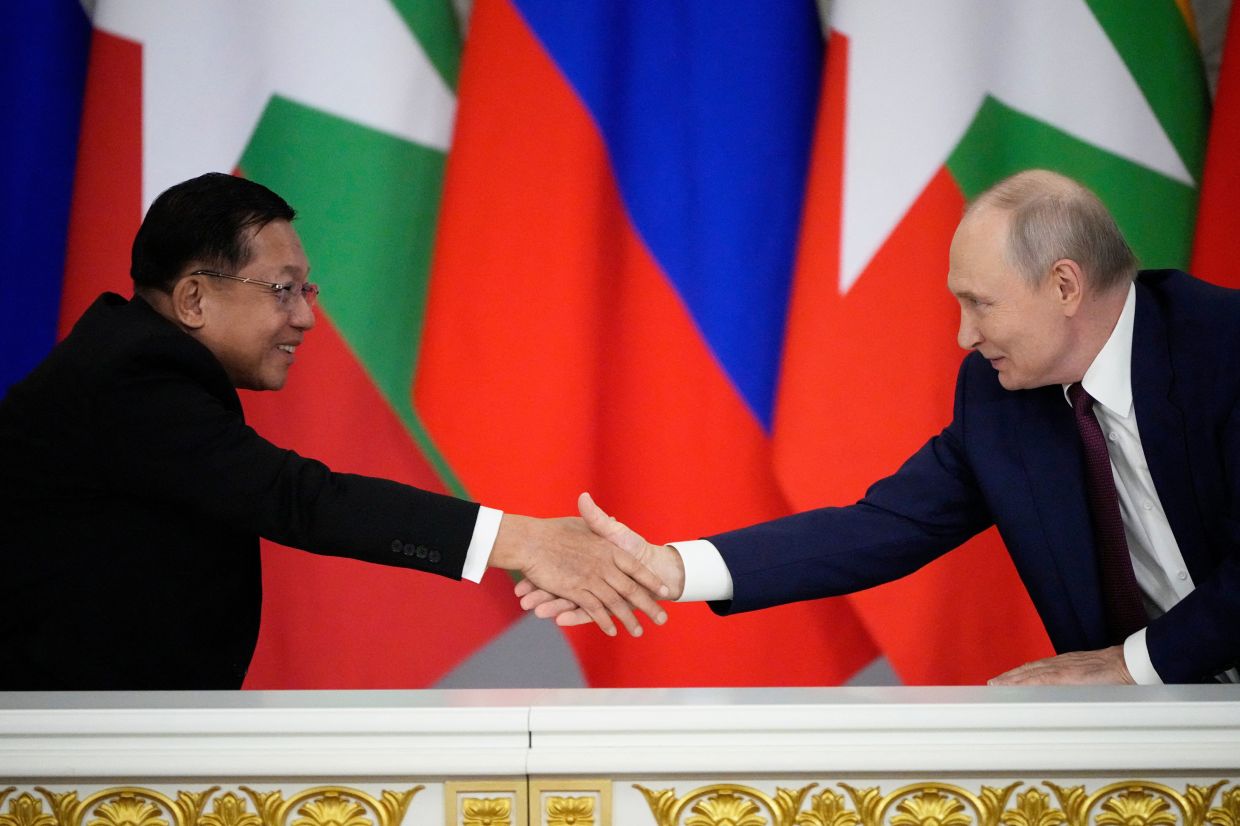
Russia and Myanmar are cementing closer strategic ties as President Vladimir Putin welcomed his counterpart Min Aung Hlaing to Moscow this week, marking the junta chief's first official visit since assuming the presidency in April. The August encounter underscores how Moscow remains one of the few major world powers willing to engage substantively with Myanmar's military government, even as Western democracies have largely frozen diplomatic and economic ties following the 2021 coup that toppled Aung San Suu Kyi.
During their Kremlin discussions on Tuesday, Putin characterised the bilateral relationship as "especially trusting," reflecting a partnership that has weathered international isolation. The Russian leader's language and the high-level composition of attendees—including senior officials overseeing defence, energy, finance, and foreign policy—reveal Moscow's intention to translate political goodwill into concrete economic and security arrangements. This messaging carries significance for Myanmar, which faces mounting international pressure to legitimise its political system and restore democratic governance.
A cornerstone of the deepening relationship involves ambitious infrastructure development. Russia intends to construct a power generation facility and petroleum refinery in Myanmar's southern regions, ambitions that represent substantial foreign investment commitments. Beyond these headline projects, Moscow seeks meaningful participation in Myanmar's geological survey activities and hydrocarbon extraction operations, positioning itself as a key partner in the nation's resource sector. These initiatives could prove transformative for Myanmar's economy, though they also risk deepening energy dependencies that constrain future policy flexibility.
The energy dimension extends to liquefied natural gas opportunities, which Putin identified as offering "good prospects" for expanded trade. For Myanmar's military government, such partnerships provide economic legitimacy and revenue streams independent of Western commercial relationships. Russia's willingness to invest where Western institutions have retreated creates strategic leverage for both parties—Moscow gains footholds in Southeast Asia while Myanmar secures capital inflows despite international sanctions and restricted access to global financial systems.
Military and defence cooperation represents the second pillar of bilateral strengthening. Putin explicitly referenced establishing "close military and military-technical cooperation" with Myanmar, language that officials carefully calibrated to signal commitment without excessive transparency. According to a United Nations report from May 2023, Russia has supplied advanced weaponry exceeding US$400 million since the 2021 coup, cementing its position as a primary defence partner. This arms relationship provides Myanmar's military with sophisticated capabilities while generating substantial revenue for Russian defence industries facing Western export restrictions.
The nuclear dimension adds another layer of strategic interdependence. Myanmar is collaborating with Russia's Rosatom State Corporation to develop a small-scale nuclear power plant, an undertaking that reflects Russia's technological prowess and willingness to engage where Western nations impose restrictions. This initiative, positioned as foundational for applications in healthcare, agriculture, and industrial sectors, strengthens institutional ties between the two nations and creates long-term technical dependencies that outlast individual political administrations.
This Moscow meeting represents the fourth encounter between Putin and Min Aung Hlaing since Russia's 2022 invasion of Ukraine, illustrating remarkable continuity despite global upheaval. The February visit by Putin's security chief Sergei Shoigu, which preceded Min Aung Hlaing's formal presidential inauguration, signalled Russia's determination to establish normalcy with Myanmar even as the military consolidated control following a contested election. International observers, including the United Nations and Western governments, questioned the legitimacy of the ballot, yet Russia's diplomatic engagement proceeded uninterrupted.
Min Aung Hlaing's current diplomatic offensive—involving recent travels to China, India, Laos, and Thailand—reflects efforts to generate broader regional acceptance of his administration's governance claims. The Moscow visit extends this strategy into relations with non-Asian powers, demonstrating that Myanmar retains significant-power partnerships despite Western diplomatic isolation. Concurrently, the junta has initiated tentative outreach toward the United States and the Association of Southeast Asian Nations, signalling awareness that comprehensive international isolation undermines legitimacy and economic stability.
The high-level Myanmar delegation that arrived in Moscow included multiple cabinet ministers and the Myanmar Space Agency director, reflecting the comprehensive nature of engagement beyond traditional defence and energy portfolios. Min Aung Hlaing's schedule encompassed meetings with Prime Minister Mikhail Mishustin and Vyacheslav Volodin, speaker of Russia's lower house, alongside participation in a Myanmar-Russia Business Forum. This orchestrated engagement demonstrates how Russia uses systematic high-level diplomacy to reinforce relationships and project normalcy around Myanmar's military government.
For Southeast Asian observers and Malaysian policymakers, these developments carry significant implications. Russia's strategic pivot toward Myanmar during Western retreat creates a new power dynamic within the region. Myanmar's geographic position, maritime access, and resource endowments make it strategically valuable, and Russia's willingness to partner where Western capital has withdrawn reshapes regional geopolitical balances. The energy infrastructure projects, should they materialise substantially, could integrate Myanmar more tightly with Russian economic systems and potentially influence regional energy security architectures.
The trajectory of Myanmar-Russia relations also illustrates how authoritarian regimes adapt to international pressure through diversified partnerships. Rather than capitulating to isolation, Myanmar's military has constructed alternative international engagement frameworks with Russia, China, and selective regional partners. This approach preserves governing autonomy while attracting capital and technical expertise, though it risks entrenching dependence on illiberal powers and constraining future democratic transitions.
Ultimately, Putin's rhetoric about "especially trusting" ties with Myanmar reflects mutual convenience rather than ideological alignment. Russia gains geopolitical influence in a strategically important Southeast Asian nation while Myanmar's isolated military government secures partnerships with a major power unencumbered by democracy promotion agendas. For Malaysia and other ASEAN members navigating complex relationships with both Myanmar and Western democracies, these developments underscore how regional geopolitical competition intensifies around Myanmar's trajectory and alignment choices.

