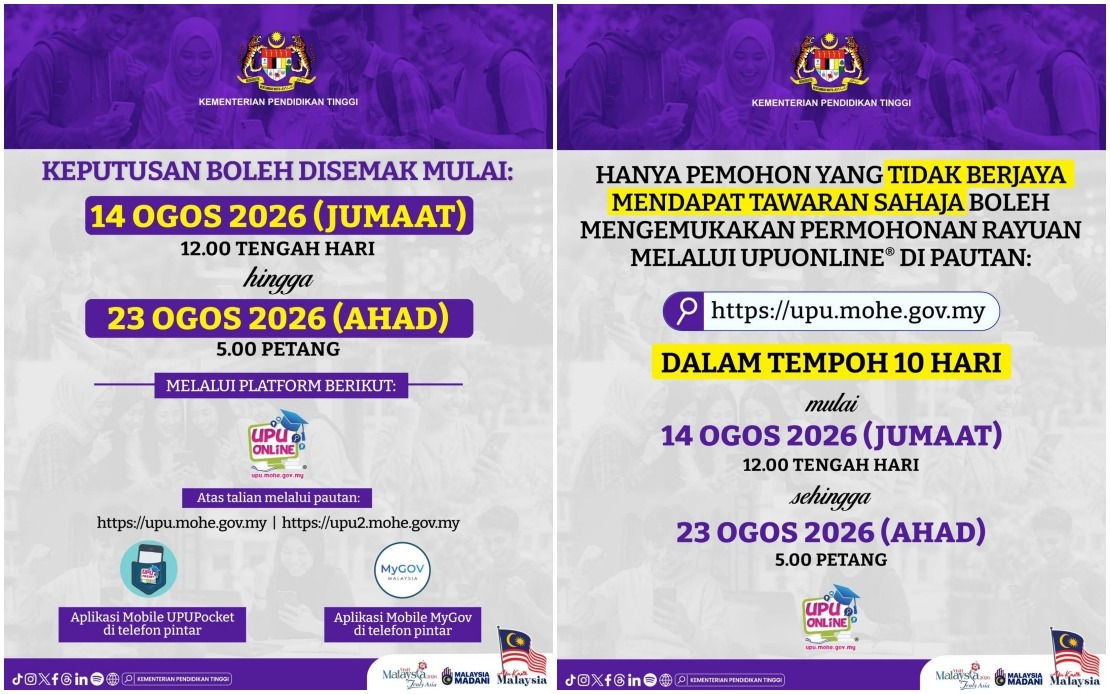
Hundreds of thousands of STPM graduates and equivalent qualification holders in Malaysia will discover their university placement outcomes on August 14, when the Ministry of Higher Education releases comprehensive results for the 2026/2027 academic intake at public institutions nationwide. The announcement marks a critical juncture in the educational journey of pre-university students, determining which undergraduates will proceed to bachelor's degree programmes across the country's network of subsidised universities.
Applicants can access their admission decisions starting at noon on August 14 and continuing until 5 pm on August 23 via multiple digital channels, reflecting the government's push toward paperless administration. The primary portal remains the official UPUOnline system at https://upu.mohe.gov.my, supplemented by a secondary platform at https://upu2.mohe.gov.my to manage traffic surges during peak access periods. For mobile-first users—the majority demographic among secondary school leavers—results are also retrievable through the UPUPocket application and the broader MyGov mobile ecosystem, ensuring accessibility across varying levels of digital infrastructure across the nation.
The confirmation phase commences immediately after results publication, with individual public universities opening their admissions websites on August 15 to facilitate acceptance or rejection declarations from candidates. This compressed nine-day window reflects institutional timelines for finalising enrolment figures and managing cohort planning. Successful applicants must actively confirm their intention to accept offers during this period; passive acceptance does not apply, meaning silence constitutes a form of rejection that forecloses the opportunity.
Official offer letters representing binding institutional commitments will be issued by universities starting August 15, but only after candidates formally confirm their willingness to enrol. This procedural requirement protects both parties—universities secure genuine commitments while students avoid inadvertent binding to unwanted placements. The staggered timeline allows administrative processing of millions of data points across dozens of institutions simultaneously, a logistical feat that requires careful orchestration to prevent system failures.
Applicants deemed unsuccessful in the primary allocation round retain recourse through an appeals mechanism, though with strict parameters. Those who received no offer can lodge appeals via UPUOnline between August 14 and 23, a ten-day window that mirrors the confirmation period for successful candidates. However, appeal outcomes depend entirely on available vacancies in specific programmes at specific institutions after initial student registration concludes—a critical distinction emphasising that appeals constitute second-round placements rather than guaranteed alternatives.
The Ministry has clarified that all placement offers for the 2026/2027 session are final and non-negotiable once issued. Applicants cannot subsequently request transfers between universities or switches to alternative programmes after their initial allocation, a policy designed to prevent institutional instability and ensure accurate cohort planning. This rigidity contrasts with some international systems permitting programme changes during early enrolment periods, reflecting Malaysia's preference for administrative certainty and institutional predictability.
The appeal selection process operates under vacancy-based allocation principles, meaning successful appeals depend on whether specific programmes retain unfilled places following new student registration completion. Registration typically concludes in late August or early September, so appeal outcomes may not be communicated until mid-September at earliest—a potential gap leaving unsuccessful appellants in administrative limbo for extended periods. This uncertainty particularly affects those from lower socioeconomic backgrounds who may require early confirmation for financial planning and accommodation arrangements.
The UPUOnline system represents a significant technological achievement for Malaysian higher education administration, consolidating applications, allocations, confirmations, and appeals within a single digital ecosystem. However, occasional technical glitches during peak periods remain a persistent challenge, with students sometimes unable to access results during the critical first hours after publication. The provision of secondary platforms and mobile applications reflects lessons learned from previous admission cycles when server overloads temporarily prevented access.
For Malaysian students, this admission cycle carries heightened stakes as university places remain relatively competitive despite overall system expansion. Public universities continue serving as the primary pathway to tertiary qualification for middle and lower-income cohorts, with STPM qualifications representing one of the primary domestic pre-university credentials alongside the matriculation programme. International baccalaureate and other alternative pathways exist but remain concentrated among private and international school populations.
Regional context illuminates Malaysia's systemic challenges. Neighbouring countries including Thailand and Vietnam have substantially expanded public university capacity in recent years, yet Malaysia's public higher education intake remains constrained relative to demand. This scarcity generates competitive pressure, with many qualified applicants receiving neither their preferred institutions nor their chosen programmes, creating disappointment cascades where students settle for available options rather than optimal educational matches.
The August 14 release date arrives approximately six weeks after STPM examination results, allowing universities adequate time for application processing and initial allocation algorithms. This timeline differs markedly from international systems where gaps between qualification and university admission can extend several months, though Malaysian schools and universities argue their compressed schedules serve student interests by enabling faster progression to tertiary study.
Beyond immediate placement concerns, the 2026/2027 admission cycle reflects ongoing tensions within Malaysia's higher education policy framework. Debates continue regarding optimal balance between meritocratic selection based purely on academic achievement versus affirmative action provisions protecting bumiputera participation, programme diversity across institutions versus institutional specialisation, and public university capacity expansion versus quality maintenance at existing institutions.

