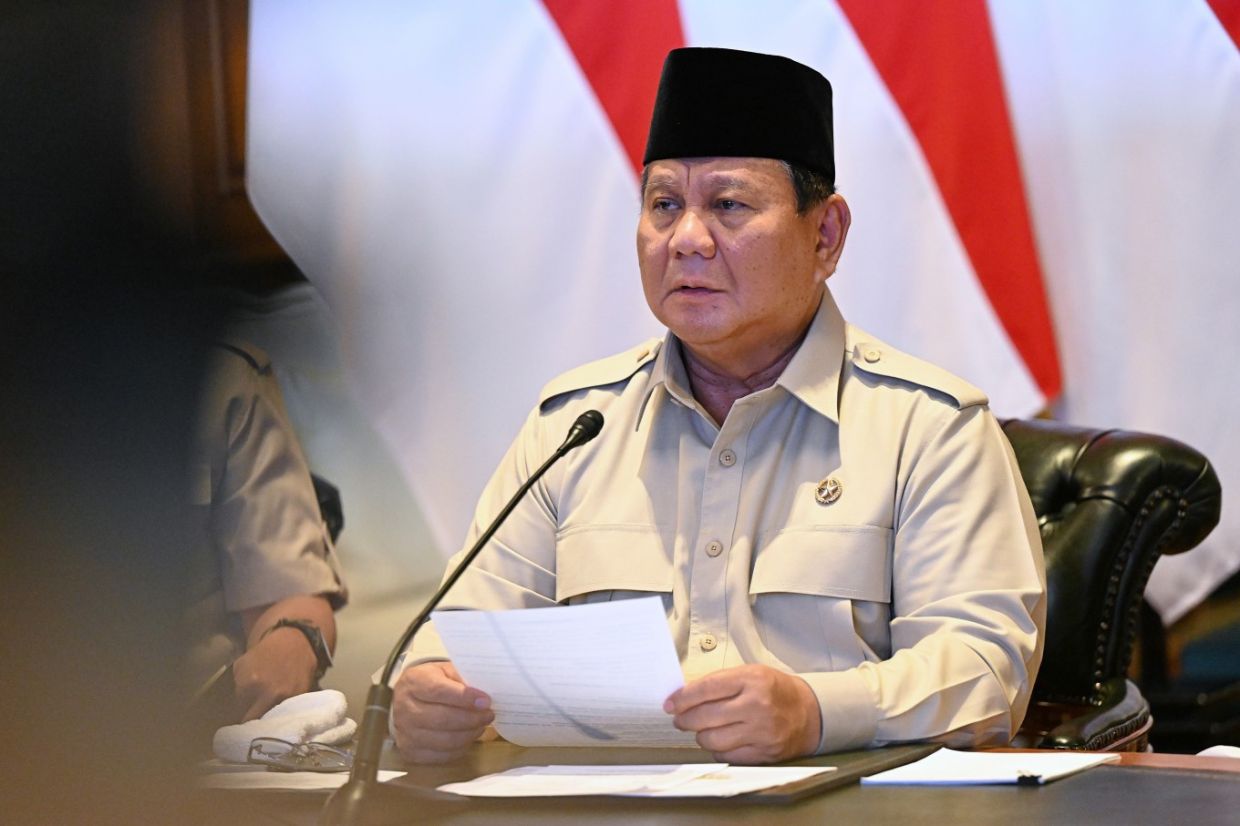
Indonesia's President Prabowo Subianto has experienced a dramatic and swift reversal in public favour, with his approval rating plunging to 51.1 per cent according to the latest polling data from Saiful Mujani Research and Consulting (SMRC). This marks a staggering 30-point drop from his zenith of 81.2 per cent recorded in November 2025, a collapse that signals the definitive end of what had been an extraordinarily durable political honeymoon stretching across his first eighteen months in office.
The longevity of Prabowo's initial popularity was itself remarkable by comparative standards. While newly inaugurated leaders typically enjoy a brief period of elevated public support, the Indonesian president managed to sustain stratospheric approval numbers well into his second year, a feat that distinguished him markedly from his immediate predecessor. Joko Widodo, despite his eventual success in consolidating political support, began his first term with similar numbers but experienced a precipitous early decline following controversial fuel price adjustments. Prabowo, by contrast, appeared insulated from the typical erosion of goodwill that accompanies the transition from campaign rhetoric to governing reality.
Social spending initiatives, particularly the free nutritious meal programme introduced in January 2025, proved instrumental in extending this exceptional run of popularity. Rather than representing mere residual momentum from his decisive 2024 election victory, Prabowo's sustained approval reflected tangible policy benefits that resonated with ordinary Indonesians. This distinction matters crucially: it demonstrated that the president had successfully translated electoral capital into concrete public goods that registered meaningfully in citizens' daily lives. The programme's visibility and immediate impact on households, especially those with school-aged children, helped anchor his political standing during the critical early phase of his administration when momentum typically dissipates.
Yet even this combination of electoral mandate and popular social programmes could not indefinitely forestall the reassertion of democratic normalcy. The July 2026 SMRC survey, conducted between 5 and 19 July among 749 respondents, reveals a stark reversal: dissatisfaction has swelled to 46.9 per cent, climbing from approximately 16 per cent just eight months prior. This is not a marginal adjustment reflecting normal statistical variation, but a fundamental shift in public sentiment that suggests the foundational pillars supporting Prabowo's initial popularity have crumbled considerably.
The underlying causes of this dramatic deterioration cluster around three interconnected domains, according to analysis by SMRC executive director Deni Irvani. Economic perceptions have deteriorated substantially, with only 15.7 per cent of respondents expressing positive views of economic conditions in July 2026. Political sentiment has experienced even sharper erosion, plummeting from 35.8 per cent positive sentiment in November 2025 to a mere 13.5 per cent by the July survey. These metrics capture the fundamental disconnect between Prabowo's campaign promises and demonstrable results: his explicit commitments to curtail corruption and accelerate GDP growth from five to eight per cent are now being measured against a weakened rupiah, anaemic stock market performance, and mounting public anxieties regarding fiscal sustainability and central bank autonomy.
What renders these findings particularly consequential is their corroboration by independent polling operations. Indikator Politik Indonesia, conducting a separate survey of 4,250 respondents across 14-24 July, documented satisfaction levels of 49.5 per cent, tracking closely with SMRC's findings and declining from 68 per cent just three months prior. This convergence between two methodologically distinct polling organisations substantially undermines suggestions that ideological bias or methodological deficiency explains the apparent collapse in presidential approval. While critics of SMRC have noted the polling organisation's founder's increasingly vocal criticism of government policies, such concerns about institutional orientation cannot withstand the reality that multiple independent surveys now document identical directional movements and comparable magnitude of decline.
The president's considerable investment in personal visibility and aggressive communications strategy, while electorally effective during periods of economic confidence, appears to have reached its natural ceiling as material conditions deteriorated. Prabowo's frequent televised addresses, deliberately designed communications operations, and readiness to engage directly with critics and journalists proved capable of sustaining popularity during the initial phase when positive economic narrative and social spending could fill inevitable gaps between promise and performance. However, the transition from campaign mode to sustained governance reveals the limitations of rhetorical force when confronted with everyday realities that citizens experience directly: inflation affecting food prices, exchange rate fluctuations impacting the cost of imported goods, employment prospects dimming, and concerns mounting regarding whether flagship social programmes like the free meals initiative can sustain delivery at their promised scale and frequency.
Concern about potential macroeconomic disruption looms over the administration's immediate policy calculus. Government sources indicate that Prabowo has convened the National Economic Council to address the evident public dissatisfaction regarding economic stewardship, an area where satisfaction has fallen most precipitously. These discussions have incorporated analysis of weakening household purchasing power and the threat posed by potential El Niño climatic disruptions, which forecasters warn could disrupt agricultural output and trigger broader supply-chain turbulence. The administration's decision to maintain fuel prices at current levels, rather than implementing politically costly adjustments, reflects a strategic recognition that additional price increases could accelerate the deterioration in public sentiment that has already advanced substantially.
Parallel to these high-level economic discussions, Prabowo's immediate advisers have engaged pollsters involved in orchestrating his successful 2024 campaign to devise a recovery strategy. These consultants have recommended comprehensive programme reviews addressing implementation failures that have accumulated, most prominently within the free nutritious meal initiative and the Red and White Cooperatives enterprise. The advice from experienced political operatives highlights an inconvenient reality: improvements in public satisfaction cannot be secured primarily through enhanced communication tactics or rhetorical repositioning, but rather through demonstrable amelioration in programme execution and economic conditions that ordinary citizens encounter daily.
Historically, the magnitude of approval decline Prabowo has experienced, while substantial, does not constitute an irreversible political trajectory. Presidents have recovered from steeper approval collapses through strategic economic management and effective programme implementation. However, the 30-point descent compressed into nine months, substantiated by multiple credible polling operations, indicates unambiguously that the initial goodwill purchased through early social spending has exhausted itself. The distinction between this moment and Prabowo's exceptional earlier standing is that his presidency is now subjected to the ordinary evaluative criteria that govern democratic accountability: concrete economic outcomes, effective institutional management, and visible progress toward declared objectives, rather than the generalised optimism and benefit of doubt that newly elected leaders conventionally enjoy.
The administration's immediate policy response will prove consequential in determining whether this trough represents a temporary correction within an otherwise durable political coalition or the beginning of a more consequential unravelling. Expanding social assistance programmes, as government sources suggest may occur, could provide temporary relief if implementation proceeds effectively. More critically, however, recovery depends upon the economic indicators that structure ordinary Indonesians' material circumstances: whether inflation moderates, the rupiah stabilises, employment prospects brighten, and programme delivery improves. In this sense, Prabowo's political future has shifted decisively from the terrain of campaign messaging and initial popularity toward the more demanding landscape of sustained governance, where performance metrics ultimately supersede rhetorical force.

