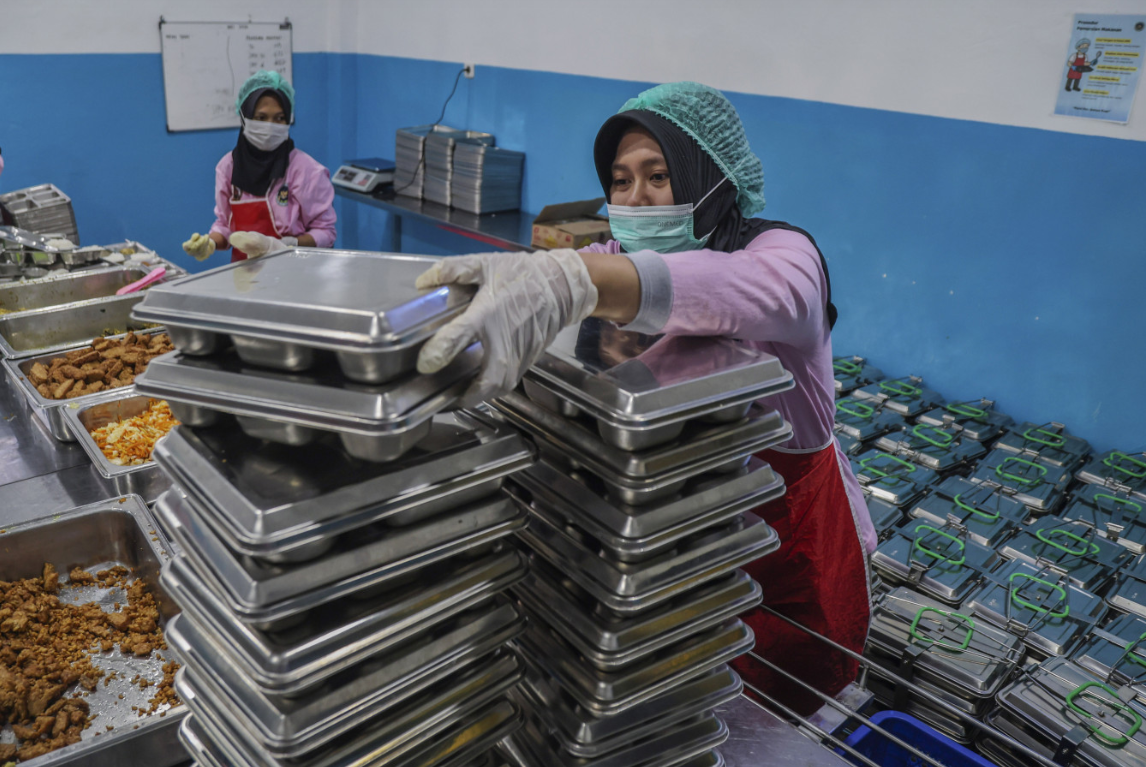
President Prabowo Subianto is undertaking a fundamental reassessment of two cornerstone initiatives that have become sources of considerable controversy within weeks of their launch. During a four-hour closed-door session at the Palace on Wednesday with cabinet officials overseeing the programmes, the Indonesian leader instructed the National Nutrition Agency to conduct an exhaustive review of how the free meals scheme operates in schools, with completion required within one month. The directive underscores growing pressure on the administration to address persistent public concerns and logistical failures that have plagued these ambitious poverty-reduction efforts.
The free nutritious meal programme, budgeted at a minimum of Rp 268 trillion (US$19.5 billion) for 2026, represents one of the largest social expenditure commitments in Indonesia's recent history. Designed to reach approximately 83 million beneficiaries—encompassing schoolchildren and pregnant women—the initiative aims to combat the country's persistent malnutrition and childhood stunting challenges, which remain significant public health concerns particularly in rural and lower-income regions. However, the sheer scale and rapid deployment of the scheme have exposed serious implementation gaps that have undermined its credibility and generated intense scrutiny from lawmakers, civil society, and the public.
According to BGN deputy chief Agustina Arumsari, President Prabowo has emphasised the need for thorough, deliberate policy adjustments rather than hasty modifications. This messaging appears designed to counter criticism that the programmes were launched without adequate planning or public consultation. The President's insistence on careful consideration of implications suggests a recognition that sweeping social programmes require nuanced implementation strategies that account for Indonesia's diverse socioeconomic landscape and cultural contexts.
A primary focus of the review concerns the criteria determining which households qualify for free meals. Currently, the programme operates on a near-universal basis, but the government is exploring whether higher-income families should be excluded to concentrate resources on the poorest segments of society. This targeting approach would represent a significant philosophical shift toward means-tested assistance rather than universal provision. However, implementation presents considerable complexity in mixed-income school settings, where excluding certain students could create social friction and psychological harm among young learners. Arumsari highlighted this concern explicitly, indicating the administration recognises the non-economic dimensions of poverty alleviation policy.
The logistical architecture of the programme is also under scrutiny. Currently reliant on dedicated free meal kitchens, officials are evaluating whether existing school canteen infrastructure could serve as an alternative delivery mechanism. This shift could reduce operational costs, leverage existing facilities, and potentially improve meal quality by incorporating local suppliers and school-based management. Such structural changes could address concerns about food safety and quality control that have plagued the initial rollout, which saw multiple reports of food poisoning incidents across participating schools.
The timing of these reviews reflects intensifying political pressure on the Prabowo administration. Street protests erupted last month demanding suspension of the programme, highlighting public frustration with execution failures alongside broader anxieties about fiscal sustainability and government competence. More seriously, a corruption investigation has implicated senior officials from the National Police and Indonesian Military in irregularities, raising questions about governance oversight and accountability within state institutions responsible for programme administration. These scandals have elevated the free meals scheme from a technocratic policy matter to a credibility test for the President's governance agenda.
Parallel to the meals programme review, the government is recalibrating its Red and White cooperative initiative, which has also encountered serious difficulties. Coordinating Food Minister Zulhas Hasan announced plans to expand the cooperatives' remit, positioning them as the primary government channel for distributing various assistance programmes and subsidised goods. Additionally, the cooperatives would intervene in agricultural markets, purchasing rice and corn when prices fall below government-determined floor levels, ostensibly protecting farmer incomes during price downturns.
However, this cooperative programme carries its own reputational damage. Military-style mandatory training for cooperative managers resulted in at least four deaths, triggering widespread public outcry and generating accusations that the government had prioritised ideological indoctrination over practical competence in leadership development. The deaths transformed a developmental initiative into a human rights concern and further eroded public confidence in the administration's handling of large-scale programmes.
For Malaysian observers, Indonesia's implementation struggles offer instructive lessons about the complexities of scaling ambitious social programmes in diverse, decentralised nation-states. Both countries share similar development challenges—rural poverty concentration, malnutrition concerns, and uneven regional development—yet Indonesia's experiences suggest that policy design and bureaucratic capacity must advance in tandem. Universal or near-universal programmes, while politically appealing, require robust administrative infrastructure and careful calibration to local contexts that many developing economies struggle to provide.
The reviews also illuminate tensions between presidential directives and institutional capacity. Prabowo's orders for thorough reconsideration, while sensible, implicitly acknowledge that initial implementation fell short of professional standards. This gap between policy ambition and administrative reality represents a fundamental governance challenge facing many Southeast Asian governments attempting to modernise welfare systems and reduce poverty through expansive state programmes.
For the Prabowo administration, these reviews represent an opportunity to recalibrate without abandoning core developmental objectives. Targeted rather than universal meal provision, improved logistical coordination, and clearer accountability mechanisms could preserve the programmes' poverty-reduction impact whilst addressing implementation failures. Success in this recalibration effort will substantially influence how Indonesia's broader development agenda is perceived domestically and regionally, particularly given the initiatives' high fiscal cost and symbolic importance to the President's populist platform.
Looking forward, the outcomes of these reviews will likely shape regional discussions about social spending effectiveness and government capacity in Southeast Asia. As Jakarta refines these programmes, policymakers across the region will closely monitor whether targeted, carefully designed interventions prove more effective than large-scale universal schemes, and whether institutional reforms can successfully support ambitious poverty-reduction efforts.

