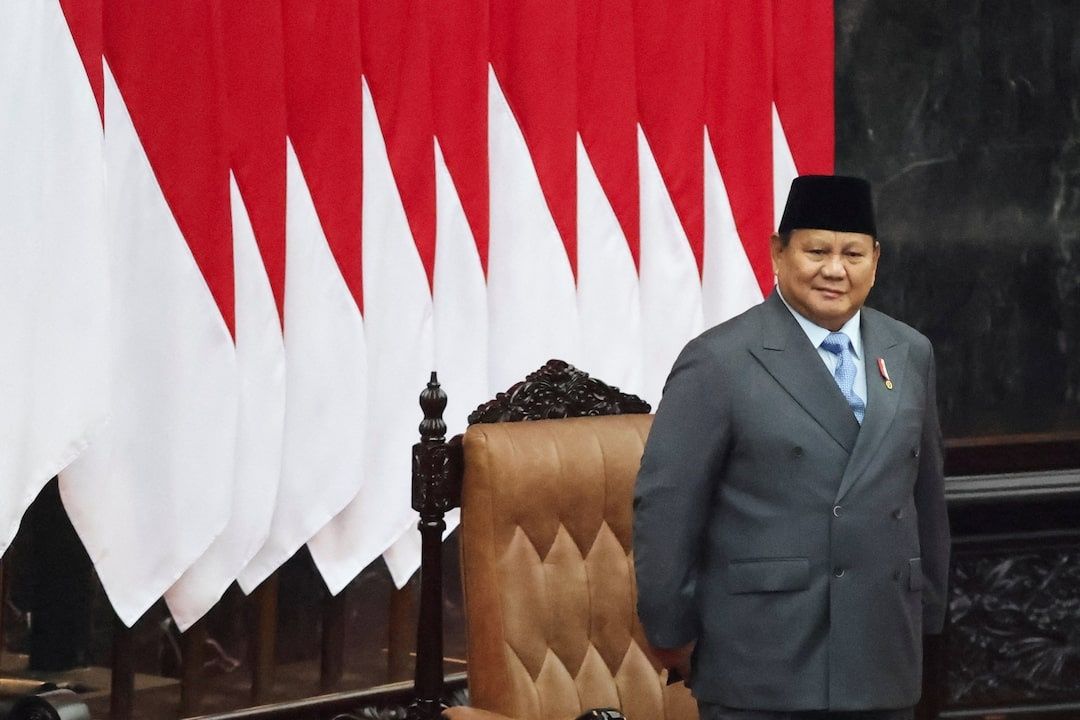
Indonesian President Prabowo Subianto faces a watershed moment this Friday when he presents his government's budget framework for 2027, a presentation that comes amid deteriorating public confidence and deepening concerns among international investors about the administration's economic direction and fiscal management. The former military commander, who swept to power in October 2024 on a platform promising sweeping anti-corruption measures, accelerated economic growth to 8% annually, and universal school meal programmes for millions of children, now confronts the harsh realities of governing amid a sliding currency, sluggish capital markets, and persistent questions about budgetary discipline and central bank independence.
The timing of Friday's presentation—delivered alongside speeches marking Indonesia's Independence Day—carries particular weight given the erosion of Prabowo's initial political capital. A recent survey found his approval rating has collapsed by 30 percentage points over just eight months, now sitting at 51%. This precipitous decline reflects a confluence of factors: economic conditions have deteriorated noticeably, the rupiah has weakened considerably, and public satisfaction with law enforcement outcomes has plummeted. Economists and policy observers interpret these numbers as a warning signal that Prabowo's ambitious reform agenda, which generated genuine excitement among voters frustrated by perceived inaction in previous administrations, now faces credibility questions from both domestic constituencies and international stakeholders.
The centerpiece of international investor anxiety is Prabowo's controversial plan, first unveiled to parliament in May, to consolidate all critical natural resource exports under a newly created state-owned enterprise, Danantara Sumberdaya Indonesia. That announcement sent shockwaves through commodity markets and financial centres across Asia. The original proposal suggested the entity would assume direct operational control over exports, fundamentally altering the competitive landscape for palm oil producers, metals traders, and agricultural exporters who have long operated within Indonesia's existing market-based framework. Such a move would represent a dramatic shift toward state-directed economics, raising concerns among investors about efficiency, potential corruption, and the country's openness to foreign investment.
Since May, senior figures within Prabowo's administration have walked back the most sweeping interpretations of the plan, with multiple officials suggesting Danantara Sumberdaya Indonesia would function primarily as a supervisory and regulatory body rather than assuming direct control of export operations. This retreat, however cautious, reflects the genuine anxiety that the original proposal generated among global capital markets and sophisticated investors who viewed it as a threat to Indonesia's long-term competitiveness. Yose Rizal Damuri, executive director of the Center for Strategic and International Studies, has indicated that international investors are desperately seeking clarity on the entity's precise mandate and authority. The ambiguity itself has become costly—investors remain uncertain whether to view the policy as pragmatic state oversight or creeping nationalisation.
For palm oil traders and other commodities exporters, Friday's budget presentation offers a chance to glean the government's true intentions. Global agricultural trading houses with exposure to Indonesian production have analysts monitoring every utterance from senior officials, seeking clues about whether export taxation, licensing requirements, or operational constraints might be imposed. The lack of definitive guidance has complicated business planning across multiple sectors, forcing companies to operate under heightened uncertainty about regulatory frameworks that could materially affect profitability.
The broader economic context makes this budget presentation particularly consequential. Indonesia's fiscal deficit currently sits at approximately 2.8% of GDP for 2025, placing it perilously close to the country's constitutional ceiling of 3%. This means Prabowo's government has virtually no room for fiscal expansion in 2027 without breaching legal constraints—a severe limitation given his campaign promises to dramatically increase public spending on welfare programmes, infrastructure, and anti-corruption initiatives. Irman Faiz, an economist at Bank Danamon, has emphasised that this budget represents a critical credibility checkpoint for international investors who have already endured two consecutive years of unexpected policy announcements and market-moving decisions from the Prabowo administration. Market tolerance for policy surprises has visibly thinned, leaving little room for further disappointments or ambiguous messaging.
The government's flagship free meal programme for schoolchildren has become emblematic of these challenges. Launched with great fanfare as a centerpiece of Prabowo's anti-poverty agenda, the initiative has suffered consecutive budget reductions and become mired in allegations of administrative mismanagement and fund diversion. These operational difficulties have punctured public confidence not merely in the programme itself but in the government's broader capacity to execute even its highest-priority initiatives competently. When flagship programmes falter due to poor implementation, broader policy announcements naturally attract greater scrutiny and scepticism.
Arya Fernandes, head of politics and social change at CSIS, has characterised Prabowo's challenge as formidable: he must simultaneously address legitimate economic concerns, demonstrate credible solutions to deteriorating conditions, and reassure voters that the government's priority programmes will function effectively. Each of these tasks individually would strain any administration; tackling them simultaneously while constrained by fiscal limits and central bank independence concerns represents a genuinely difficult political and economic situation. The speech scheduled for Friday afternoon represents Prabowo's opportunity to recalibrate expectations, provide concrete detail on contentious policies like Danantara Sumberdaya Indonesia, and rebuild investor confidence through demonstrated fiscal discipline.
For Southeast Asian observers and Malaysian policymakers, the unfolding situation in Indonesia carries important lessons about the challenges of translating campaign promises into sustainable governance under real-world economic constraints. Indonesia's struggles with currency depreciation, capital market weakness, and investor uncertainty resonate across the region where similar economic pressures are visible. The manner in which Prabowo navigates this critical juncture—whether through pragmatic policy adjustment, clearer communication, or doubling down on controversial positions—will likely influence how international investors assess governance and economic management across the region's larger economies.

