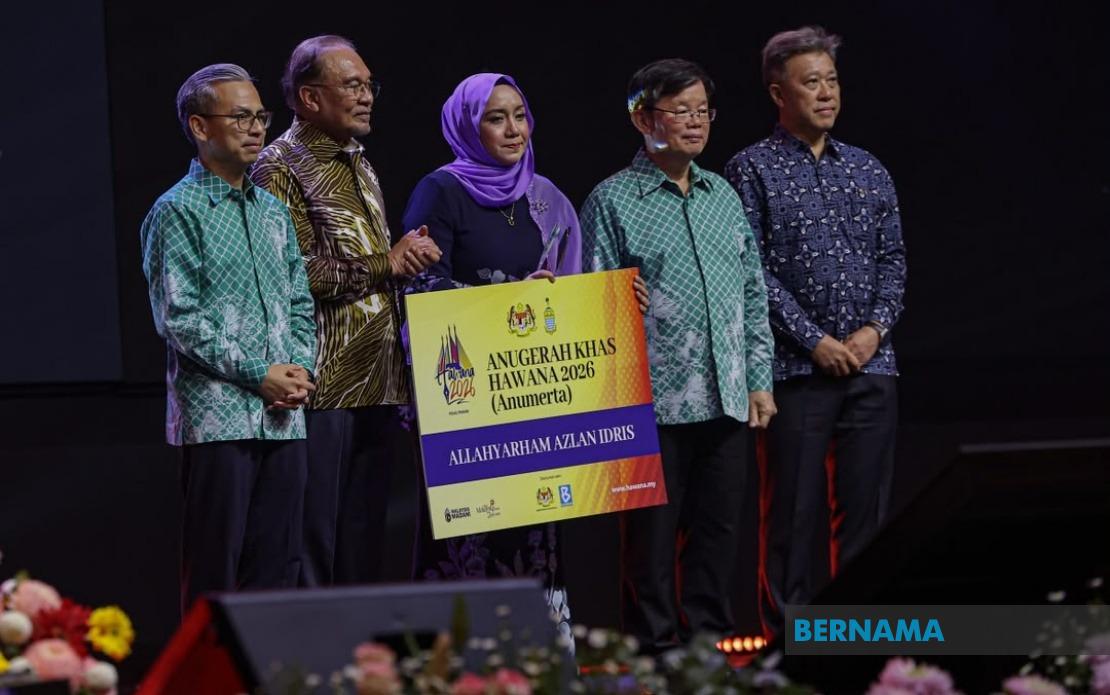
The National Journalists' Day (HAWANA) 2026 Special Award was presented posthumously to Azlan Idris, the former head of Bernama Radio, at a ceremony held in Butterworth on June 20. Prime Minister Datuk Seri Anwar Ibrahim conferred the honour upon Azlan's widow, Wan Syahrina Wan Abdul Rahman, during festivities at the PICCA@Arena Butterworth Convention Centre, acknowledging the late broadcaster's lasting impact on Malaysia's media landscape and his unwavering commitment to journalism excellence.
The recognition comes nearly six months after Azlan's passing on January 15 at the age of 57, marking a significant tribute to a figure whose career spanned multiple decades and several prominent Malaysian broadcasters. The ceremony brought together key figures from Malaysia's political and media establishments, including Penang Chief Minister Chow Kon Yeow, Communications Minister Datuk Fahmi Fadzil, and Malaysian National News Agency chairman Datuk Seri Wong Chun Wai, underscoring the national significance of the award and the esteem in which Azlan was held across government and industry circles.
Azlan's professional journey reflected the evolution of broadcast journalism in Malaysia during a period of technological transformation. Before assuming leadership at Bernama Radio, he accumulated substantial experience working with major broadcasters including TV3, NTV7, and Channel 9, positions that shaped his understanding of contemporary news gathering and editorial standards. His appointments across these organisations demonstrated his growing prominence in the Malaysian broadcasting sector and the confidence that media institutions placed in his capabilities.
The establishment of Bernama Radio in 2007 represented a strategic initiative to expand the national news agency's reach beyond traditional wire services into audio broadcasting, a medium requiring distinct editorial sensibilities and technical expertise. Azlan's pivotal role in developing this platform from its inception through subsequent years of operation made him instrumental in determining the channel's journalistic direction, editorial standards, and audience engagement strategies. Under his stewardship, Bernama Radio established itself as a credible news source, navigating the competitive Malaysian broadcasting environment while maintaining the standards expected of a government-affiliated news organisation.
Beyond his broadcasting responsibilities, Azlan made substantial contributions to the Malaysian journalism community through his involvement in organising HAWANA celebrations, the annual national recognition of the profession. Serving as chairman of the main celebration committee from the 2022 event in Melaka onwards, he demonstrated commitment to honouring his peers and promoting journalistic excellence across the industry. This role afforded him influence in shaping how Malaysia's journalism community recognised and celebrated its own achievements, a responsibility requiring both diplomatic finesse and deep understanding of sectoral dynamics.
The decision to confer the HAWANA 2026 Special Award upon Azlan reflects the journalism profession's appreciation for individuals who advance the field through both direct editorial work and institutional stewardship. Special awards carry particular weight within professional recognition systems, typically reserved for figures whose contributions transcend single achievements or positions. The award acknowledges not merely specific accomplishments but rather the cumulative impact of a career dedicated to media development and journalistic standards.
For Malaysian journalism observers, Azlan's recognition carries particular resonance given the evolving challenges facing traditional news media in the digital age. His career trajectory encompassed the transition from predominantly broadcast and wire service journalism towards an era of fragmented media consumption and rapid technological change. The roles he held at various broadcasters and Bernama positioned him at critical junctures in how Malaysian media institutions adapted their operations and editorial approaches to remain relevant to audiences navigating increasingly complex information landscapes.
The presentation of the award to Azlan's widow rather than acceptance by the honouree himself adds a poignant dimension to the recognition, as it allows his family to share in professional acknowledgment of his contributions while highlighting the broader question of how the journalism profession remembers and honours those who have departed. Such posthumous recognitions serve important functions in institutional memory, ensuring that significant figures continue to shape how the profession understands its own history and values.
Further, the prominence of government officials and senior media figures at the ceremony underscored the interconnectedness between Malaysia's news institutions and political establishment. The presence of the Communications Minister and Penang Chief Minister alongside Bernama leadership reflected how journalism is positioned within Malaysia's broader governance and public communication framework, a reality that shaped much of Azlan's professional environment and the institutional contexts within which he operated.
For Bernama Radio and the wider Malaysian broadcast journalism sector, the award represents validation of the strategic importance of the organisation's radio division within the national news ecosystem. By honouring the platform's founding leader, the journalism profession and government acknowledged the contribution that audio journalism continues to make in reaching diverse Malaysian audiences, particularly in an era when radio consumption persists despite digital disruption elsewhere in media.
The HAWANA 2026 Special Award to Azlan Idris thus functions simultaneously as personal recognition, institutional acknowledgment of Bernama Radio's importance, and a statement about the profession's values. It suggests that Malaysian journalism, despite facing pressures common to the industry globally, maintains commitment to recognising those whose careers advance journalistic standards, institutional development, and professional community engagement. The ceremony in Butterworth therefore represented not merely an awards presentation but rather a moment of reflection on journalism's evolving role in Malaysia and the individuals who shape that role across different broadcasting and news gathering platforms.
%22%2F%3E%3C%2Fpattern%3E%3C%2Fdefs%3E%3Crect%20width%3D%22100%25%22%20height%3D%22100%25%22%20fill%3D%22url(%23ph1o3zeg)%22%2F%3E%3Crect%20width%3D%22100%25%22%20height%3D%22100%25%22%20fill%3D%22url(%23ph1o3zep)%22%2F%3E%3Ctext%20x%3D%2250%25%22%20y%3D%2250%25%22%20text-anchor%3D%22middle%22%20dominant-baseline%3D%22central%22%20fill%3D%22rgba(255%2C255%2C255%2C0.95)%22%20font-family%3D%22Georgia%2C%20'Times%20New%20Roman'%2C%20serif%22%20font-weight%3D%22700%22%20font-size%3D%22170%22%20letter-spacing%3D%22-0.02em%22%3ENational%3C%2Ftext%3E%3C%2Fsvg%3E)
%22%2F%3E%3C%2Fpattern%3E%3C%2Fdefs%3E%3Crect%20width%3D%22100%25%22%20height%3D%22100%25%22%20fill%3D%22url(%23ph4gh41g)%22%2F%3E%3Crect%20width%3D%22100%25%22%20height%3D%22100%25%22%20fill%3D%22url(%23ph4gh41p)%22%2F%3E%3Ctext%20x%3D%2250%25%22%20y%3D%2250%25%22%20text-anchor%3D%22middle%22%20dominant-baseline%3D%22central%22%20fill%3D%22rgba(255%2C255%2C255%2C0.95)%22%20font-family%3D%22Georgia%2C%20'Times%20New%20Roman'%2C%20serif%22%20font-weight%3D%22700%22%20font-size%3D%22170%22%20letter-spacing%3D%22-0.02em%22%3EMalaysia%3C%2Ftext%3E%3C%2Fsvg%3E)
%22%2F%3E%3C%2Fpattern%3E%3C%2Fdefs%3E%3Crect%20width%3D%22100%25%22%20height%3D%22100%25%22%20fill%3D%22url(%23ph4a2eeg)%22%2F%3E%3Crect%20width%3D%22100%25%22%20height%3D%22100%25%22%20fill%3D%22url(%23ph4a2eep)%22%2F%3E%3Ctext%20x%3D%2250%25%22%20y%3D%2250%25%22%20text-anchor%3D%22middle%22%20dominant-baseline%3D%22central%22%20fill%3D%22rgba(255%2C255%2C255%2C0.95)%22%20font-family%3D%22Georgia%2C%20'Times%20New%20Roman'%2C%20serif%22%20font-weight%3D%22700%22%20font-size%3D%22136%22%20letter-spacing%3D%22-0.02em%22%3EGovernment%3C%2Ftext%3E%3C%2Fsvg%3E)