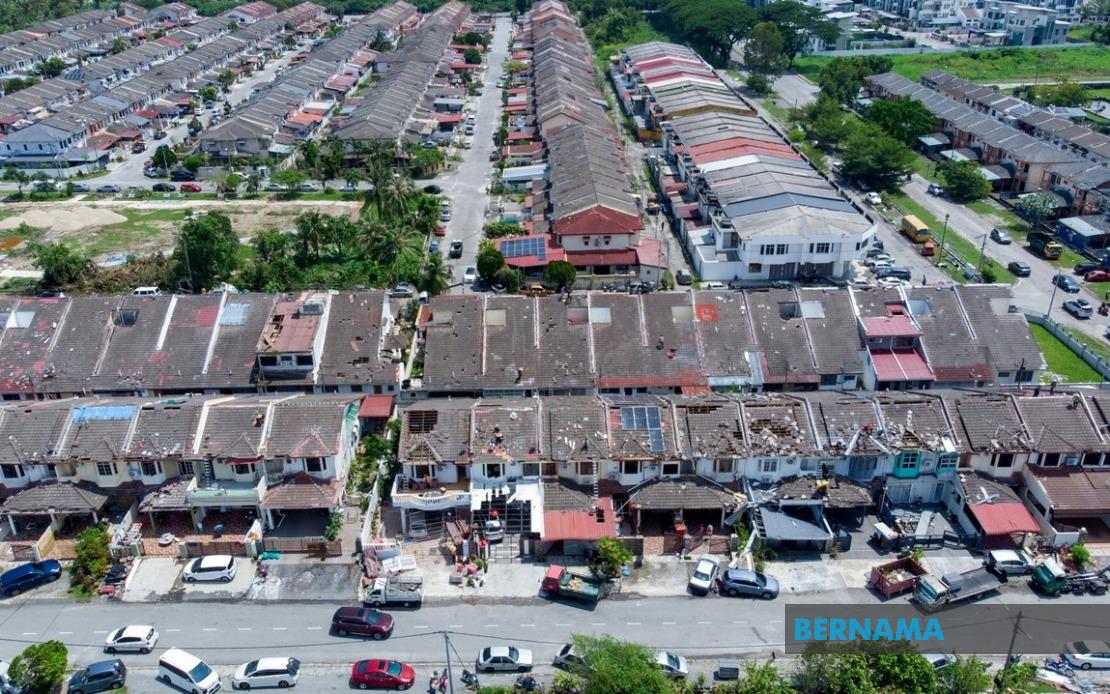
In response to widespread damage from a severe storm that devastated the Bercham district in Ipoh on Friday, police have established a security cordon spanning five neighbourhoods, implementing controlled entry and exit protocols designed to safeguard affected properties during the recovery phase. The Ipoh district police chief, ACP Muhammad Najib Hamzah, announced the containment measures at a briefing held at the Bercham police station, acknowledging the tension between allowing residents legitimate access for repairs and preventing criminals from exploiting the chaos of the disaster.
The storm, now believed to have been generated by a rare landspout phenomenon according to remarks by Ipoh Barat Member of Parliament M. Kulasegaran, inflicted significant structural damage across multiple residential zones, prompting authorities to adopt defensive policing tactics. The Deputy Minister in the Prime Minister's Department (Law and Institutional Reform) characterised the weather event as unprecedented in its intensity and scope, with preliminary assessments indicating that more than 200 dwellings sustained damage severe enough to require immediate intervention and cleanup efforts by their residents.
ACP Muhammad Najib acknowledged that rigid enforcement would create hardship for residents attempting to salvage belongings and assess damage, particularly given the prolonged loss of electrical supply affecting areas such as Anjung Bercham. Rather than imposing an absolute lockdown, police have adopted a graduated approach that permits daytime movement with minimal scrutiny while substantially increasing surveillance and verification procedures during night hours. This calibrated response reflects practical considerations about the workload facing families who must sort through debris and secure damaged structures before additional weather deteriorates their situations further.
The decision to enforce stricter nocturnal restrictions addresses legitimate law enforcement concerns about organised property crime exploiting disaster zones. The police chief expressed particular worry that thieves might pose as residents engaged in legitimate cleanup activities, thereby gaining access to damaged homes where security measures have been compromised. By requiring police personnel to verify ownership and confirm the legitimacy of night-time entry requests, authorities hope to deter this category of opportunistic crime while still accommodating genuine residents whose employment or family circumstances necessitate evening work schedules.
As of the morning briefing, police recorded 492 reports related to storm damage through their Op Bencana disaster response channel, though officials cautioned that this figure likely represents only a fraction of actual losses given that affected residents remain preoccupied with immediate survival priorities rather than formal reporting. The authorities have notably removed any temporal deadline for victims to lodge damage reports, acknowledging that the chaotic nature of disaster recovery means some residents will require days or weeks before they can undertake the documentation needed for insurance claims or government assistance applications.
The geographic scope of the disaster extends across six distinct residential communities within Bercham, each presenting different recovery challenges. Anjung Bercham Utara, Taman Mujur, Kampung Bercham, Kampung Tersusun Tasek, Taman Pusat Bercham, and Taman Indah Sakti collectively house hundreds of families now grappling with structural damage, personal loss, and the logistics of restoration. These mixed residential zones serve a cross-section of Ipoh's demographics, suggesting the disaster impact transcends particular income brackets or demographic segments, complicating government response coordination across multiple assistance programmes.
The Incident Control Post established at Bercham police station functions as a coordination hub for police, emergency services, and local government agencies managing the disaster response. By centralising information gathering and resource allocation through this command structure, authorities aim to synchronise security operations with reconstruction efforts undertaken by residents and professional contractors. The police inspection visit underscored the operational importance of this coordination point, indicating that security considerations remain embedded within the broader disaster management framework rather than functioning as an isolated enforcement operation.
Quantifying the total financial impact remains premature, with officials declining to estimate aggregate losses pending completion of systematic damage assessments across all affected properties. The absence of finalised loss figures reflects the incomplete state of recovery operations, as residents continue discovering additional structural compromise as they clear debris and inspect concealed areas of their homes. Insurance companies and government agencies will require substantially more detailed information before claims assessment and relief disbursement can proceed, creating a documentation challenge that extends beyond the immediate security concerns requiring police intervention.
For residents across Ipoh and the broader Perak state, the Bercham incident exemplifies the vulnerability of residential areas to extreme weather phenomena that meteorological science is still working to fully understand and predict. The identification of a landspout as the probable causative mechanism highlights how climate variability can produce localised destructive events that conventional weather monitoring systems may detect only after significant damage has occurred. This realisation carries implications for urban planning, building code enforcement, and disaster preparedness across Malaysian cities situated in vulnerable geographic zones.
The police response architecture established in Bercham provides a practical model for balancing security imperatives against humanitarian considerations in post-disaster environments, where the normal distinction between victims and perpetrators can blur when desperation meets opportunity. The approach adopted here—distinguishing between day and night access, requiring ownership verification, and maintaining intensive patrols in high-risk areas—demonstrates how law enforcement can adapt operational doctrine to disaster-specific contexts without abandoning fundamental protective mandates. As Bercham residents navigate the extended recovery process, the security framework established by police will likely require continuing adjustment based on actual crime patterns and community feedback regarding the effectiveness of access controls versus their impact on legitimate reconstruction activities.