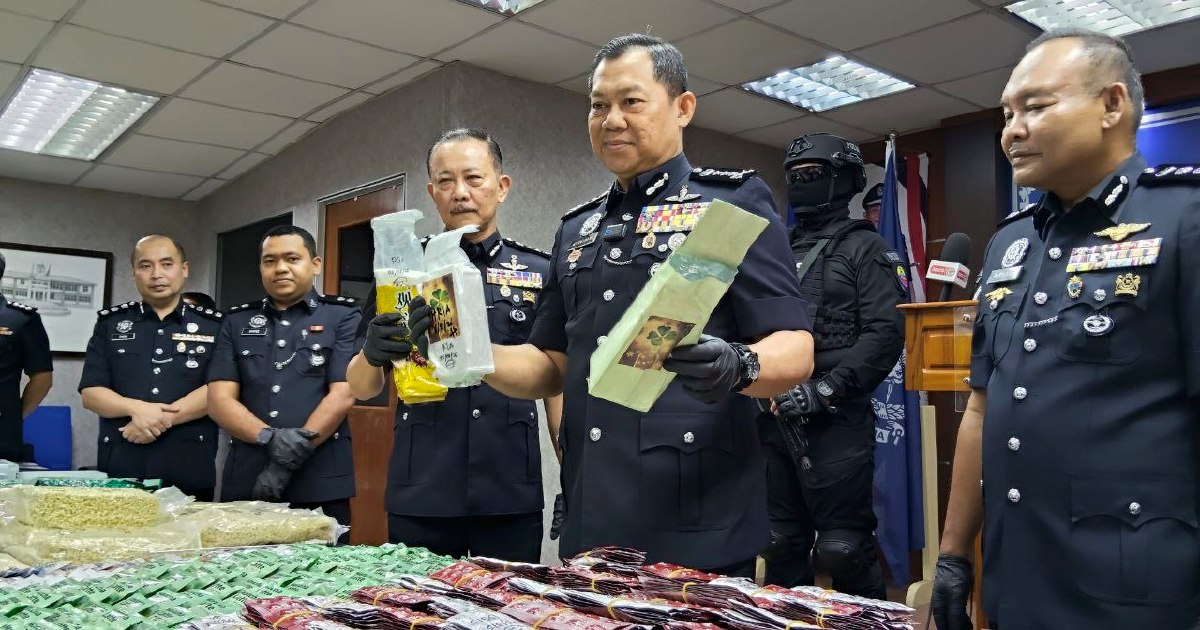
A significant blow against organised drug trafficking in Johor has emerged following a police raid on a residential apartment in the Masai district that uncovered one of the state's larger recent hauls of controlled substances. Officers discovered approximately 96.76 kilograms of various drugs stashed within a unit at Persiaran Senibong, with an estimated street value reaching RM8.49 million. The operation resulted in the arrest of two individuals suspected of orchestrating the distribution network that utilised the apartment as a clandestine storage and supply hub.
The apartment's strategic location made it an attractive operational base for the suspected traffickers, situated within a residential complex that would have provided convenient access whilst maintaining a veneer of normalcy. According to police investigations, the unit had been deliberately rented and modified specifically to function as a secure holding facility for the illicit inventory. This method of compartmentalising storage from street-level distribution points is a sophisticated tactic commonly employed by larger syndicates seeking to reduce immediate law enforcement exposure whilst managing substantial drug volumes.
This seizure arrives amid intensifying efforts by Johor Police to dismantle supply chains feeding the state's drug market. The sophistication displayed in how this operation was structured—renting anonymous residential space rather than operating from traditional premises—suggests the syndicate possessed considerable organisational capability and resources. Such methodologies indicate networks extending beyond street dealers into more structured criminal enterprises capable of acquiring, transporting, and warehousing multi-kilogram quantities of dangerous substances.
The variety of drugs recovered underscores the syndicate's diversified product range, a hallmark of distribution operations intent on maximising market reach and revenue streams. Rather than specialising in a single narcotic category, the network apparently maintained stocks across multiple substance types, positioning it to supply various customer segments. This horizontal integration within their criminal operations amplifies both the scale of the public health threat and the complexity law enforcement must navigate when pursuing such organisations.
For residents across Johor and the broader Klang Valley region, such operations highlight the persistent challenge posed by drug trafficking despite sustained police interdiction efforts. The use of residential apartments as storage facilities means organised crime operates in proximity to ordinary families and communities, creating neighbourhood-level security concerns beyond the specific criminal enterprise. Masai's industrial and commercial proximity makes it a natural corridor for trafficking logistics, connecting port facilities and manufacturing zones with distribution networks downstream.
The investigation leading to this breakthrough exemplifies the intelligence-gathering work required to transition from street-level enforcement to dismantling supply infrastructure. Police must track patterns, monitor suspicious rental activities, and develop informant networks capable of identifying where large quantities congregate before distribution begins. The successful execution of this particular operation suggests investigators had developed sufficient actionable intelligence to justify a targeted raid on this specific location.
From a regional trafficking perspective, Johor's position as a gateway between Malaysia and Singapore elevates its significance in transnational drug flows. Syndicates often establish Malaysian-side storage and distribution points before moving merchandise across the Causeway or into regional markets. Disrupting these facilities impairs the operational efficiency of trafficking networks whilst potentially creating market supply constraints. However, law enforcement agencies stress that eliminating one storage facility, whilst operationally significant, represents a single intervention against continuously adaptive criminal enterprises.
The two arrested individuals now face serious drug trafficking charges, which carry severe penalties under Malaysian law, potentially including lengthy imprisonment and significant fines depending on their specific roles within the syndicate. Beyond the immediate suspects, police investigations typically extend to identifying suppliers, downstream distributors, and financial facilitators. The structure and capitalisation evident in this operation suggests multiple layers of criminal organisation requiring systematic dismantling.
Malaysia's ongoing battle against drug trafficking has seen periodic large seizures, yet overall usage rates and trafficking indicators remain concerning. This Masai case demonstrates that despite enforcement successes, syndicates continue operating substantial distribution networks. The estimated RM8.49 million value reflects street-level pricing, indicating the commercial scale commanding criminal attention and investment. Disrupting such operations requires sustained, intelligence-led policing supported by community reporting and inter-agency cooperation across state and international boundaries.
For Malaysian drug policy advocates and law enforcement strategists, this seizure reinforces longstanding arguments regarding the need for comprehensive approaches combining interdiction, demand reduction, and criminal network disruption. Addressing not merely the symptoms—street-level dealing and consumption—but the underlying supply infrastructure requires resources, intelligence capability, and operational patience to develop investigations of sufficient depth to justify authorised interventions against specific targets.
The Johor Police's successful identification and raid on this distribution facility represents important tactical progress, yet the broader strategic challenge of curtailing organised trafficking remains formidable. As syndicates adapt their methodologies and operational security protocols in response to enforcement pressure, law enforcement agencies must continuously refine investigative techniques and intelligence collection. The RM8.49 million seizure serves as both a law enforcement success and a sobering reminder of trafficking networks' persistence and scale operating within Malaysian communities.

