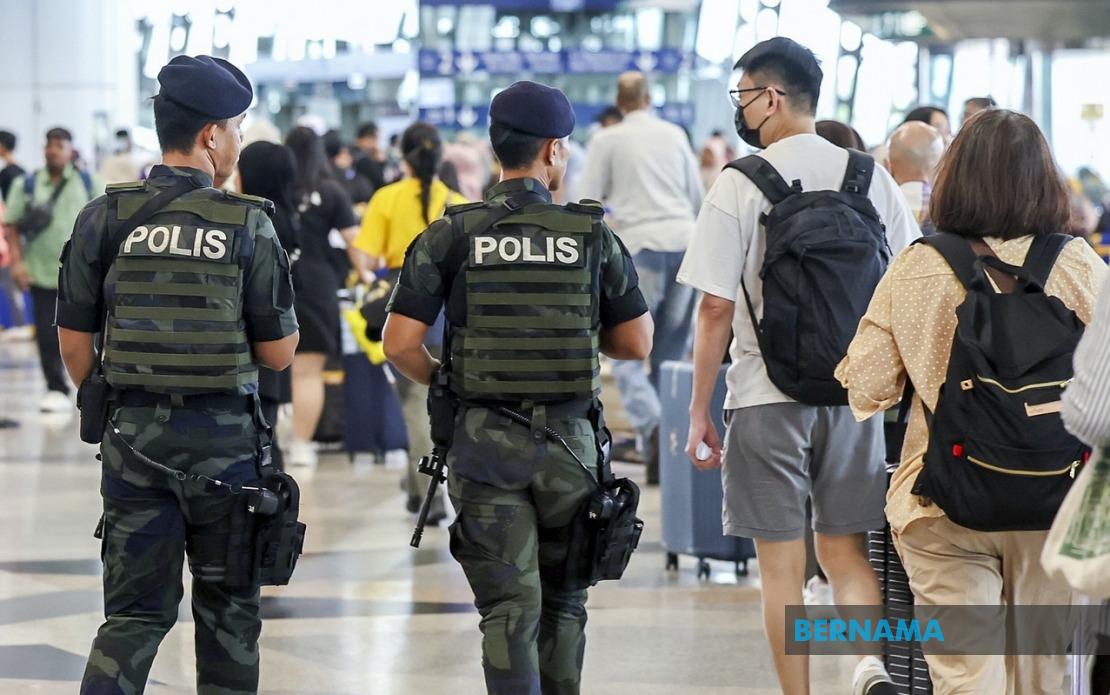
The Malaysian government has committed to deploying officers from the Royal Malaysia Police to strengthen operations within aviation security units across the country's airports, a decision announced by Communications Minister Datuk Seri Fahmi Fadzil during his weekly press briefing in Putrajaya on Tuesday. The deployment represents the first in a series of coordinated security enhancements being rolled out following the arrest of a 39-year-old Malaysian pilot in Indonesia, who authorities suspect was attempting to smuggle narcotics through one of Southeast Asia's busiest aviation hubs.
The announcement came after deliberations at the Cabinet meeting, where both the Home Ministry and Transport Ministry presented a range of immediate corrective actions designed to close potential gaps in Malaysia's airport security framework. At the heart of these reforms is a fundamental restructuring of how aviation security operations are managed at Malaysian airports. Currently, the Aviation Security unit operates with auxiliary police personnel managing day-to-day activities, a staffing arrangement the government has now determined requires upgrading to ensure more rigorous oversight and enforcement capabilities.
The case that precipitated these changes unfolded at Indonesia's Soekarno-Hatta International Airport, where Indonesian National Police officers apprehended the Malaysian pilot at Terminal 3. During subsequent inspections, authorities discovered 15 packages containing approximately 70,114 capsules of ecstasy and methamphetamine, with an estimated street value reaching RM45 million according to Indonesian market valuations. The magnitude of the seizure, combined with the involvement of an experienced commercial aviation professional, has raised serious questions about security vulnerabilities within Malaysia's aviation sector and whether existing screening mechanisms for flight crew are sufficiently robust.
Beyond the immediate personnel deployment, Malaysia Aviation Group has been instructed to conduct a comprehensive review of its background screening and health assessment protocols for pilots and co-pilots. This directive signals recognition that vetting procedures established for commercial aviation personnel may need modernisation to detect indicators of potential criminal involvement or substance abuse that could compromise flight safety and national security. The review takes on particular significance given that the arrested pilot's position granted him privileged access to secure airport areas and international flight operations, creating exceptional opportunities for illegal activity that would be unavailable to ordinary passengers.
Fahmi emphasised that the Royal Malaysia Police and the Malaysian Border Control and Protection Agency have received concurrent instructions to conduct systematic reviews of airport security systems, with particular focus on identifying weaknesses or exploitable gaps that might have enabled the alleged smuggling attempt. This parallel investigation approach underscores the government's determination to treat the incident not as an isolated case but as a symptom of broader structural vulnerabilities requiring comprehensive remediation. Both agencies have been tasked with developing corrective measures that can be implemented expeditiously, recognising that delayed responses could allow others to exploit similar loopholes.
The government has not yet ruled out establishing a specialised investigation team dedicated to the case, though Fahmi indicated that any decision regarding such a task force would depend on reviewing the complete factual record. To date, Malaysian officials have received only preliminary oral briefings from the Transport and Home Ministers, with the full investigative report still pending. Since the case remains under active investigation by Indonesian authorities, Malaysian decision-makers are exercising caution to avoid premature conclusions or actions that could inadvertently compromise the cross-border investigation or create diplomatic complications with Indonesia.
The timing of this incident carries particular weight for Malaysian aviation authorities, given the region's history of security challenges and the ongoing importance of international flight operations to the country's tourism and business sectors. Airport security enhancements inevitably generate operational and financial implications for airlines and ground service operators, yet the incident demonstrates that maintaining rigorous standards protects not only Malaysia's reputation but also the safety of millions of passengers transiting through the country's airports annually. The involvement of a commercial pilot adds an unsettling dimension, as such individuals undergo extensive background checks and professional training, yet this case illustrates that established crew vetting mechanisms may not adequately screen for financial desperation, substance addiction, or other risk factors that could motivate participation in smuggling schemes.
For Malaysia's neighbours and trading partners, the government's swift policy response offers some reassurance regarding the seriousness with which aviation security matters are being addressed at the national level. Regional air traffic volumes and the interconnected nature of Southeast Asian aviation networks mean that security lapses in one country can have implications across the broader region. By moving to strengthen AVSEC operations through police deployment and enhanced crew screening, Malaysia is signalling commitment to maintaining standards consistent with international aviation security frameworks and regional expectations.
The specific focus on auxiliary police replacement within AVSEC units reflects a broader strategic principle that security-critical functions benefit from deployment of fully trained, regularly accountable law enforcement personnel rather than civilian or quasi-military contractors. Auxiliary police units typically operate with different accountability structures and training standards compared to regular police officers, and their replacement with PDRM personnel introduces greater institutional consistency and clearer lines of command and responsibility. This organisational change, though administratively straightforward, potentially carries significant implications for how violations and suspicious activities are detected and responded to within airport security zones.
Looking forward, Fahmi's comments indicate that the government will proceed methodically in determining which additional measures warrant implementation, prioritising actions that can be executed immediately while developing longer-term strategic responses. The involvement of multiple agencies—including the Home Ministry, Transport Ministry, police, and border control authorities—suggests that the government recognises this issue transcends any single institutional responsibility and requires coordinated action across traditional bureaucratic boundaries. Malaysian authorities appear determined to ensure that whatever vulnerabilities enabled this smuggling attempt are identified and corrected, sending a clear signal that aviation security will remain a high priority for the incoming administration.

