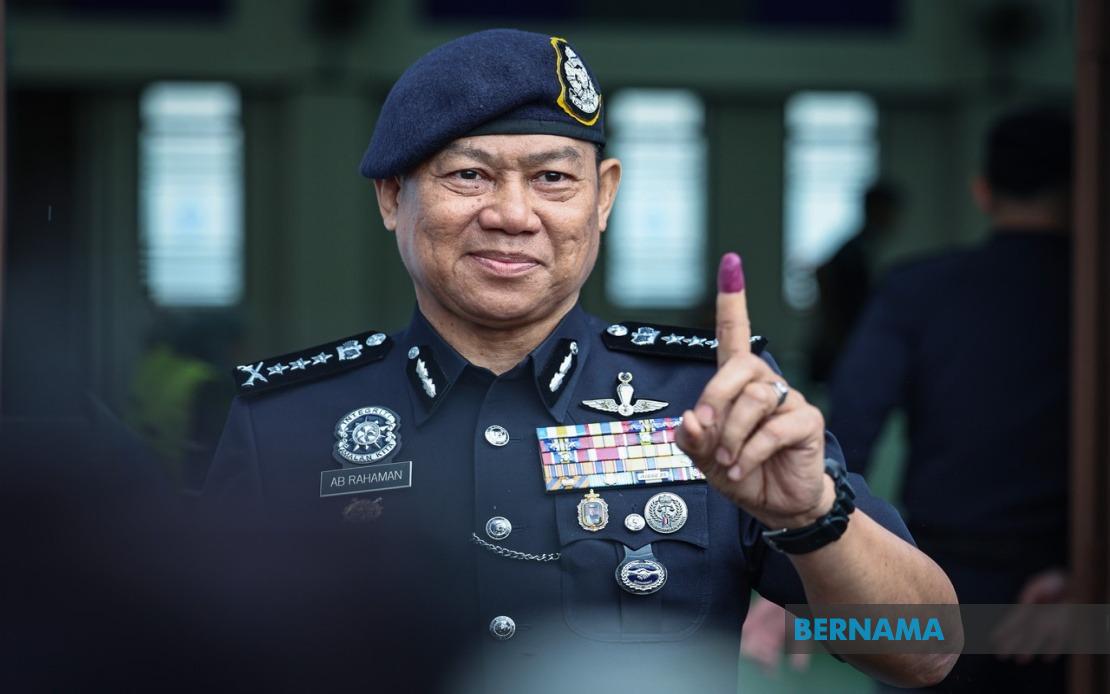
The 16th Johor state election entered its early voting phase on July 7 with police personnel and armed forces members exercising their ballot rights ahead of Saturday's main polling day. By mid-morning, security force participation had reached a substantial 36.3 per cent, translating to 4,257 votes cast from the eligible police contingent across the state. The coordinated early voting arrangements, which commenced at 8 am across 64 dedicated polling centres, accommodated a total of 20,607 registered early voters from both the police and Malaysian Armed Forces.
Johor Police Chief Datuk Ab Rahaman Arsad reported that the voting mechanics had progressed without friction or disruption. All 53 early voting centres statewide maintained orderly procedures, and no incidents threatening the credibility or operational integrity of the process materialised. Speaking to journalists after fulfilling his own voting obligation at the Johor Police Contingent Headquarters in Johor Bahru, Ab Rahaman emphasised that the absence of complaints demonstrated the professionalism underlying the electoral administration. However, he clarified that an authoritative assessment of overall voter participation would only emerge once all polling stations across the state concluded their operations that afternoon.
The staggered closure arrangement for early voting centres—between noon and 6 pm depending on geographical location and registered voter numbers—reflected logistical planning to accommodate security personnel's operational commitments and varying constituency demands. This phased approach has become standard practice in Malaysian elections involving uniformed personnel, recognising their continued duty obligations during electoral periods. The orderly conduct contrasted with periodic challenges that have marked previous electoral cycles in Malaysia, suggesting effective coordination between electoral commission personnel and security force administrators.
Beyond the immediate voting mechanics, the campaign period preceding early polling had generated administrative workload across Johor's law enforcement apparatus. Ab Rahaman disclosed that police reports and investigation files opened during the campaign season predominantly centred on vandalism targeting campaign infrastructure. These incidents encompassed destruction or defacement of party flags and political billboards—a recurring feature of Malaysian electoral contests that reflects intensifying partisan competition and occasionally heated grassroots mobilisation. While such incidents technically constitute criminal offences, they typically represent lower-order electoral disturbances rather than systematic integrity threats.
A more substantive controversy emerged from allegations by former Johor State Assembly Speaker Datuk Dr Mohd Puad Zarkashi regarding palace involvement in the state legislature's dissolution. The controversy triggered substantial police attention nationwide, with 153 reports lodged as of the reporting date. Johor authorities confirmed that investigations into Dr Mohd Puad's claims remained active and ongoing, indicating that law enforcement personnel continued examining the allegations' factual foundations and potential legal implications. The matter illustrated how electoral disputes in Malaysia increasingly assume institutional and constitutional dimensions, extending beyond routine campaign management to encompass relationships between political leadership, royalty, and statutory bodies.
The 16th Johor state election encompasses 172 candidates pursuing seats across 56 constituencies, establishing a competitive landscape with significant implications for state governance and potentially broader peninsular politics. The election scheduled for Saturday would draw participation from more than 2.7 million registered voters, making it a substantial democratic exercise with meaningful stakes for Johor's political trajectory. Early voting arrangements for security personnel represented institutional recognition that uniformed personnel require accommodated participation pathways, reflecting democratic principles that extend electoral participation to those whose operational duties might otherwise complicate Saturday attendance.
The early voting experience in Johor carries relevance beyond the state's immediate political context. As Malaysia refines electoral administration practices and addresses participation barriers for specific constituencies, the successful management of security force voting offers a model potentially applicable to other demographic groups facing access constraints. The coordination demonstrated between polling authorities and institutional stakeholders provides methodological insights for future electoral exercises. Furthermore, the professional conduct of early voting procedures reinforced public confidence in Malaysia's electoral mechanics—a foundational requirement for democratic legitimacy and acceptance across regional and international contexts.
The absence of reported incidents or complaints during early polling reflected credit on both electoral administrators and the security forces themselves. In a regional context where electoral disputes occasionally assume confrontational dimensions, the orderly and dignified execution of Johor's early voting procedures demonstrated institutional capacity and citizen restraint. Such procedural success, while seemingly routine, constitutes meaningful democratic infrastructure that sustains electoral integrity and public faith in representative mechanisms. The smooth progression enabled voters to exercise franchise rights without confusion, intimidation, or administrative barriers—fundamentals upon which legitimate electoral systems depend.
Looking toward Saturday's main polling day, the early voting returns suggested reasonable participation momentum among security personnel, a demographic typically demonstrating relatively high electoral engagement. The 36.3 per cent rate by mid-morning indicated potential for substantial overall participation within this constituency by the early voting process conclusion. Extrapolating from the police contingent's performance and anticipated Malaysian Armed Forces participation, election administrators could anticipate meaningful early voting contributions that would potentially ease polling station congestion during main election day. This preliminary performance benchmark provided operational data for resource allocation and contingency planning across the remaining 56 constituencies and their respective polling infrastructure throughout Johor.

