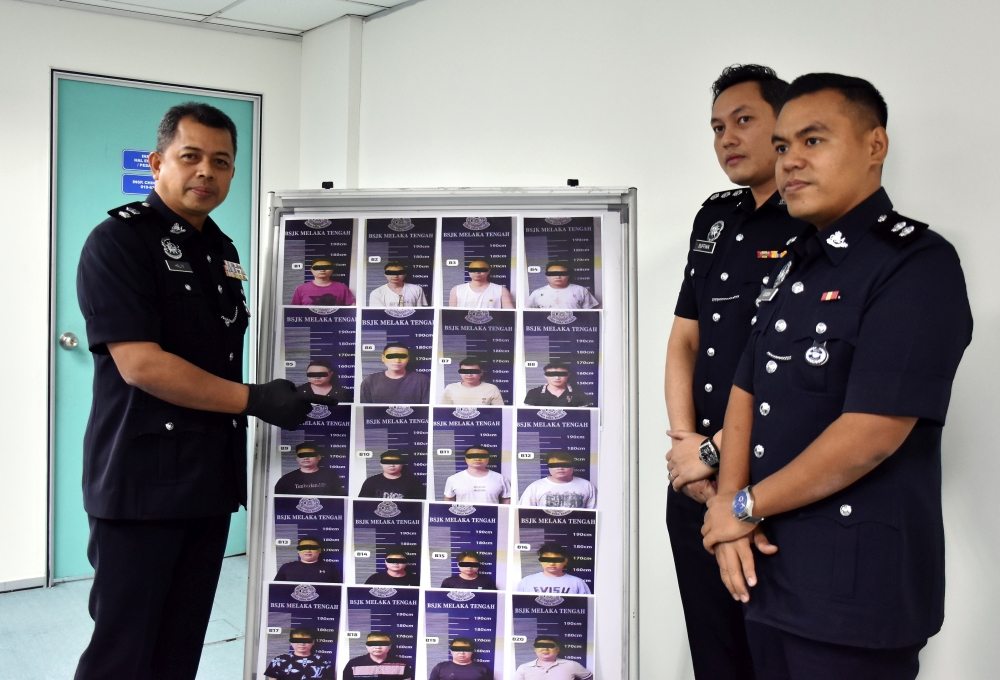
In a significant crackdown on transnational financial crime, the Melaka police force has detained 21 Chinese nationals believed to be operating a widespread investment fraud syndicate from within the state. The operation, uncovered following a series of intelligence-led investigations, represents another troubling instance of organized financial deception targeting Malaysian and potentially Southeast Asian victims who were promised returns from non-existent investment opportunities.
The syndicate's modus operandi involved creating an elaborate facade of legitimacy around spurious investment schemes. Perpetrators used sophisticated digital marketing and social engineering techniques to cultivate trust among potential victims, often posing as financial advisors or investment managers operating through seemingly credible platforms. The illusion of legitimacy was further reinforced through fabricated documentation, falsified credentials, and carefully constructed communication channels designed to withstand basic due diligence checks from unsuspecting investors.
The discovery of this operation underscores a growing vulnerability within Malaysia's financial ecosystem, where digital connectivity and cross-border ease of communication have created new opportunities for organized fraud rings. These criminal enterprises typically target individuals with limited financial literacy or those seeking quick investment returns, leveraging psychological manipulation and the prospect of substantial profits to overcome their victims' initial skepticism. The arrests in Melaka suggest authorities had identified multiple coordinated cells working in tandem to maximize operational efficiency and minimize detection risk.
When examining the geographic context, Melaka's location as a commercially active, cosmopolitan port city makes it an attractive operational base for transnational criminal networks. The state's position in the Klang Valley corridor and proximity to major transportation arteries facilitates both the movement of operatives and the logistics required to sustain complex fraud networks. The presence of substantial migrant populations, combined with the city's developed telecommunications infrastructure, creates conditions that criminal groups actively exploit.
The scale of this particular bust—involving 21 suspects—indicates that authorities may have penetrated a relatively substantial operation rather than disrupting a smaller cell. This suggests that the investigation likely involved collaboration between federal law enforcement agencies and state-level intelligence services, possibly triggered by victim complaints or financial institution alerts. The timing and execution of such arrests typically reflects several months of groundwork, surveillance coordination, and warrant preparation before operational deployment.
From a broader regional perspective, investment fraud syndicates originating in or operating through Southeast Asia have become increasingly sophisticated over recent years. Criminal networks now commonly leverage cryptocurrency platforms, digital banking channels, and messaging applications that provide encrypted communications and built-in money laundering capabilities. The involvement of international operatives, particularly organized groups from countries with weak law enforcement coordination with Malaysia, compounds the challenge for local authorities attempting to dismantle these networks and pursue accountability across borders.
The financial damage inflicted by such schemes extends beyond individual victims. When large numbers of people lose savings to fraudulent investment operations, the cumulative economic impact can influence consumer confidence in legitimate investment markets and financial institutions. This undermines the broader financial ecosystem's stability and complicates efforts by regulators and banking authorities to encourage productive capital deployment among ordinary Malaysians. Victims often face significant emotional trauma alongside financial hardship, with elderly and retired individuals frequently representing disproportionate shares of affected populations.
For victims of such schemes, the practical consequences prove devastating. Recovery of lost funds remains remarkably difficult even when perpetrators are apprehended, particularly when money has been transferred overseas or converted into difficult-to-trace assets. The legal process of recovering stolen funds through civil litigation can extend for years and often yields only partial restitution, leaving victims with permanent losses. Additionally, victims may experience secondary victimization through shame, social stigma, and family relationship strain resulting from investment decisions that proved catastrophic.
The arrest of 21 individuals demonstrates that Malaysian law enforcement maintains capacity to identify and disrupt organized financial crime operations, yet the emergence of new syndicates suggests that deterrent effects remain limited. The fundamental profitability of investment fraud, combined with relatively manageable operational costs and persistent victim availability, ensures continued motivation for criminal entrepreneurs. Cross-border investigation challenges mean that apprehending one cell often proves insufficient to dismantle entire networks, with international operatives capable of relocating operations or reorganizing under new pretexts.
Looking forward, authorities must balance enforcement efforts with victim awareness initiatives and financial institution cooperation. Banks and digital payment platforms possess substantial capacity to identify and flag suspicious transactions characteristic of fraud operations, yet coordination between these entities and law enforcement remains inconsistent. Enhanced information-sharing protocols between Malaysian financial institutions and regional counterparts could strengthen the detection capability across Southeast Asia, potentially identifying syndicate networks before they reach operational maturity.
The investigations following these arrests will likely reveal additional operational details about recruitment methods, victim targeting strategies, and money movement patterns. Intelligence gathered from the 21 detained individuals may facilitate identification of victims currently unaware they have been defrauded, enabling authorities to issue timely warnings and potentially facilitate asset recovery actions. Such secondary investigations typically occupy law enforcement resources for extended periods following major arrests, reflecting the complexity involved in dismantling established criminal enterprises.

