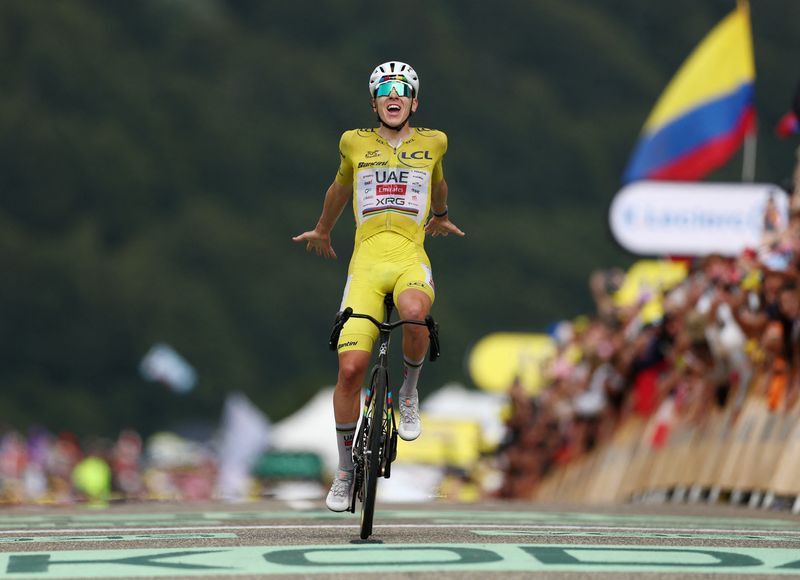
Tadej Pogacar demonstrated why he remains the commanding force in professional cycling this season, delivering a clinical solo victory on Saturday's 14th stage of the Tour de France to further cement his grip on the general classification. The four-time champion unleashed his winning move on the most punishing section of the Col du Haag, one of three category one climbs dotting the 155.3-kilometre route from Mulhouse to Le Markstein Fellering, establishing a performance that leaves him four minutes and 30 seconds clear of second-placed Jonas Vingegaard with nearly a week of racing still remaining.
The 27-year-old Slovenian's fourth stage triumph this year represents far more than a single victory on the road. It reflects a calculated tactical approach executed with near-flawless precision by his UAE Team Emirates-XRG squad, which controlled the race tempo throughout a demanding day in the Vosges mountains. By the time Pogacar's teammates had shepherded him through the final major climbs, they had systematically dismantled the breakaway attempts that characterised the early kilometres, setting up the conditions for their leader to unleash his decisive strike when it mattered most.
The stage itself tested the entire peloton's mettle, combining three major mountain passes with treacherous weather that added another layer of difficulty to competitors already pushing their physical limits. Heavy rainfall swept across the region during the descent from Col du Page, forcing riders to exercise extreme caution on slippery roads where a momentary lapse in concentration could prove costly. The Grand Ballon, the first significant ascent of the day, saw Frenchman Valentin Paret-Peintre from Soudal Quick-Step crest the summit ahead of Richard Carapaz while the main pack trailed nearly two minutes behind, suggesting the stage would develop into a battle between breakaway specialists and the general classification contenders.
The narrative shifted dramatically as the race progressed toward Ballon d'Alsace, where a coalition of stronger climbers gradually whittled down the advantage of the leading group. A critical moment emerged when Carapaz and EF Education–EasyPost teammate Ben Healy took an incorrect turn during the ascent to Ballon d'Alsace, forcing them to backtrack and rejoin the leaders as the peloton continued closing the gap. Such incidents, though quickly overcome, highlight the narrow margins that separate success from setback in the Tour's most demanding stages. Despite this momentary confusion, both riders recovered to contest the climb's summit, where the tactical battle intensified as the gradient steepened.
Pogacar's attack materialised precisely where the mathematics of cycling dictate success becomes most likely—on the steepest gradients of the final climb, where power and mental fortitude separate the champions from the challengers. As the Col du Haag gradient reached a punishing 16 percent during the final two kilometres, the general classification leaders made their move in rapid succession. Carapaz launched first, followed by Tobias Johannessen, but neither possessed sufficient strength to withstand the Slovenian's acceleration. Within 2.5 kilometres of the summit, Pogacar had dispatched his rivals, building a 30-second advantage at the peak and extending it further along the final five kilometres to the finish line.
Isaac Del Toro of Pogacar's own team demonstrated the depth of their tactical planning by claiming second place, finishing 38 seconds behind his leader and securing fourth position overall. Del Toro's solid performance underscores how modern Tour de France victories increasingly depend on team cohesion and coordinated strategy rather than isolated individual brilliance. Paul Seixas, representing the host nation as a local favourite, completed the podium in third, while Del Toro's advancement in the general classification standings reflects the team's capacity to place multiple riders in contention for the final mountain stages.
Vingegaard, widely regarded as Pogacar's primary challenger for the title, crossed the line in fourth position and continues trailing by an ever-widening margin. The French climber, winner of the last two editions of the Tour before Pogacar's arrival in top form, faces mounting pressure as the race enters its critical third week. With mountainous terrain remaining on Sunday's stage 15 from Champagnole to Plateau de Solaison and several more high-altitude finishes pencilled into next week's schedule, Vingegaard's mathematical chances of reclaiming the yellow jersey grow increasingly remote.
Pogacar's assessment of the challenge ahead reveals both confidence and tactical awareness. He acknowledged that Sunday's stage presented additional obstacles, describing the subsequent day's racing as likely to prove demanding for his entire team. The Slovenian's measured language masks the substantial advantage he has engineered, but the mathematics are unambiguous: barring catastrophic misfortune, he stands on the threshold of a third consecutive Tour de France victory, a feat that would place him among the sport's all-time greats. His dominance across diverse terrain—successfully defended against climbers of Vingegaard's calibre on mountain stages while maintaining consistency on flatter terrain—demonstrates a versatility that separates transcendent talents from ordinary stage racers.
For Malaysian and Southeast Asian cycling enthusiasts, Pogacar's performance illustrates the extraordinary physical and mental demands required to compete at the Tour's highest level. The interplay between individual brilliance and team coordination, the capacity to execute predetermined tactics under conditions of extreme fatigue, and the psychological resilience required to sustain a four-minute lead through week three of a three-week race all illuminate why the Tour de France maintains its status as professional cycling's ultimate test. Pogacar's trajectory from promising young talent to dominant force across multiple seasons offers insights into how elite athletes transition from success to sustained dominance in sports demanding sustained excellence across diverse challenges and opponents.

