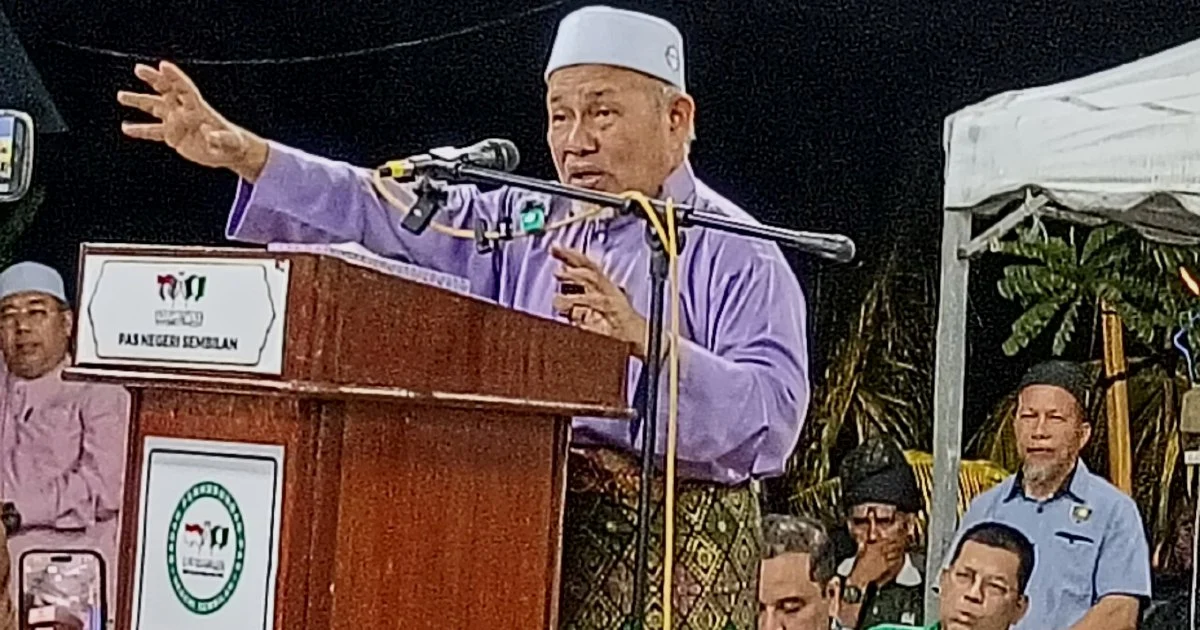
The question of who holds true ownership over Perikatan Nasional has become a flashpoint within Malaysian politics, with PAS deputy president Datuk Seri Tuan Ibrahim Tuan Man pushing back firmly against what he characterises as Bersatu's claims of singular dominion over the coalition. His rebuke addresses simmering tensions that have threatened to destabilise the three-year-old alliance, which has become a pivotal force in the nation's political landscape since its formation ahead of the 2020 general election.
Tuan Ibrahim's intervention underscores a fundamental ideological and structural disagreement about how Perikatan Nasional should function as a political entity. The coalition emerged from the wreckage of the Muhyiddin Yassin government and has since consolidated into one of Malaysia's two major blocs, competing with the Pakatan Harapan-led administration for control of parliament and state governments. Yet beneath this cohesion lies an unresolved question about governance: should coalition decisions rest primarily with the largest or most influential component, or should authority be genuinely distributed among constituent parties?
PAS, as the coalition's most electorally formidable component with the deepest grassroots networks particularly in rural Malay-majority heartlands, has long positioned itself as PN's moral and demographic backbone. With its nationwide organisational capacity and the largest parliamentary representation within the alliance, PAS leadership views the coalition as a venture requiring consensus from all parties, not diktat from any single player. This perspective reflects the party's historical experience navigating complex political arrangements and its investment in presenting itself as a responsible governing force.
The dispute with Bersatu, meanwhile, carries additional complexity given the relative youth and evolving character of Muhyiddin Yassin's party. Bersatu emerged from the UMNO split in 2016 and has undergone numerous internal upheavals and leadership transitions. Despite its organisational challenges, Bersatu holds symbolic importance as the nominal anchor of PN, given Muhyiddin's prominent role in assembling the coalition and his periodic claims to its direction and policy orientation. This has created friction over whether numerical strength, historical assembly role, or democratic consensus should determine coalition leadership.
Tuan Ibrahim's clarification gains significance against the backdrop of broader Malaysian political realignment. Since the 2022 general election, PN has evolved from opposition challenger to something more complex—a coalition that has supported federal governments while contesting state power, and whose component parties have occasionally pursued parallel agendas. This structural ambiguity has generated repeated questions about coalition cohesion and decision-making authority, particularly when individual parties contemplate state-level alliances or seek to position themselves advantageously for future electoral contests.
For Malaysian readers and regional observers, this internal PN dispute reflects a wider challenge confronting multi-party coalitions in the region. Unlike the more hierarchically organised Pakatan Harapan, Perikatan Nasional has never fully resolved mechanisms for internal governance, dispute resolution, or resource allocation among components. PAS's insistence on collective ownership reflects the practical reality that a coalition lacking genuine power-sharing arrangements risks either becoming dominated by one faction or fracturing under stress. The party's emphasis on joint stewardship serves both democratic principle and survival instinct.
The ownership question also carries implications for potential government formation scenarios. If PN ever gains sufficient parliamentary numbers to lead a federal administration, the mechanisms through which it distributes ministerial positions, shapes policy priorities, and allocates campaign resources become critically important. A coalition that functions as Bersatu's vehicle might operate differently than one genuinely controlled by consensus among PAS, Bersatu, and smaller components like Sarawak GPS or UPKO. These structural choices have tangible consequences for policy execution and political stability.
Tuan Ibrahim's public intervention suggests PAS leadership believes clarifying PN's collective character serves its strategic interests. By asserting that the coalition belongs to all members equally, PAS grounds its claims to meaningful influence and prevents Bersatu from unilaterally determining coalition positions on government formation, policy matters, or electoral strategy. This is particularly relevant given PAS's traditional ambivalence toward working with non-Islamist partners—emphasising collective ownership allows PAS to exercise veto power over coalition decisions that might compromise its organisational interests or religious credentials.
The broader implications for Malaysian governance should not be overlooked. Coalition politics have become essential to Malaysian democracy, given the fragmentation of both Malay-Muslim and Chinese-centric political blocs. Coalitions that function transparently, with genuine power-sharing and clear decision-making processes, tend to deliver more stable governments and more accountable public administration. Conversely, coalitions that operate as vehicles for dominant individuals or parties frequently face paralysis, defection, and collapse. Tuan Ibrahim's defence of collective ownership, therefore, amounts to an argument for institutional integrity and democratic governance within PN's structure—a principle with resonance far beyond internal coalition mechanics.