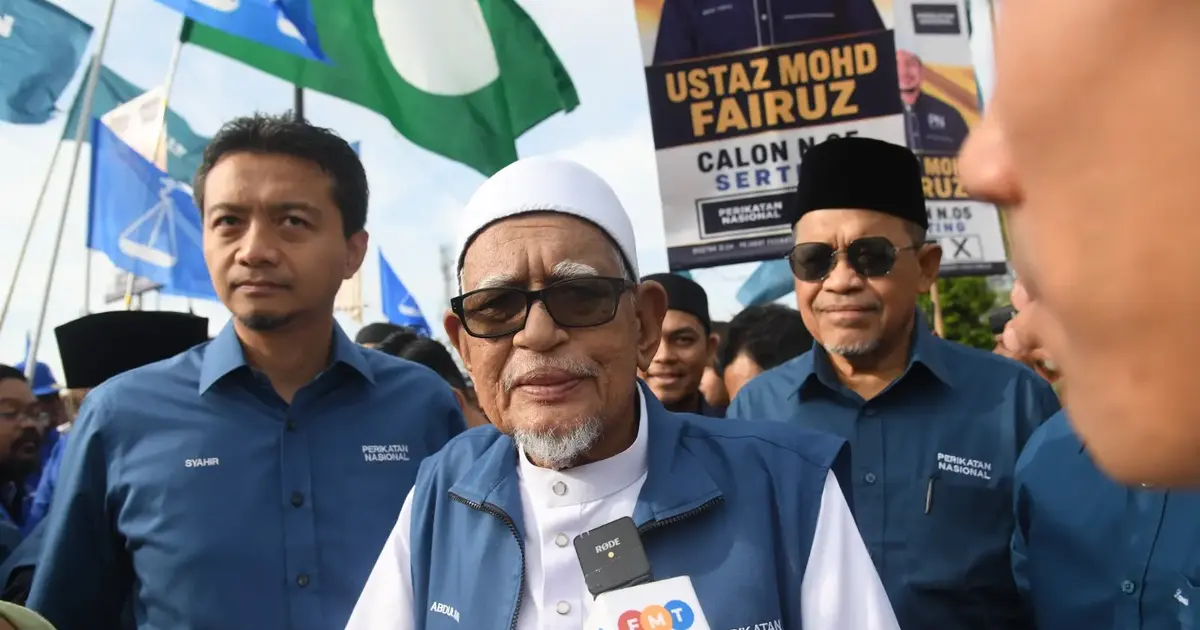
PAS President Hadi Awang has offered a striking metaphor to describe the relationship between Perikatan Nasional and Barisan Nasional in Negeri Sembilan, claiming their partnership operates on a level far exceeding the transactional nature typically associated with formal political alliances. The characterisation carries significance in a state where coalition dynamics have historically proven fragile and subject to sudden realignment, making the rhetoric of deeper commitment a notable statement in regional political discourse.
Hadi's description of the partnership as transcending a conventional marriage suggests that beyond the immediate mechanics of seat allocation and electoral cooperation, the two coalitions share fundamental values and strategic objectives in the state. This framing appears designed to signal stability and permanence to both party members and the broader electorate in Negeri Sembilan, where voter confidence in coalition cohesion directly influences electoral outcomes. The metaphorical elevation of the relationship may also serve to preempt speculation about potential fractures, particularly given Malaysia's recent history of dramatic political recalibrations at the state level.
The context for Hadi's remarks extends to ongoing negotiations about the formal architecture of the PN-BN cooperation. Rather than presenting a detailed roadmap for institutionalising the partnership, the PAS leader emphasised that decisions regarding official formalisation would emerge through future discussions. This measured approach suggests the coalitions are prioritising flexible operational arrangements over rigid structural commitments at this juncture, allowing both groupings to maintain negotiating positions on contentious matters such as post-election power-sharing and ministerial portfolios.
Negeri Sembilan occupies a strategically important position within Malaysia's political landscape, controlling a state assembly with significant federal implications. The state has witnessed considerable volatility in recent election cycles, with power alternating between coalitions and individual representatives sometimes shifting allegiances. Against this backdrop, any alliance claiming durability and depth rather than expedience faces elevated credibility thresholds. Hadi's rhetorical strategy attempts to move beyond conventional political language to suggest something more substantial and resilient than voters have previously experienced in the state's coalition arrangements.
For Barisan Nasional, encompassing UMNO and its longstanding partners, the PN-BN cooperation in Negeri Sembilan represents a significant evolution from the period when UMNO dominated state politics independently. The inclusion of PAS and other PN components introduces fresh demographic appeal and potentially strengthens reach into constituencies where traditional BN messaging had weakened. Simultaneously, BN retains its organizational machinery and institutional experience, creating a complementary dynamic that Hadi's language attempts to valorise as something deeper than mere convenience.
The timing of Hadi's statement carries implications for Malaysian political observers monitoring the broader trajectory of PN-BN relations nationally. Since the 2022 general election, these coalitions have engaged in complex negotiations across multiple states, sometimes cooperating, sometimes competing, and occasionally maintaining distance. Negeri Sembilan has emerged as a test case for sustained cooperation, making leadership pronouncements about alliance quality particularly consequential. The PAS president's emphasis on transcendent partnership values may indicate preparation for difficult conversations ahead regarding resource distribution and electoral candidacy matters.
Political observers in Southeast Asia have noted that Malaysian coalition dynamics frequently pivot on personality and perception as much as institutional design. Hadi's choice to employ relationship metaphors rather than detailing specific mechanisms reflects this reality. By suggesting the PN-BN partnership embodies something beyond transactional exchange, the PAS leader creates a rhetorical framework within which friction points might be reframed as internal adjustments within a larger shared mission rather than fundamental disagreements requiring resolution through separation.
The statement also carries implications for opposition parties attempting to exploit coalition divisions. If PN and BN can convincingly project unity in Negeri Sembilan, they potentially neutralize a significant opposition avenue for territorial advancement. Conversely, any subsequent visible tension within the partnership would dramatically underscore the gap between aspirational rhetoric and operational reality, providing opposition coalitions ammunition for messaging emphasising that the ruling partnership remains fundamentally unstable and driven by self-interest rather than principle.
As Malaysian political cycles continue rotating toward various state-level contests and eventual federal elections, the Negeri Sembilan model will receive scrutiny as either a replicable framework for PN-BN cooperation or evidence that deeper formal alliance structures remain elusive. Hadi's unwillingness to commit to specific timelines for formalisation suggests the coalitions prefer maintaining operational flexibility while cultivating the perception of strategic alignment. This approach carries risks, as voters increasingly expect clarity regarding post-election arrangements and power distribution. The delicate balance between projecting stability through metaphorical language while deferring concrete institutional decisions will shape how effectively PN-BN cooperation translates into sustained electoral performance across Negeri Sembilan's constituencies.

