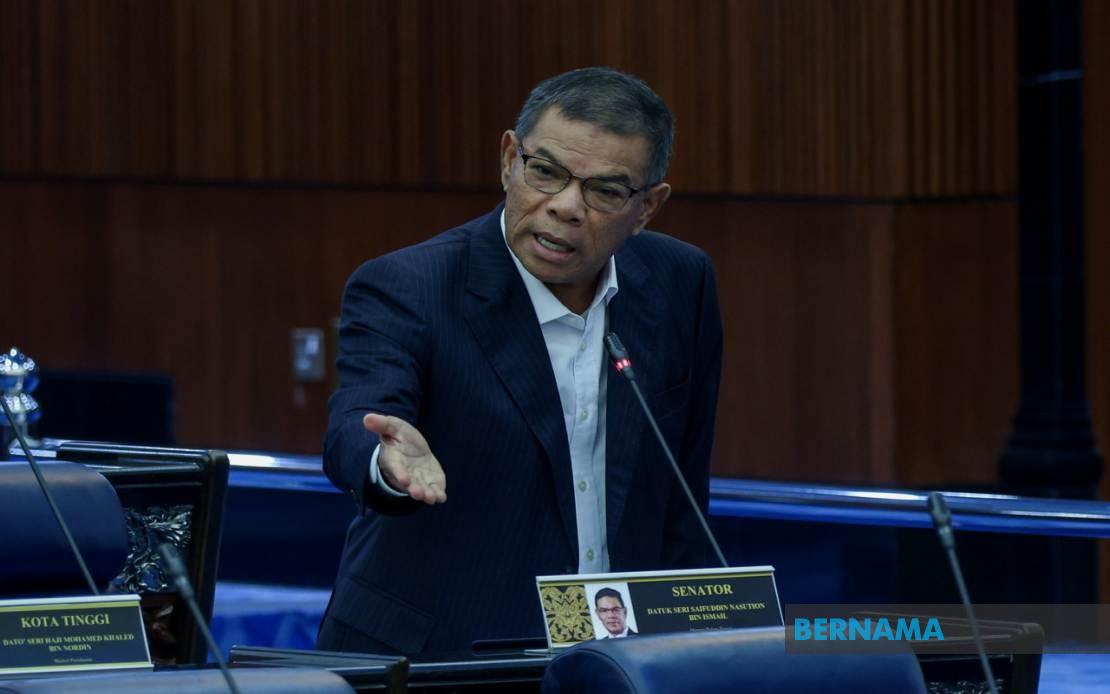
Prime Minister Datuk Seri Anwar Ibrahim has approved a RM22 million financial commitment to furnish the Border Control and Protection Agency (AKPS) with firearms and associated protective gear, according to Home Minister Datuk Seri Saifuddin Nasution Ismail. The funding decision emerged from an urgent reassessment of personnel safety protocols within the nascent agency, precipitated by a February incident in Bukit Kayu Hitam, Kedah, where armed individuals targeted a vehicle occupied by an AKPS senior commander. The approval represents a direct governmental response to operational vulnerabilities that threatened agency personnel working along Malaysia's international boundaries.
Saifuddin Nasution outlined the progression that led to the Prime Minister's swift approval, explaining that he had formally petitioned Datuk Seri Anwar Ibrahim to address critical equipment gaps within AKPS shortly after the Kedah incident. The minister characterised the RM22 million allocation as fulfilling essential operational needs, enabling AKPS to procure firearms and supplementary armaments calibrated to the distinct requirements of border security work. This intervention directly responds to longstanding concerns raised by field personnel about inadequate protective measures during active duty assignments along Malaysia's frontiers.
The funding allocation addresses specific vulnerabilities previously highlighted by opposition parliamentarians. Datuk Seri Takiyuddin Hassan had questioned the operational constraints facing AKPS officers who conducted border duties without fundamental safety provisions such as firearms or ballistic protection vests. Saifuddin Nasution acknowledged this vulnerability whilst clarifying that not all AKPS personnel possess the technical competency required for firearms deployment. Since AKPS incorporates staff drawn from approximately twenty distinct government agencies—including personnel from the Ministry of Health—only individuals with existing firearms training, particularly seconded police officers, would receive weapons authorisation.
Beyond immediate security provisions, the Home Minister emphasised how AKPS consolidation fundamentally restructures Malaysia's border control architecture. Historically, border management functions were fragmented across more than twenty separate government entities, creating procedural bottlenecks and administrative redundancies. This fragmentation inadvertently generated vulnerability points for corrupt conduct, as complex multi-agency approval chains created opacity and reduced accountability. By concentrating border functions within a unified AKPS framework, the government theoretically eliminates bureaucratic sequencing, enabling more streamlined decision-making and reducing circumstances where integrity breaches could occur.
Saifuddin Nasution presented AKPS's inaugural performance record as vindication for the consolidation approach. Throughout its first operational year, the agency claims significant seizures, including a major pharmaceutical trafficking interception valued at tens of millions of ringgit at Penang International Airport. The agency's detection of illegal e-waste smuggling operations at Malaysian ports—accomplished through coordinated efforts with complementary enforcement agencies—further demonstrated operational effectiveness. These accomplishments suggest that unified command structures, despite requiring substantial financial investment and organisational restructuring, generate tangible enforcement dividends.
Constitutional anxieties regarding AKPS establishment surfaced during parliamentary exchanges, particularly from Sabah-based representatives concerned about federal incursion upon state border functions. Datuk Seri Shafie Apdal raised questions about whether AKPS operations might contravene constitutional provisions or undermine Sabah and Sarawak's specific prerogatives under the Malaysia Agreement 1963 (MA63). Saifuddin Nasution provided reassurance that AKPS implementation maintains full constitutional compliance and preserves MA63 protections. The minister indicated that constitutional compatibility had undergone extensive discussion and received legislative confirmation before parliamentary passage of the enabling legislation, positioning contemporary debates as operational clarifications rather than fundamental policy disagreements.
The government's consolidation strategy draws legitimacy from established precedents within Malaysia's security architecture. Saifuddin Nasution referenced the Eastern Sabah Security Command (ESSCOM) and the Malaysian Maritime Enforcement Agency (MMEA) as institutional models demonstrating successful integration of multiple agencies into coordinated operational structures. Both entities functionally demonstrate that unified command arrangements addressing specialised security domains—maritime enforcement or geographically concentrated threats—can effectively coordinate resources from diverse contributing agencies whilst maintaining operational coherence. ESSCOM's track record managing complex security challenges across eastern Sabah provides particularly relevant regional parallels.
The RM22 million firearms programme situates within broader strategic objectives outlined for AKPS establishment. Government documentation identifies several foundational purposes: optimising the movement of authorised persons and cargo across borders, enhancing institutional integrity through consolidated command accountability, expanding government revenue through improved tariff and customs collection, and fortifying security posture at vulnerable international entry points. These objectives extend beyond immediate law enforcement considerations, encompassing economic and administrative dimensions that reflect government priorities for integrated border management.
Malaysia's security landscape increasingly demands integrated border governance given transnational criminal networks, trafficking operations, and asymmetric security threats traversing Southeast Asian territories. AKPS represents governmental acknowledgment that nineteenth-century fragmented approaches prove inadequate for twenty-first century border challenges. The RM22 million investment in personnel weaponisation reflects recognition that modern border operations require capable personnel equipped with contemporary security apparatus. Neighbouring jurisdictions have similarly consolidated border functions, suggesting regional acceptance that unified frameworks outperform dispersed arrangements.
Implementation timelines and procurement methodologies for the RM22 million allocation remain subjects for detailed specification by AKPS management and relevant Defence Ministry procurement authorities. The approval's significance extends beyond immediate budgetary approval, signalling consistent governmental commitment to AKPS consolidation despite legitimate constitutional and operational questions. This sustained political backing, reinforced through substantial financial commitments within the first operational year, indicates substantial government investment in making the border consolidation experiment succeed across Malaysia's diverse international boundaries and challenging operational environments.