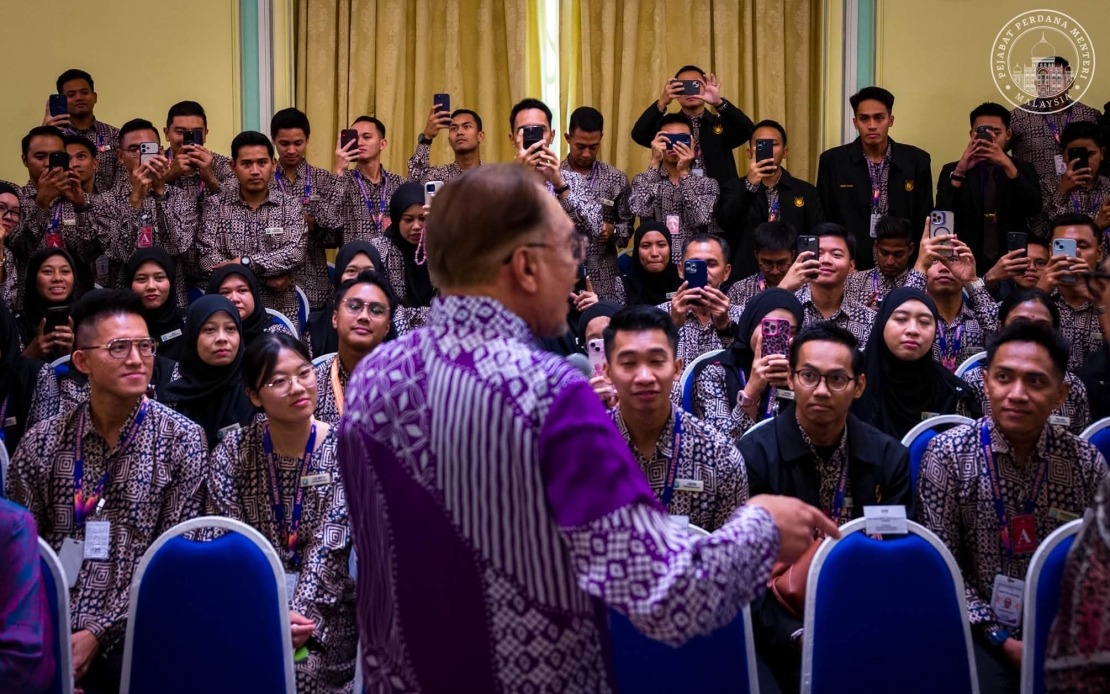
Prime Minister Datuk Seri Anwar Ibrahim has underscored the critical role that integrity, efficiency and adaptability must play in Malaysia's civil service, warning that the country's development trajectory depends fundamentally on how its public sector responds to contemporary challenges. Speaking during an engagement with Administrative and Diplomatic Service cadets pursuing advanced qualifications in public management at his Putrajaya office, Anwar articulated a vision of governance rooted in principled leadership and unwavering commitment to the public good.
The exchange with the PTD officer cohort undergoing the Postgraduate Diploma in Public Management programme reflected the Prime Minister's conviction that Malaysia's next generation of senior civil servants requires more than technical competence. Through his remarks, Anwar signalled that tomorrow's administrators must cultivate moral courage alongside professional expertise, recognising that governance failures often stem from compromised ethical standards rather than a lack of institutional capacity.
Central to the PM's message was the notion that public service transcends bureaucratic procedure. Instead, it demands a fundamental reorientation of priorities whereby individual advancement, departmental convenience or political expediency are subordinated to genuine service in the national interest. This framing carries particular weight given Malaysia's recent political history, during which governance lapses and institutional erosion prompted sustained public scrutiny of the civil service's independence and ethical standards.
The emphasis on embracing change represents a pointed acknowledgment that Malaysia's administrative machinery faces mounting pressures from economic disruption, technological transformation and evolving citizen expectations. Rather than defending entrenched practices or institutional inertia, Anwar's exhortation suggests that effective governance requires proactive adaptation—an appetite for reform that permeates the service culture itself. For emerging PTD officers, this implies that career advancement will increasingly reward those who drive modernisation rather than merely executing inherited procedures.
The invocation of "good governance" as a foundational principle speaks directly to international frameworks and domestic accountability mechanisms that now define civil service performance standards. Excellence in Malaysia's public administration can no longer rest solely on hierarchical obedience or procedural compliance. Instead, it must encompass transparency, responsiveness to stakeholder concerns and demonstrable results in service delivery—benchmarks that demand institutional cultures capable of continuous self-examination and improvement.
From a regional perspective, Anwar's address signals Malaysia's commitment to building a civil service aligned with standards expected in upper-middle-income economies. Southeast Asian nations increasingly compete for talent, investment and international credibility partly through the perceived quality and integrity of their state institutions. Civil services that command public confidence and demonstrate ethical consistency project economic stability and predictability to external observers, factors that influence foreign direct investment decisions and international partnerships.
The timing of this engagement with PTD cadets carries symbolic import. These officers represent the frontline of Malaysia's administrative future, occupying positions that shape policy implementation, resource allocation and citizen-state interactions across federal and state structures. By directly addressing this cohort, the Prime Minister sought to imprint his governance philosophy onto the professional identities of individuals who will occupy influential positions throughout their careers.
The message also implicitly critiques any lingering administrative cultures that prioritise self-preservation, factional loyalty or political accommodation over institutional mission. Malaysia's civil service has faced recurring challenges in maintaining professional autonomy and merit-based advancement, with patronage networks and political interference occasionally compromising personnel decisions and policy priorities. Anwar's emphasis on principled leadership and unwavering commitment to national interests thus functions as a corrective injunction against these corrosive practices.
For Malaysia's broader reform agenda, the civil service represents a crucial lever through which policy aspirations translate into tangible outcomes. Without a public sector committed to integrity and capable of adapting to new operational environments, even well-designed initiatives founder in implementation. The PM's appeal to emerging officers to embrace this dual mandate—upholding established ethical standards while simultaneously driving institutional evolution—reflects recognition that stability and reform need not represent opposing imperatives.
The convergence of integrity and change-readiness that Anwar articulated reflects sophisticated understanding of governance challenges facing developing economies. Institutional trust erodes when citizens perceive that rules apply unevenly or that officials prioritise private interests over public mission. Simultaneously, rigid institutions incapable of adaptation become irrelevant, unable to deliver services that populations expect or respond effectively to economic and social transitions. The Prime Minister's address thus positioned integrity and adaptability not as separate virtues but as complementary dimensions of effective public stewardship.
Moving forward, how Malaysia's civil service responds to this leadership message will influence the country's capacity to achieve developmental objectives outlined in national transformation blueprints. The PTD cadets receiving these remarks represent individuals capable of shaping administrative practices across multiple government domains. Their embrace of the principles articulated by the Prime Minister—integrity, efficiency, adaptive capacity and public-centredness—will determine whether Malaysia's public sector emerges as an institutional asset supporting national progress or remains constrained by the practices and mentalities of previous decades.

