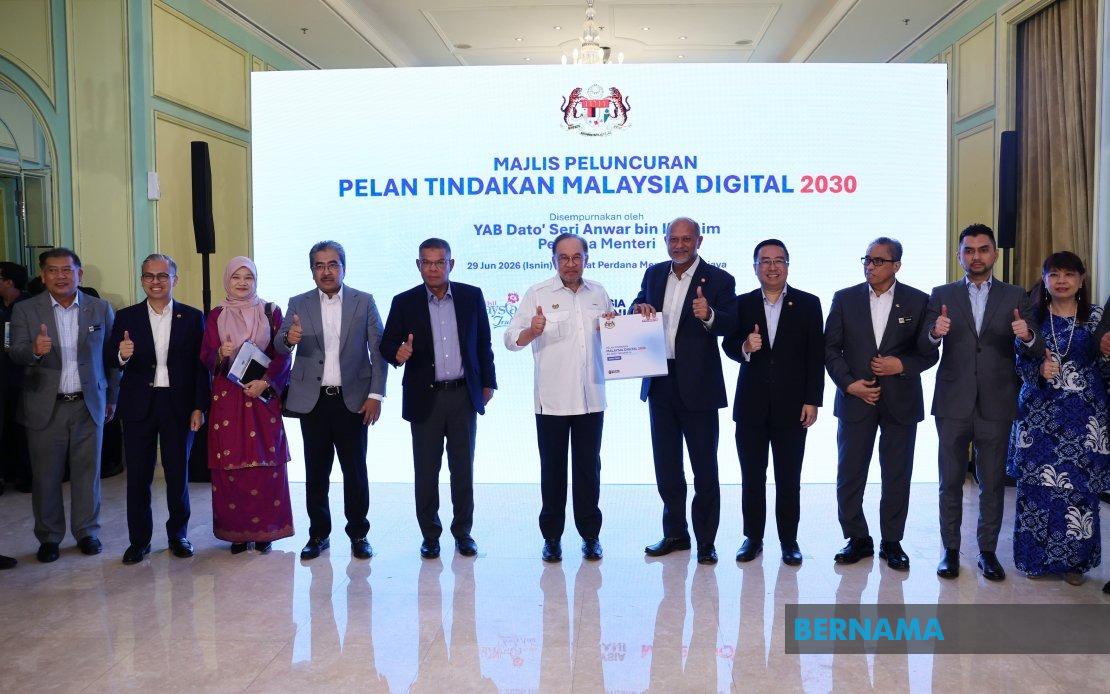
Prime Minister Datuk Seri Anwar Ibrahim formally unveiled Malaysia Digital 2030 (MD2030) in Putrajaya on June 29, marking a decisive pivot in the nation's digital trajectory. The action plan, which will govern the country's technology and innovation landscape from 2026 through 2030, represents a fundamental repositioning of Malaysia's role in the global digital economy. Rather than continuing as a consumer of imported technology solutions, the blueprint commits the nation to developing and exporting homegrown digital innovations, establishing Malaysia as a respected creator rather than merely an adopter of cutting-edge technologies.
The comprehensive strategy encompasses seven interconnected pillars, each directed by a senior cabinet minister to ensure coordinated implementation across government. Spanning government modernisation, economic transformation, infrastructure development, workforce preparation, social inclusion, cybersecurity and data governance, and technological innovation, the framework reflects an ambitious whole-of-government commitment. Chief Secretary to the Government Tan Sri Shamsul Azri Abu Bakar will oversee the Government pillar, while Investment, Trade and Industry Minister Datuk Seri Johari Abdul Ghani leads the Economy pillar, Digital Minister Gobind Singh Deo anchors Trust and Security, and Science, Technology and Innovation Minister Datuk Chang Lih Kang directs the Innovation pillar. This ministerial-level steering ensures MD2030 transcends typical policy documents to become integrated into daily governmental operations.
The economic ambitions embedded within MD2030 are deliberately expansive. Officials have set a target to elevate the digital economy's contribution to gross domestic product to 30 per cent by 2030, a significant uplift from current levels that would fundamentally reshape Malaysia's economic structure. Simultaneously, the government aims to generate 500,000 high-value digital sector jobs, addressing both unemployment concerns and the need for skills-matched career opportunities for Malaysia's increasingly educated workforce. The plan also envisions extracting RM4.5 billion in operational efficiencies through government digitalisation, demonstrating that the transformation is expected to yield tangible fiscal benefits. Furthermore, the target of delivering 95 per cent of government services through fully integrated online platforms would place Malaysia among the world's most digitally advanced public administrations, potentially enhancing citizen satisfaction and administrative efficiency.
The Economy pillar specifically targets Malaysia's transition into a regional hub for digital innovation and commerce. By promoting "Made by Malaysia" products and intellectual property, the strategy seeks to reverse decades of technological dependency. The approach includes accelerating adoption of advanced technologies within Malaysia's High Growth High Value sectors—such as semiconductors, renewable energy, and advanced manufacturing—where the nation already possesses competitive advantages. The pillar also emphasises data and digital assets as sources of competitive advantage, recognising that information itself has become an economic commodity in the modern digital era. This framing positions data governance not merely as a regulatory concern but as a strategic economic asset requiring careful stewardship.
Infrastructure development constitutes a critical foundation for achieving these ambitions. The Infrastructure pillar prioritises delivering high-quality internet connectivity throughout the nation, addressing the persistent digital divide between urban centres and rural areas that has historically constrained inclusive economic participation. Beyond connectivity, the framework calls for developing data centres, cloud computing facilities, and smart city infrastructure. This physical and digital infrastructure base will enable both government services and private sector innovation to flourish. For Malaysia, a regionally significant economy with aspirations to lead Southeast Asian technology development, such infrastructure investments become essential prerequisites rather than optional enhancements.
The Talent pillar directly addresses workforce readiness, recognising that technological transformation requires human capacity. The framework establishes a comprehensive talent policy designed to prepare Malaysia's workforce for digital economy employment. Rather than relying exclusively on foreign expertise, the strategy emphasises transitioning existing workers into digital roles through agile retraining initiatives while simultaneously building Malaysia's reputation as a regional and global digital talent destination. This dual approach acknowledges both immediate workforce needs and longer-term ambitions to retain highly skilled professionals within Malaysia rather than experiencing continued brain drain to more established technology hubs.
Social inclusion features prominently within MD2030, reflecting commitment to ensuring digital transformation delivers benefits across Malaysian society rather than concentrating advantages among urban, educated populations. The Society pillar institutionalises the Malaysian Digital Inclusion Index, establishing metrics to measure equitable access to digital services. The strategy explicitly targets rural community empowerment, recognising that geographic disadvantage has historically translated into economic disadvantage. By rolling out socially impactful digital solutions tailored to community needs, the framework attempts to position digitalisation not solely as economic modernisation but as a tool for addressing regional inequality.
The Trust and Security pillar tackles concerns that have constrained digital adoption among Malaysian citizens and businesses. Acknowledging that unchecked data collection and cybersecurity vulnerabilities undermine public confidence in digital systems, the framework calls for operationalising the National Data Commission and developing a comprehensive National Digital Trust and Data Security Strategy spanning 2026 through 2030. This pillar recognises a tension that digital leaders must navigate: enabling innovation and efficiency gains while simultaneously protecting citizen privacy and maintaining secure systems. For Malaysia, where concerns about data governance and surveillance have gained prominence in public discourse, this explicit focus on trust and security may prove essential to maintaining public support for the broader transformation agenda.
The Innovation pillar attempts to catalyse domestic technology creation by establishing a robust Research, Development, Commercialisation, Innovation and Economy (RDCIE) ecosystem. Rather than limiting innovation to academic research, the framework emphasises pathways from university laboratories through commercialisation to market deployment. This pipeline approach recognises that technological breakthroughs require not merely scientific discovery but also business acumen, investment capital, and market understanding to translate research into products and services. Malaysia's position as a middle-income nation with established research institutions but limited global venture capital ecosystem makes this ecosystem development particularly critical.
Implementation will involve coordination among multiple agencies already operating within Malaysia's digital governance structure. The National AI Office, GovTech Malaysia, the Malaysia Digital Economy Corporation, CyberSecurity Malaysia, MyDIGITAL Corporation, and the Malaysia Centre for the Fourth Industrial Revolution will collectively drive execution. This institutional framework reflects recognition that technology transformation requires sustained bureaucratic capacity and dedicated funding rather than sporadic initiatives. Digital Minister Gobind Singh Deo, addressing the launch, emphasised that the Digital Ministry would ensure coordinated implementation across all participating agencies, positioning the ministry as conductor of a complex governmental orchestra rather than operating in isolation.
For Malaysia's regional position, MD2030 carries significance extending beyond national borders. As Southeast Asia's most industrialised economy after Indonesia, Malaysia's success in transitioning from technology consumer to innovation producer could influence how other regional nations approach similar transitions. Conversely, failure to execute the ambitious targets would underscore the difficulty of shifting established economic models. The plan's emphasis on positioning Malaysia as a regional digital champion reflects awareness that the government cannot isolate Malaysia from global technological currents; instead, the strategy attempts to position Malaysia within favourable positions in regional technology hierarchies.
The MADANI government's commitment to ensuring "inclusive and equitable transformation" suggests recognition that digital progress divorced from social benefit generates backlash. By explicitly embedding equity considerations within MD2030's structure rather than treating them as afterthoughts, the framework attempts to construct legitimacy across Malaysian society. However, success will ultimately depend on execution quality, adequate resource allocation, and sustained political commitment across electoral cycles. The comprehensive nature of MD2030 suggests serious governmental intent, yet the gap between ambitious strategy documents and implementation reality has historically constrained Malaysian policy outcomes.

