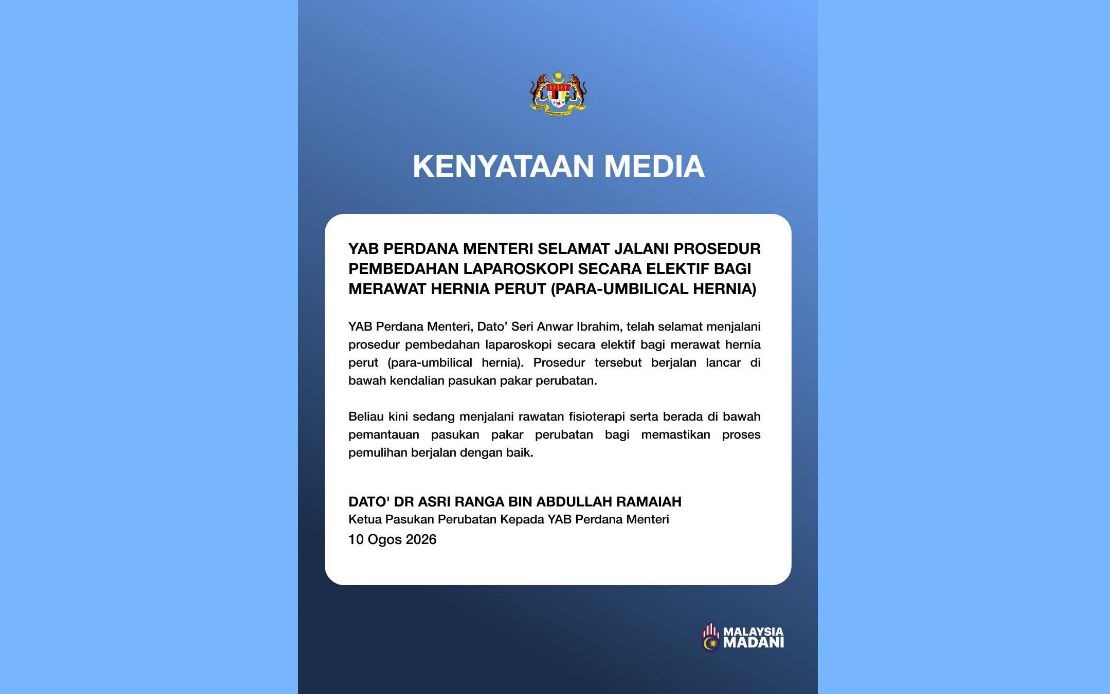
Prime Minister Datuk Seri Anwar Ibrahim has completed an elective laparoscopic surgical procedure to address a para-umbilical hernia, with his medical team confirming the operation proceeded without complications on August 10. The minimally invasive approach, overseen by a specialist surgical team, represents a straightforward intervention for a common abdominal condition that affects the tissue around the navel area.
The head of the Prime Minister's Medical Team, Datuk Dr Asri Ranga Abdullah Ramaiah, indicated through an official statement that the surgical intervention met all clinical expectations. The controlled nature of elective procedures—where timing is planned in advance rather than emergency—typically carries lower risk profiles and allows for comprehensive pre-operative preparation. This scheduled approach underscores the importance of addressing health concerns proactively rather than allowing conditions to deteriorate.
In the immediate aftermath of surgery, Anwar is receiving structured physiotherapy to support his physical recovery and restore normal function. The multi-disciplinary medical team continues providing close observation during this critical post-operative window, during which the body undergoes the initial healing process. Dr Asri's emphasis on ongoing monitoring reflects best medical practice, ensuring any complications are detected early and managed appropriately.
The Prime Minister's senior press secretary Tunku Nashrul Abaidah communicated that Anwar would remain under hospital observation for approximately two days following the procedure. This timeframe aligns with standard protocols for laparoscopic abdominal surgery, which typically involves minimal tissue trauma due to the use of small incisions and specialised instruments. The shorter recovery period compared to traditional open surgery means Anwar is expected to return to his official responsibilities within a reasonable timeframe.
Public statements from the Prime Minister's office sought prayers and well-wishes from Malaysians as Anwar progresses through recovery. Such appeals reflect both cultural sensibilities in Malaysia and the genuine role that public support and positive sentiment can play in boosting morale during health challenges. The transparency of the official announcement demonstrates confidence in the medical outcome and maintains public trust through clear communication.
Para-umbilical hernias occur when abdominal tissue protrudes through weakened muscle layers surrounding the navel, creating a noticeable bulge that can cause discomfort or become aesthetically concerning. While many such hernias remain asymptomatic, surgical intervention becomes advisable when complications arise or the condition affects quality of life. The laparoscopic approach chosen for Anwar's treatment involves inserting a small camera and instruments through tiny incisions, allowing the surgeon to visualise and repair the hernia with precision while minimising post-operative pain and scarring.
For Southeast Asian leaders and political figures, maintaining public confidence in their health and capacity to govern remains strategically significant. Anwar's decision to undergo an elective procedure rather than postpone treatment demonstrates a commitment to addressing health concerns systematically. This proactive stance can actually reinforce public confidence in a leader's judgement and responsibility—qualities essential for political legitimacy and effective governance.
The timing of Anwar's surgical intervention occurs within Malaysia's broader political context, where the Prime Minister's availability and functioning capacity remain subjects of public interest. His Medical Team's detailed communication serves to manage expectations and prevent speculation or misinformation about his condition or recovery timeline. In an era of rapid information spread through social media, official medical bulletins provide authoritative guidance that helps counter rumours.
Anwar's medical situation also highlights the quality of healthcare available to Malaysian leaders at premier institutions within the country. The involvement of multiple medical specialists and access to advanced minimally invasive surgical techniques reflects Malaysia's status as a regional healthcare hub. This capability extends beyond government officials to private and public sector patients, positioning Malaysian medical facilities as competitive alternatives to overseas treatment options.
The broader implications of Anwar's recovery extend to questions of succession planning and governmental continuity. While the hernia surgery is a routine procedure with excellent outcomes, any temporary incapacity of a sitting Prime Minister prompts consideration of constitutional mechanisms and deputy leadership arrangements. Malaysia's political and administrative systems have established protocols to manage such periods, ensuring no disruption to governance or decision-making capacity.
As Anwar progresses through physiotherapy and completes his observation period, observers will assess whether the recovery proceeds without complications and whether the expected return to full duties occurs on the anticipated timeline. The success of elective surgical procedures typically depends on post-operative compliance with medical guidance—including activity restrictions, wound care, and gradual return to normal function. The Prime Minister's Medical Team's continued supervision suggests careful attention to these rehabilitation elements.
The incident underscores universal truths about health and leadership: no public figure remains immune to the common medical challenges affecting the broader population, and transparency about health matters ultimately serves leaders better than attempted concealment. Anwar's situation provides a reminder that even those occupying Malaysia's highest offices navigate the same healthcare landscape as ordinary citizens, albeit typically with access to premium medical resources and specialist expertise. His recovery trajectory will be closely followed both domestically and regionally as observers track his return to full official capacity.

