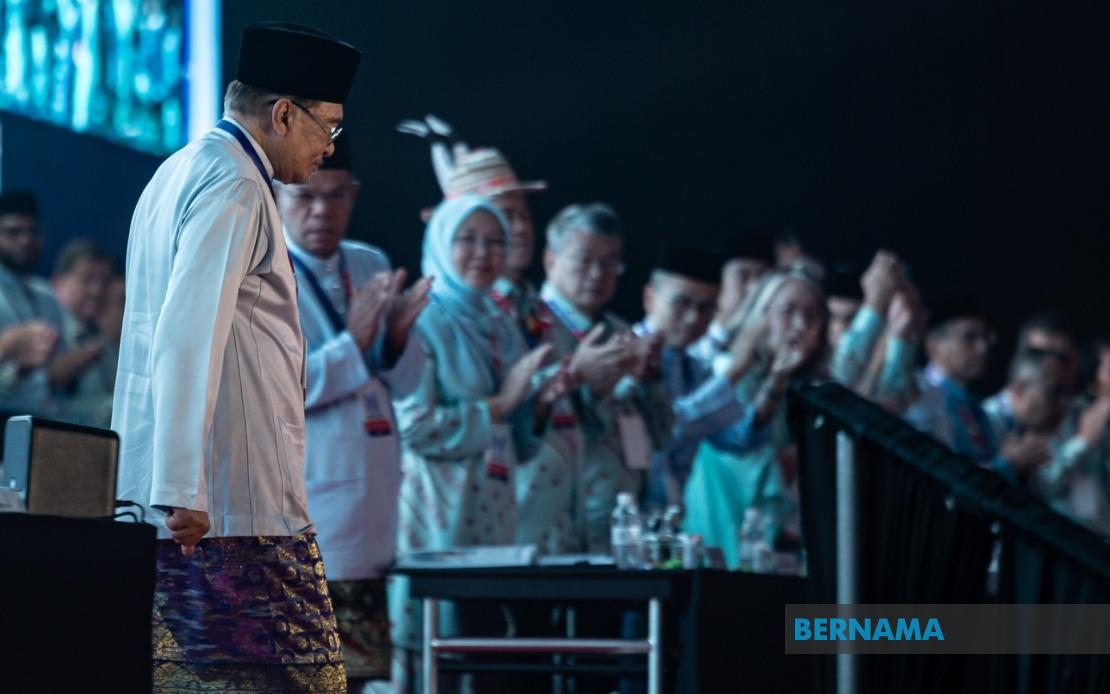
Prime Minister Datuk Seri Anwar Ibrahim has pushed back against allegations that his administration is leaving certain states behind, declaring instead that federal expenditure has grown meaningfully across all regions under the MADANI Government's tenure. Speaking at the 2026 PKR National Congress in Melaka on August 15, Anwar laid out a detailed case showing how budgetary allocations to states have risen substantially since the government took office, countering what he characterised as unfounded complaints from various quarters about uneven resource distribution.
The Prime Minister singled out Sabah as a key example, noting that federal expenditure allocated to the state has grown by 35 per cent over the past three years. This represents a jump from RM13 billion in 2022 to RM17.6 billion in 2026, demonstrating what Anwar framed as a tangible commitment to the state's development. He also posed a rhetorical challenge to previous administrations, questioning why such allocation disparities had not been raised as concerns during their governance, suggesting that the MADANI Government's approach represents an improvement on prior practice.
Sarawak has similarly benefited from expanded federal coffers, with its allocation climbing from RM10.2 billion in 2022 to RM15.1 billion, representing a 48 per cent increase. This growth rate exceeds that of several other states, underscoring Anwar's assertion that East Malaysian states have not been deprioritised despite occasional political tensions. For Kedah and Kelantan, both states where opposition parties hold sway, Anwar emphasised that allocations have nonetheless increased overall, suggesting that budget decisions are driven by developmental need rather than partisan considerations.
The Prime Minister also highlighted improvements to Terengganu's budget envelope, which expanded from RM6 billion in 2022 to RM8.1 billion in the current financial year. This 35 per cent growth mirrors Sabah's trajectory and signals a concerted effort to boost resources flowing to states traditionally perceived as lagging in federal support. Similarly, Johor's allocation jumped from RM10.2 billion in 2022 to RM14.6 billion projected for 2026, a substantial boost reflecting the state's economic significance and development ambitions.
Perlis also received mention in Anwar's itemisation of improvements, grouped alongside other states benefiting from rising federal contributions. The cumulative picture Anwar painted was of a government consciously raising the baseline for all states rather than picking winners and losers along political or geographic lines. This narrative carries weight in Malaysian federalism debates, where state governments frequently complain about resource constraints and demand larger federal transfers.
Anwar's framing of allocations as responsive to "priorities" rather than uniform raises important questions about how the government determines which states receive larger increases. The Prime Minister's language suggests that budgets are calibrated to address specific developmental challenges or capitalise on economic opportunities within each state. This approach contrasts with a simple formula-based redistribution model and implies that central government maintains discretion over capital deployment based on assessments of state-level needs and potentials.
The speech delivered at the Melaka International Trade Centre during the ruling PKR's national congress provided Anwar with a controlled platform to address the allocation question directly. The venue and occasion underscored the political dimensions of this debate, with the ruling coalition defending its stewardship of public finances ahead of potential future electoral contests. Opposition parties and certain state governments have occasionally alleged that federal resources flow preferentially to ruling coalition-controlled states, making Anwar's detailed rebuttal strategically significant.
For Malaysian federalism and regional development policy, Anwar's emphasis on rising overall allocations across states reflects a broader philosophy of expanding the fiscal pie rather than redistributing existing resources. This approach relies on sustained economic growth and tax revenue increases to fund higher state-level budgets without necessitating zero-sum compromises between regions. However, the sustainability of such growth-oriented budgeting depends on economic performance and may face constraints during slower growth periods.
The Prime Minister's arguments address a persistent tension in Malaysian governance: balancing the fiscal autonomy and development aspirations of state governments with federal coordination and resource management. By documenting concrete budget increases for a range of states, Anwar sought to establish that his government takes seriously the principle of equitable development across the federation. Whether such increases are sufficient to meet states' expectations and development goals remains a matter of ongoing political debate.
The allocation figures cited reflect nominal increases that, when adjusted for inflation and population growth, may represent more modest real per capita improvements in some cases. State governments and analysts scrutinising these figures will likely evaluate whether the increases genuinely address infrastructure deficits, economic disparities, or other developmental challenges within specific regions. The MADANI Government's allocation strategy will ultimately be judged not merely on percentage increases but on tangible outcomes in service delivery, infrastructure development, and economic performance across states.
Anwar's willingness to engage directly with sidelining claims and provide specific budgetary evidence suggests the government considers this a significant political concern requiring explicit rebuttal. The detailed response, naming multiple states and citing precise allocation figures from 2022 through 2026, indicates that perceptions of unequal resource distribution retain political salience in Malaysian federal politics. How effectively such arguments persuade state governments and their constituents will influence the broader political narrative around federal-state relations during the remainder of the MADANI Government's tenure.

