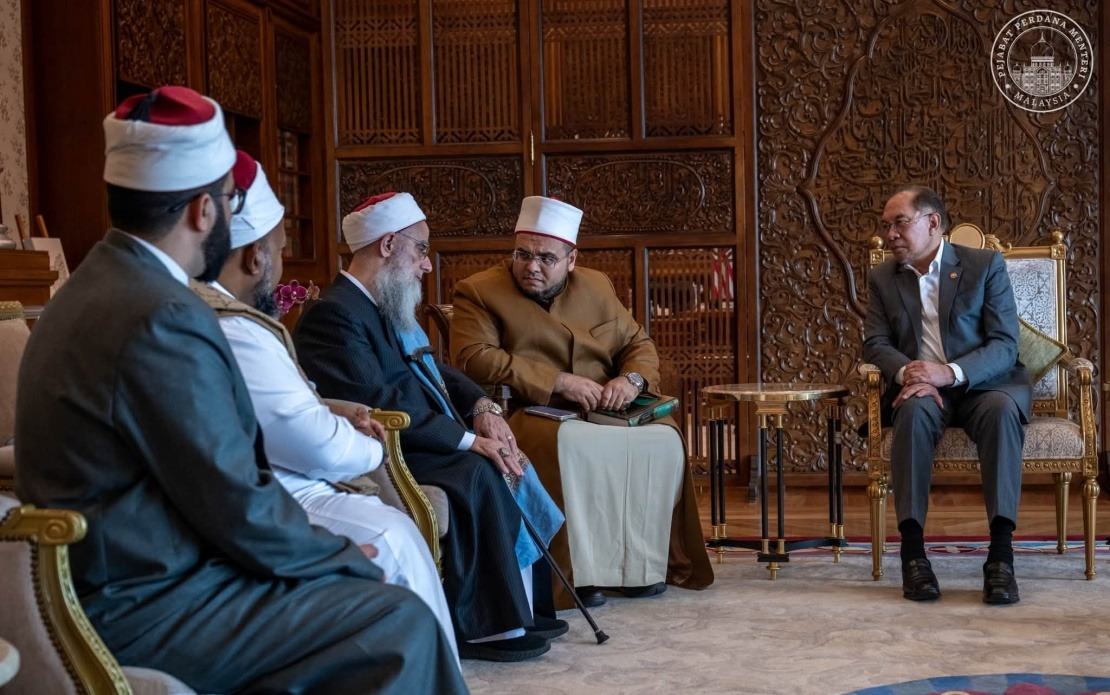
Prime Minister Datuk Seri Anwar Ibrahim received a courtesy visit from Sheikh Dr Mustafa An-Nadwi Al-Hasani, a distinguished Egyptian Islamic scholar from Mansurah, at his Putrajaya office this week. The encounter underscores Malaysia's continued engagement with prominent Islamic intellectuals and reflects the government's commitment to fostering dialogue on moral and intellectual advancement across the Muslim world.
In remarks shared on social media, Anwar characterised Sheikh Dr Mustafa as a leading authority whose scholarly work emphasises ethical grounding, intellectual depth, and rigorous study of hadith—the recorded sayings and practices of the Prophet Muhammad. The prime minister's emphasis on these particular qualities suggests deliberate alignment with a vision of Islam that values careful scholarship and principled reasoning, attributes increasingly important in countering simplistic or politicised interpretations of religious teaching.
Sheikh Dr Mustafa's lineage in Islamic learning carries significant weight within scholarly circles. He is counted among the prominent students of Sheikh Abul Hasan Ali al-Nadwi, a twentieth-century Islamic thinker whose influence extended across the Arab world and beyond. This intellectual pedigree positions him as a custodian of a particular tradition emphasising the compatibility of Islamic values with contemporary ethical concerns, a message that resonates with Malaysia's positioning as a moderate Muslim-majority nation navigating globalisation and social change.
Anwar's public commentary on the visit carried a broader philosophical dimension. He drew attention to what he characterised as a cultural tension in modern times, where sensationalism frequently eclipses genuine learning and knowledge production. By contrasting this trend with the quiet, nourishing quality of authentic wisdom—described through the metaphor of morning dew—the prime minister articulated a vision of intellectual and spiritual development that prioritises substance over spectacle, a theme particularly relevant to contemporary Malaysian discourse amid the proliferation of social media and rapid information flows.
The visit afforded both parties an opportunity to exchange perspectives on contemporary global and regional issues. Such high-level dialogues between Malaysian leadership and internationally respected Islamic figures serve multiple purposes: they strengthen Malaysia's soft power within Islamic intellectual circles, provide the government access to diverse perspectives on transnational Muslim concerns, and signal to Malaysia's domestic Muslim audience the government's engagement with serious scholarship rather than sectarian controversies.
Sheikh Dr Mustafa's presence in Malaysia as part of a broader lecture and engagement programme demonstrates ongoing interest among influential Arab Islamic scholars in the Malaysian context. The country's particular approach to Islam—characterised by constitutional secularism combined with recognition of Islam's role in public life—and its successful management of religious and ethnic diversity continue to attract attention from international Islamic intellectuals seeking practical models of coexistence and moderation.
Anwar's specific mention of discussing knowledge sessions being conducted during the scholar's Malaysian sojourn indicates substantive intellectual programming beyond ceremonial courtesy visits. Such sessions likely engage local religious scholars, students, and interested members of the public, facilitating knowledge transfer and cross-cultural learning. For Malaysian audiences, exposure to international Islamic thought traditions helps situate local religious discourse within broader scholarly conversations and counterbalances parochial approaches to Islamic learning.
The prime minister's expression of gratitude for Sheikh Dr Mustafa's prayers and counsel regarding Malaysia's unity and prosperity reflects how spiritual and intellectual dimensions intersect in diplomatic engagement. Anwar's public acknowledgement of receiving the scholar's counsel on national matters elevates the conversation beyond courtesy, suggesting substantive consultation on issues affecting the nation's trajectory and collective well-being.
The timing and visibility of such engagements carry particular significance for Malaysia's positioning in regional and global Islamic discourse. As the country navigates complex questions surrounding Islamic education, the role of religious institutions, and the integration of Islamic values within secular constitutional frameworks, regular engagement with internationally respected Islamic scholars provides intellectual resources and validates Malaysia's approach through association with serious, thoughtful scholarship rather than reactive or populist interpretations of Islam.
Furthermore, visits from prominent Arab Islamic figures strengthen Malaysia's cultural and intellectual ties with the Arab world, particularly Egypt, which remains a major centre of Islamic learning and religious influence. Such connections help Malaysia maintain relevance within broader Muslim intellectual networks and create opportunities for collaboration on areas of mutual concern, from Islamic finance and education to interfaith dialogue and the development of moderate Islamic thought.
Anwar's public framing of the encounter as an occasion for mutual exchange rather than one-way instruction reflects a confident, secure approach to religious diplomacy. Rather than projecting defensiveness or seeking validation, the government presents itself as a serious conversation partner capable of engaging with international Islamic thought while maintaining its own distinctive path. This confidence appeals to constituencies seeking evidence that Islam and modern governance can coexist constructively.
The visit ultimately illustrates Malaysia's sustained commitment to cultivating relationships with international Islamic scholars and institutions, treating such engagement as integral to national development and regional influence. By publicly welcoming and facilitating such interactions, the government signals to both domestic and international audiences that serious Islamic learning, intellectual exchange, and spiritual reflection remain central to the nation's identity and aspirations.

