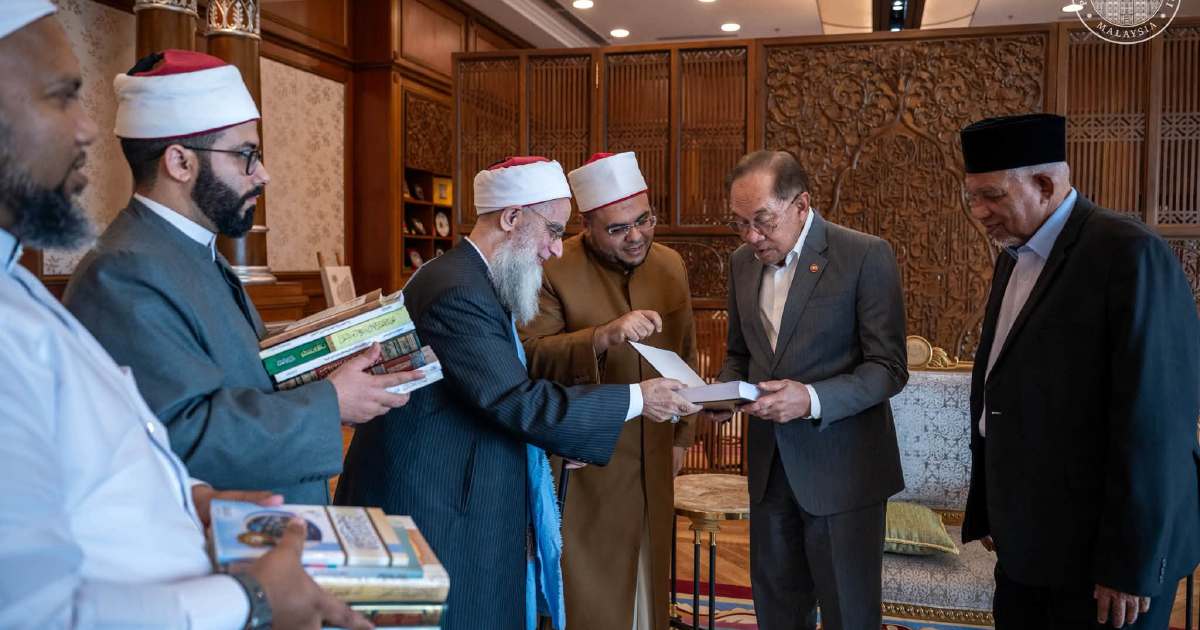
Prime Minister Datuk Seri Anwar Ibrahim has welcomed renowned Egyptian Islamic scholar Sheikh Dr Mustafa An-Nadwi Al-Hasani Mansurah during an official visit to his office in Putrajaya. The reception underscores Malaysia's continued commitment to fostering intellectual and religious dialogue with leading figures in Islamic scholarship across the Muslim world.
Sheikh Dr Mustafa An-Nadwi represents a significant voice within contemporary Islamic academia, bringing decades of scholarly expertise to discussions on Islamic jurisprudence, theology, and contemporary religious thought. His prominence in Egyptian academic circles and beyond reflects the growing importance of engaging with intellectuals who shape discourse on Islamic principles and their application in modern societies.
The meeting between Malaysia's premier and the distinguished Egyptian scholar carries particular significance given the regional context of Southeast Asian Islam. Malaysia, as a Muslim-majority nation with a sophisticated Islamic institutional framework, has positioned itself as a bridge between Middle Eastern Islamic scholarship and Southeast Asian religious interpretation. Such high-level engagements demonstrate how Kuala Lumpur continues to cultivate relationships with influential Islamic scholars who contribute to global conversations on faith, governance, and social development.
Egypt's intellectual traditions have long influenced Islamic thought across multiple continents, and scholars of Dr Mustafa An-Nadwi's standing typically engage with questions spanning contemporary Islamic ethics, educational philosophy, and the intersection of tradition with modernity. These discussions become increasingly relevant as Muslim-majority nations navigate challenges related to religious education, interfaith relations, and the role of Islamic principles in plural societies.
For Malaysia specifically, such exchanges offer opportunities to explore shared perspectives on Islamic governance and social frameworks. The country has developed distinctive models for managing religious pluralism while maintaining Islamic institutional prominence, areas where external scholarly perspectives often provide valuable comparative insights. The reception at Putrajaya suggests the government views these intellectual engagements as substantive diplomatic and cultural endeavours rather than ceremonial formalities.
The visit also reflects broader patterns of Malaysian engagement with the Islamic world during Anwar Ibrahim's tenure as Prime Minister. His administration has emphasised strengthening ties with influential voices across Muslim-majority regions, recognising that contemporary challenges—from economic development to social cohesion—benefit from diverse scholarly perspectives grounded in Islamic principles and traditions.
Sheikh Dr Mustafa An-Nadwi's scholarship typically addresses how classical Islamic learning can inform contemporary policy discussions and social frameworks. His work spans jurisprudential analysis, Islamic educational methodology, and the philosophical foundations underlying Islamic social ethics. These areas align with priorities that Malaysian policymakers have identified as central to the nation's development trajectory, particularly regarding the balance between modernisation and preserving religious values.
The timing of such visits also carries diplomatic weight within the broader Middle Eastern context. Egypt remains a pivotal country within the Arab world and Islamic civilisation, and engagement with its leading intellectual figures signals Malaysian interest in maintaining constructive relationships with key regional players. This is particularly relevant given ongoing developments across the Middle East and the importance of voices that advocate for thoughtful, principled approaches to contemporary religious and social questions.
Beyond the ceremonial aspects, meetings between national leaders and prominent scholars create informal channels for discussing substantive issues affecting Muslim communities. Such exchanges frequently generate insights that inform policy discussions on education, interfaith dialogue, and the intellectual development of the next generation of religious leaders and thinkers. For a country like Malaysia with significant investments in Islamic education and institutional development, exposure to diverse scholarly perspectives helps refine approaches to these critical areas.
The reception of Sheikh Dr Mustafa An-Nadwi also reflects Malaysia's self-perception as a nation capable of hosting and engaging with global Islamic intellectual leadership. This positioning has become increasingly important as countries across Southeast Asia compete for influence in shaping regional Islamic discourse and institutional development. By welcoming such distinguished visitors and facilitating high-level dialogue, Malaysia reinforces its role as a platform for serious Islamic scholarly engagement.
Looking forward, such visits typically generate follow-up engagements involving Malaysia's Islamic institutions, universities, and think tanks. The presence of international scholars often catalyses academic collaboration, lecture programmes, and research initiatives that enrich local intellectual environments. These practical outcomes extend the impact of official state visits beyond diplomatic protocol into substantive educational and cultural domains.
The meeting represents Malaysia's ongoing effort to position itself as both a stable Muslim-majority democracy and an active participant in global Islamic intellectual discourse. As regional geopolitical dynamics continue evolving, maintaining such high-level exchanges with respected international scholars helps the country navigate complex questions about Islamic governance, social development, and Malaysia's broader role within the Muslim world and Southeast Asia.

