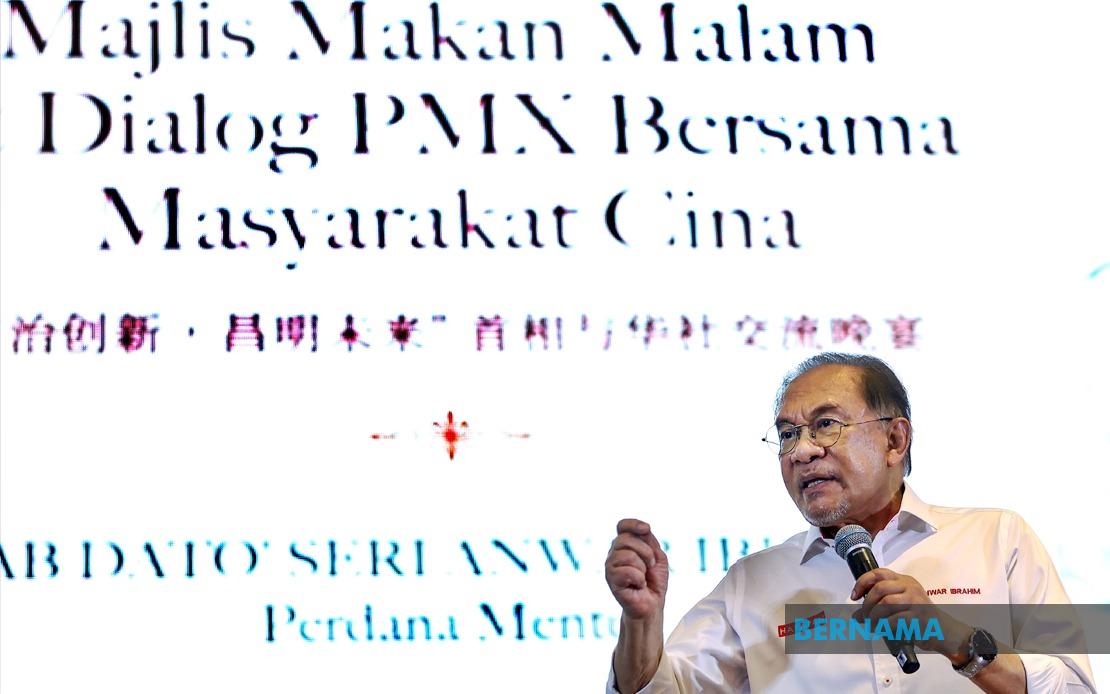
Prime Minister Datuk Seri Anwar Ibrahim has reiterated his determination to guide Malaysia towards becoming a thriving and prosperous nation during an engagement with the Chinese community in Johor Bahru this week. The statement reflects the Prime Minister's continued emphasis on nation-building and his personal commitment to maintaining high standards of governance during his tenure.
During his remarks at a community dinner, Anwar articulated a vision centred on representation and mutual respect across Malaysia's diverse population. His comments underscore a governing philosophy that prioritizes dialogue with different ethnic and cultural groups, recognising that national progress depends on the participation and wellbeing of all citizens. This inclusive approach stands as a counterpoint to more divisive political narratives that have periodically emerged in Malaysian public discourse.
At this stage of his political career, Anwar indicated that his focus has shifted towards ensuring a meaningful legacy rather than pursuing additional personal ambitions. The emphasis on legacy-building is significant for a leader who has navigated considerable political upheaval throughout his career, including periods of incarceration and political rehabilitation. His articulation of values—fairness, cleanliness, and dedicated service—represents a deliberate framing of what he wishes to be remembered for by future generations of Malaysians.
The Prime Minister's assertion that every citizen deserves equal attention from their elected representatives touches on a fundamental principle of democratic governance. By stating that his role requires serving the entire population regardless of demographic factors, Anwar positioned himself as accountable to Malaysians across all communities. This universal approach to leadership carries particular weight in a multicultural democracy where concerns about equitable resource distribution and fair treatment frequently surface in political discourse.
Anwar's personal reflection on aging and eventual retirement adds an emotional dimension to his political messaging. By contemplating his legacy while still in office, he invited citizens to consider the trajectory of his leadership and his contributions to national development. This introspective approach differs from purely performance-based political rhetoric and appeals to voters' desires for leaders motivated by principles rather than power consolidation.
The public expression of affection for the Malaysian people—"I want people to say Anwar loved the people, and the people loved him back"—represents an emotional appeal grounded in reciprocal loyalty. In the Malaysian context, where personal relationships and trust between leaders and communities carry cultural significance, such language resonates beyond mere political positioning. It suggests a mutually beneficial social contract where leaders demonstrate care through action and policy, while citizens reciprocate through support and cooperation.
The call for collective stewardship of the nation, framed as a shared responsibility, aligns with Malaysia's constitutional vision of a pluralistic state. By invoking the idea of looking after the country "as our own, together," Anwar emphasised that national success requires sustained cooperation among different groups rather than competition for dominance. This messaging becomes increasingly relevant as Malaysia confronts development challenges and social divisions that demand unified approaches.
The presence of Parti Keadilan Rakyat vice president and Selangor Menteri Besar Datuk Seri Amirudin Shari at the event reflects the broader coalition dynamics within Malaysia's governing structure. Such appearances serve to reinforce party unity and demonstrate senior leadership alignment on core governance principles. The gathering itself, focused on engagement with the Chinese community, exemplifies the tactical importance placed on maintaining communication with specific demographic constituencies in Malaysian politics.
For regional observers, Anwar's emphasis on clean governance carries significance beyond Malaysia's borders. Southeast Asia has confronted recurring challenges related to corruption and institutional integrity, making public commitments to ethical leadership noteworthy. Malaysia's position as a major regional economy means that the quality of its governance influences investor confidence, institutional credibility, and regional stability. Anwar's explicit framing of anti-corruption efforts as central to his legacy sends signals to both domestic and international stakeholders about the government's priorities.
The timing of such public statements about leadership values and legacy occurs within a broader context of Malaysian political reformation and institutional rebuilding. Following periods of significant political turbulence and institutional challenges, articulations of governance principles serve both to reassure the public and to establish benchmarks against which subsequent performance can be measured. Citizens and analysts will assess whether the government's policies and implementation align with the inclusive, fair governance principles being articulated.
Moving forward, the challenge for the administration lies in translating these expressed commitments into concrete policy outcomes that tangibly benefit all segments of Malaysian society. Public declarations of noble intentions require reinforcement through budget allocation, institutional reform, and demonstrable improvements in service delivery across different regions and communities. The degree to which the government successfully delivers on these articulated values will significantly influence public perception of leadership authenticity and national progress toward the vision being outlined.

