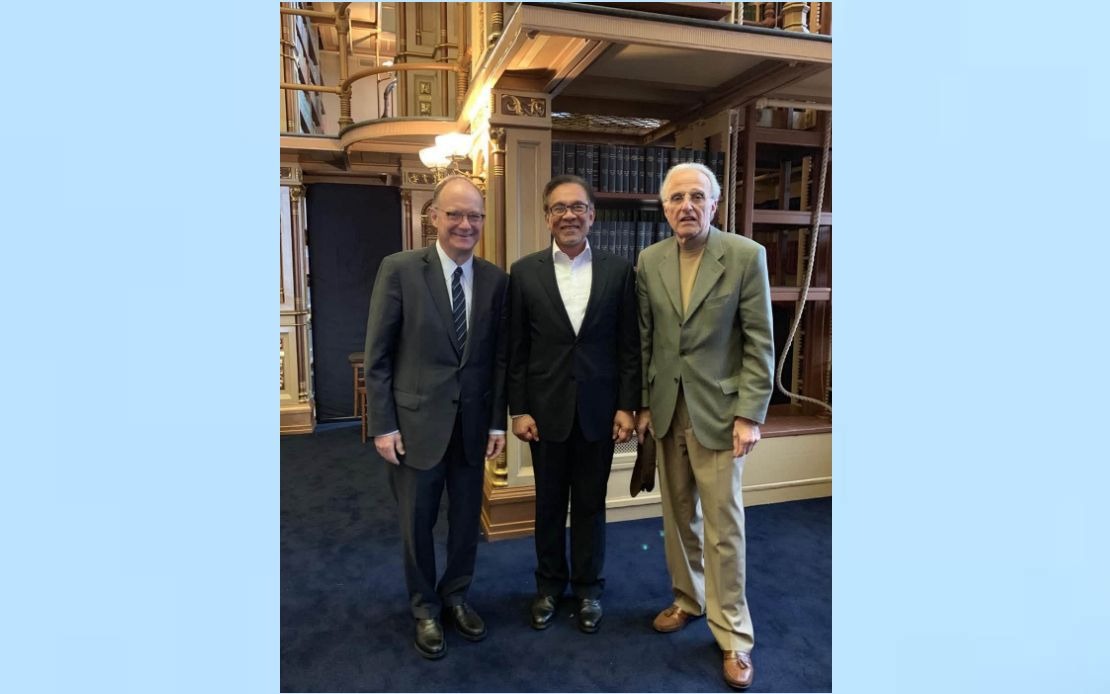
Prime Minister Datuk Seri Anwar Ibrahim has expressed profound sorrow at the death of Professor John L. Esposito, one of the world's foremost authorities on Islamic studies and Muslim-Christian relations. Through a Facebook post released on July 16, the Premier acknowledged the loss of a scholar whose intellectual legacy has fundamentally reshaped how Western audiences comprehend Islam and Muslim societies. Anwar's remarks underscore the deep personal and professional bonds that linked him to Esposito across half a century of global engagement on interfaith matters.
The connection between Malaysia's leader and the American academic traces back to the early 1970s, when their relationship began at a formative moment in both their careers. Over the subsequent decades, this friendship evolved into a partnership of mutual respect, with Anwar repeatedly drawing on Esposito's scholarly insights and measured approach to interpreting Islam within a global context. The longevity of their bond speaks to the consistency of Esposito's intellectual commitment and the value Anwar placed on his counsel during periods of significant regional and international upheaval.
Esposito's most enduring contribution to global discourse centred on his pioneering efforts to establish academic frameworks through which Western institutions could study Islam with rigour and nuance. As the founding director of Georgetown University's Centre for Muslim-Christian Understanding, he created a formal space dedicated to scholarly examination of religious traditions and their interaction. This institutional achievement represented far more than administrative success; it signalled a shift within American academia toward treating Islam and Islamic thought with the same intellectual seriousness accorded to other major world religions and civilisational forces.
The scholar's extensive publication record demonstrates the breadth of his engagement with Islamic topics. His co-authorship of Makers of Contemporary Islam provided a comprehensive examination of influential thinkers and activists shaping modern Muslim societies, while his monographs sought to demystify complex theological and political concepts for educated but non-specialist readers. Through works such as What Everyone Needs to Know About Islam and Who Speaks for Islam?, Esposito deliberately brought academic sophistication to mass audiences, recognising that public understanding of Islam had become a matter of pressing international consequence.
The geopolitical significance of Esposito's work became particularly acute in the post-9/11 environment, when the Western world urgently required credible, informed voices capable of separating scholarly understanding from emotional reaction and political manipulation. His willingness to engage in rigorous analysis of Islam and Islamic movements at a moment of deep polarisation demonstrated intellectual courage. Rather than retreat into simplistic categories that portrayed Islam monolithically as either fundamentally compatible or incompatible with Western values, Esposito maintained that understanding required sustained engagement with the religion's theological diversity and the varied political contexts within which Muslim communities operated.
Anwar's characterisation of Esposito as a bridge-builder carries particular resonance for Malaysia and Southeast Asia. The region has grappled throughout its modern history with questions about how Islamic identity intersects with multiethnic nationalism, secular governance, and economic development. Scholars and policymakers across ASEAN have drawn inspiration from Esposito's demonstration that Islam and interfaith coexistence need not be conceptualised as opposing forces, but rather as compatible elements within diverse societies. His intellectual framework provided validation for the possibility of Muslim-majority nations adopting plural political structures and minority protections without betraying religious commitments.
The Prime Minister's emphasis on Esposito's private character alongside his public scholarship illuminates a dimension often overlooked in academic assessments. By noting that Esposito proved equally generous in confidential conversation as rigorous in published writing, Anwar highlights the integration between personal integrity and intellectual honesty. This observation suggests that Esposito's scholarly conclusions emerged from genuine engagement with Muslim interlocutors and colleagues, rather than from predetermined ideological commitments imposed upon evidence. For Malaysian audiences, this distinction matters significantly, as it speaks to how global intellectual leaders approach their subjects.
Esposito's steadfast commitment to the Muslim world extended beyond academic production into consistent advocacy for more nuanced Western foreign policies and public attitudes. He resisted both orientalist tendencies that caricatured Islam as unchanging and static, and triumphalist narratives suggesting Islam represented an inevitable ideological threat to the secular West. This balanced approach, while frequently contested by ideological critics on both sides, created intellectual space for genuine dialogue rather than mere rhetorical performance. His willingness to engage seriously with Anwar and other Muslim leaders demonstrated commitment to reciprocal understanding rather than one-directional instruction.
The scholar's institutional contributions through Georgetown University's Centre have extended well beyond his individual lifetime, establishing frameworks for continuing research and dialogue that have influenced countless students and scholars. The Centre's existence represents a concrete manifestation of Esposito's belief that institutional change could facilitate deeper mutual comprehension. For Malaysia and the broader Southeast Asian region, institutions modelled on this approach to interfaith and cross-cultural scholarship have become increasingly important as societies navigate religious pluralism alongside rapid development.
Anwar's tribute extends beyond personal reminiscence to encompass broader civilisational significance. By describing Esposito as fundamentally a friend to the Muslim world, the Prime Minister positions him within a lineage of Western intellectuals who rejected orientalism and cultural supremacy while maintaining rigorous scholarly standards. This positioning reflects recognition that Esposito's contributions have proven particularly valuable precisely because they maintained analytical integrity while demonstrating genuine respect for Islamic civilisation and Muslim perspectives. The timing of Esposito's death coincides with renewed debates about Islam's relationship with modernity, Western values, and global governance, making his legacy of balanced scholarship increasingly relevant.
The global implications of Esposito's scholarly contributions resonate across multiple policy domains relevant to Malaysia and Southeast Asia. His work on Islamic political movements, for instance, has informed governmental and academic understanding of how religious ideologies interface with electoral politics, social movements, and state capacity. By refusing reductive categorisations that treated all expressions of Islamic politics as inherently destabilising, Esposito created intellectual permission for policymakers to engage with diverse Muslim political actors as complex entities worthy of serious negotiation rather than dismissal. This approach has practical value for multiethnic societies managing religious pluralism.
Anwar's invocation of Esposito's memory occurs at a moment when global tensions around religious identity and civilisational difference remain acute. The scholar's decades-long commitment to dialogue and mutual understanding offers a counterweight to contemporary trends toward polarisation and zero-sum frameworks. For Malaysia and Southeast Asia, where religious coexistence remains foundational to national stability and prosperity, Esposito's intellectual legacy provides both inspiration and practical models for institutionalising interfaith engagement. His passing represents the loss of a unique voice, yet his published work and the scholarly networks he cultivated continue to shape how new generations approach questions of religious identity and global understanding.
In concluding his tribute, Anwar extended condolences to Esposito's wife Jean and to the broader scholarly community that benefited from his mentorship and intellectual generosity. The expression of grief transcends formal diplomatic courtesy; it reflects the genuine loss experienced across academic and policy circles that depended upon Esposito's wisdom to navigate increasingly complex questions about Islam's role in the contemporary world. For Malaysia, the passing of such a distinguished friend to understanding and dialogue serves as a reminder that building bridges between communities requires sustained intellectual commitment, personal integrity, and willingness to transcend ideological boundaries in pursuit of truth and mutual respect.

