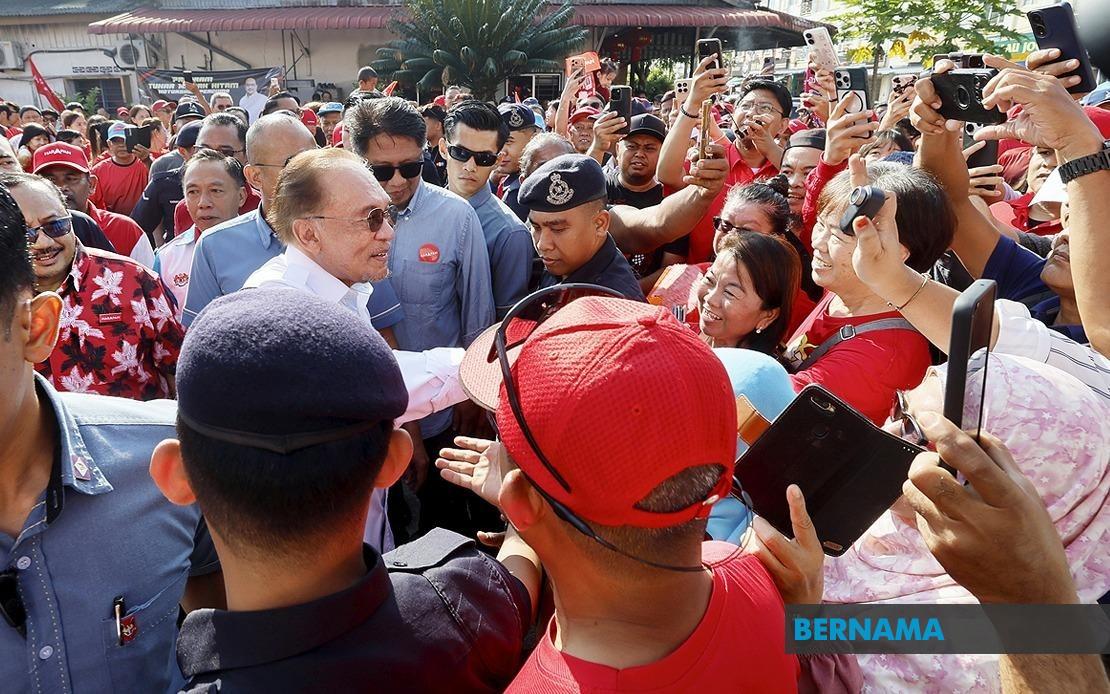
Prime Minister Datuk Seri Anwar Ibrahim reconnected with an elderly couple whose determined journey to meet him has resonated with Malaysians across the country. Abdul Razak Pelangga, 86, and his wife Jamilah Samsudin, 64, gained widespread attention after pedalling their trishaw nearly a kilometre through Senggarang to see the Prime Minister during a breakfast stop the previous Sunday. The heartwarming encounter unfolded anew when Anwar made time to meet them personally at the "Yok! Meriahkan Johor! Undi Harapan" programme held in the same location, demonstrating the human dimension behind electoral campaigning.
The reunion took on a lighter tone as Anwar engaged with Abdul Razak in good-natured banter, marvelling at the octogenarian's physical vigour and his willingness to pedal the traditional three-wheeled vehicle. Beyond the playful exchange, the Prime Minister took the opportunity to express genuine gratitude towards the couple for their unwavering support, acknowledging the genuine enthusiasm they represented among ordinary voters. Such moments have become increasingly significant in modern political engagement, where spontaneous expressions of backing from citizens can resonate more powerfully with the electorate than orchestrated campaign messaging.
The event in Senggarang served as a campaign rally for Pakatan Harapan ahead of Johor's state election, scheduled for Saturday. Datuk Fahmi Fadzil, who holds the dual roles of PH Communications director and Minister of Communications, attended the programme alongside several coalition candidates contesting in the state. The candidate lineup included Onn Abu Bakar competing for the Senggarang seat, Mohd Khuzzan Abu Bakar standing in Semerah, and Felicia Poh Rui Ling campaigning for Penggaram, representing the breadth of PH's push across the state's diverse constituencies.
Abdul Razak and Jamilah's story encapsulates a broader narrative unfolding across Malaysia's political landscape. Their decision to undertake such a journey—combining physical exertion with genuine civic participation—reflects the type of grassroots engagement that political parties seek to cultivate among voters. The couple's actions were not prompted by incentives or party mobilisation but emerged from personal conviction, lending authenticity to their gesture that resonates far beyond typical campaign optics.
The trishaw itself carries significant cultural weight in Malaysian society, representing a traditional mode of transport deeply connected to the nation's heritage. In an era dominated by motorcars and modern conveyances, the image of an octogenarian pedalling such a vehicle to participate in democratic processes carries symbolic value. It speaks to accessibility, determination, and a willingness to engage with political processes despite physical limitations that might discourage others from active participation. For younger generations witnessing such commitment from elderly citizens, the impact extends beyond the immediate political context.
Johor's state election represents a significant electoral test for the current administration, coming at a time when coalition politics remains volatile and voter sentiment continues shifting across the country. The state has historically been a stronghold for certain political forces, and the outcome will provide important indicators of broader electoral trends. Campaign strategies therefore necessarily balance large-scale rallies with intimate encounters that demonstrate genuine connection between political leadership and constituents at the grassroots level.
The timing of this reunion, occurring just days before voting commenced, afforded the Prime Minister an opportunity to reinforce messages of inclusivity and accessibility. By demonstrating willingness to engage meaningfully with elderly supporters and recognising their efforts, Anwar positioned himself within a narrative of responsive leadership. Such interactions, when captured and shared through contemporary media channels, amplify their reach far beyond those physically present at the event, influencing perceptions among voters throughout the state and nationwide.
Early voting had already taken place the preceding Tuesday, allowing certain eligible voters—including those working in essential services or living away from their constituencies—to cast ballots before the official election day. This staggered voting process reflects modern administrative approaches to electoral management, though it also creates a compressed campaign timeline where every interaction and message receives heightened scrutiny and attention from political observers and the media.
The story of Abdul Razak and Jamilah demonstrates how electoral campaigns increasingly intersect with social media narratives and human interest angles. In Malaysia's crowded political environment, where campaign messages constantly compete for public attention, authentic stories of citizen engagement can prove more memorable and persuasive than conventional advertising. Their trishaw journey became a talking point precisely because it was unscripted and genuine, emerging from personal motivation rather than campaign coordination. Political strategists across the spectrum recognise the power of such moments, which cannot be artificially manufactured but must be authentically earned through demonstration of genuine public connection.

