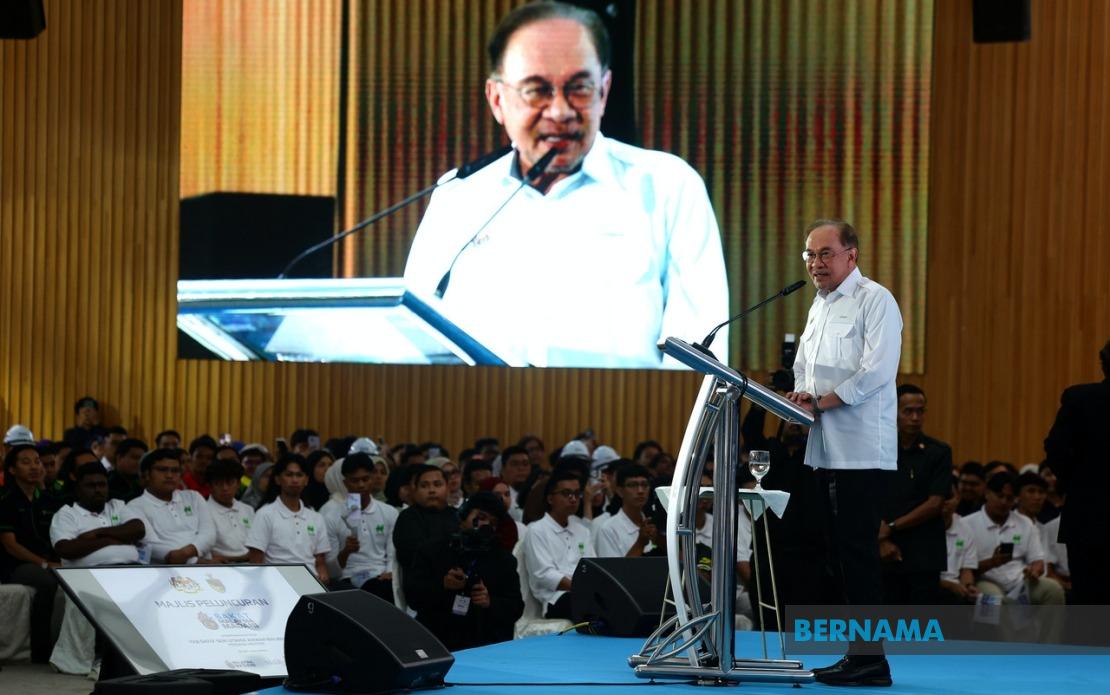
Prime Minister Datuk Seri Anwar Ibrahim officially launched the Bakat MADANI initiative in Seremban on June 29, announcing that the programme will extend support to approximately 25,000 individuals seeking to advance their careers and economic prospects. The initiative represents a coordinated national effort that brings together government-linked investment companies, government-linked companies, and Petronas in a unified push to strengthen Malaysia's human capital development and address persistent skills gaps across the economy.
The partnership model underlying Bakat MADANI reflects a fundamental shift in how Malaysia approaches workforce development. Rather than relying solely on government budgeting, the initiative leverages the financial and operational capacity of major corporate entities to scale training programmes and job placement initiatives to unprecedented levels. This collaborative structure allows participating organisations to contribute their expertise, resources and recruitment capacity whilst the government provides policy direction and regulatory support. Anwar emphasised during the launch that participating companies bear significant financial responsibility for programme delivery, underscoring that success depends on genuine corporate commitment rather than token involvement.
Finance Minister II Datuk Seri Amir Hamzah Azizan outlined three strategic pillars that anchor the initiative's approach to talent development. First, the programme seeks to strengthen the employability of graduates and young professionals within the existing ecosystem of GLICs, GLCs and Petronas, ensuring they acquire the specific competencies these organisations demand. Second, it aims to expand job placement opportunities across key strategic sectors facing acute talent shortages, including semiconductors, renewable energy, the digital economy and advanced manufacturing. Third, it focuses on empowering Technical and Vocational Education and Training institutions to deliver curriculum aligned with industry requirements and employer expectations.
The targeting of high-growth, high-value sectors reflects Malaysia's economic priorities as the nation seeks to transition towards more sophisticated, technology-intensive industries. Semiconductors and renewable energy represent critical areas where Malaysia possesses natural advantages and existing industrial bases but faces growing international competition for skilled talent. The digital economy presents perhaps the most dynamic opportunity, with demand far outpacing the supply of qualified professionals across software development, data analytics and cybersecurity. Advanced manufacturing encompasses precision engineering and high-tech production processes where automation and sophisticated tooling require workers with advanced technical knowledge.
Amir Hamzah announced that the government will introduce special tax incentives for companies running approved training programmes under Bakat MADANI. These incentives are designed to make skills development more commercially attractive to employers, encouraging greater participation in structured training initiatives. Critically, the new incentive framework expands coverage to include Technical and Vocational Education and Training graduates, broadening the talent pool beyond traditional university degree holders. Additionally, minimum allowance levels for trainees have been increased to ensure fair and competitive compensation, addressing a perennial criticism that vocational and apprenticeship programmes sometimes exploit participants through inadequate stipends.
The programme builds upon and transforms existing initiatives into integrated models of technical education and workforce preparation. Petronas is leading the transformation of VISTA into Vista i-Plus through collaboration with the Malaysian Petroleum Resources Corporation and the Malaysian Oil, Gas & Energy Services Council. This enhanced model will coordinate training delivery across MARA Skills Institutes, National Youth Skills Institutes, Advanced Technology Training Centres and the Malaysian Construction Academy, creating clearer pathways from vocational education into employment within the energy sector and related industries.
Within the broader GLIC and GLC ecosystem, Khazanah Nasional Berhad has partnered with 23 higher education institutions to prepare graduates for workforce entry. These partnerships span well-established universities including Universiti Teknologi MARA, Universiti Teknikal Malaysia Melaka and Universiti Malaysia Sabah, indicating that Bakat MADANI extends beyond vocational training to embrace conventional university pathways. The collaboration emphasises industrial training modules, technical certifications earned whilst still in education, and structured exposure to actual workplace environments and industry standards. This integration of academic learning with practical industry experience addresses a critical gap where many graduates discover their qualifications misaligned with employer requirements only after completing their studies.
For Malaysian workers and job seekers, Bakat MADANI offers tangible mechanisms for upskilling and accessing quality employment within fast-growing sectors. The programme's emphasis on competitive compensation for trainees and formal qualifications addresses a key barrier that has historically discouraged talented individuals from pursuing vocational pathways. By positioning technical qualifications alongside university degrees as equivalent pathways to rewarding careers, the initiative challenges lingering stigmas associated with vocational education in Malaysian society, where university degrees have traditionally been viewed as the only legitimate route to middle-class employment.
The regional implications extend beyond Malaysia's borders. As Southeast Asian economies compete intensely for inflows of multinational investment in semiconductors, renewable energy and digital services, the availability of trained, job-ready talent becomes a decisive competitive factor. Countries investing in workforce development programmes comparable to Bakat MADANI strengthen their appeal to international investors considering regional headquarters, research and development centres and manufacturing facilities. Malaysia's commitment to this scaled-up talent development initiative signals confidence in its ability to support the expansion of strategic industries and positions the nation competitively against regional rivals including Vietnam, Thailand and Indonesia.
The success of Bakat MADANI ultimately depends on sustained coordination between government, educational institutions and participating corporations. Amir Hamzah's emphasis that talent must be connected with genuine employment opportunities highlights the risk that poorly executed programmes can produce qualified graduates unable to secure relevant jobs, thereby wasting resources and demoralising participants. The involvement of senior government figures, corporate leaders and education administrators at the launch underscores political and institutional commitment, yet implementation challenges across diverse organisations and sectors will require continuous attention and adjustment throughout the programme's operational life.

