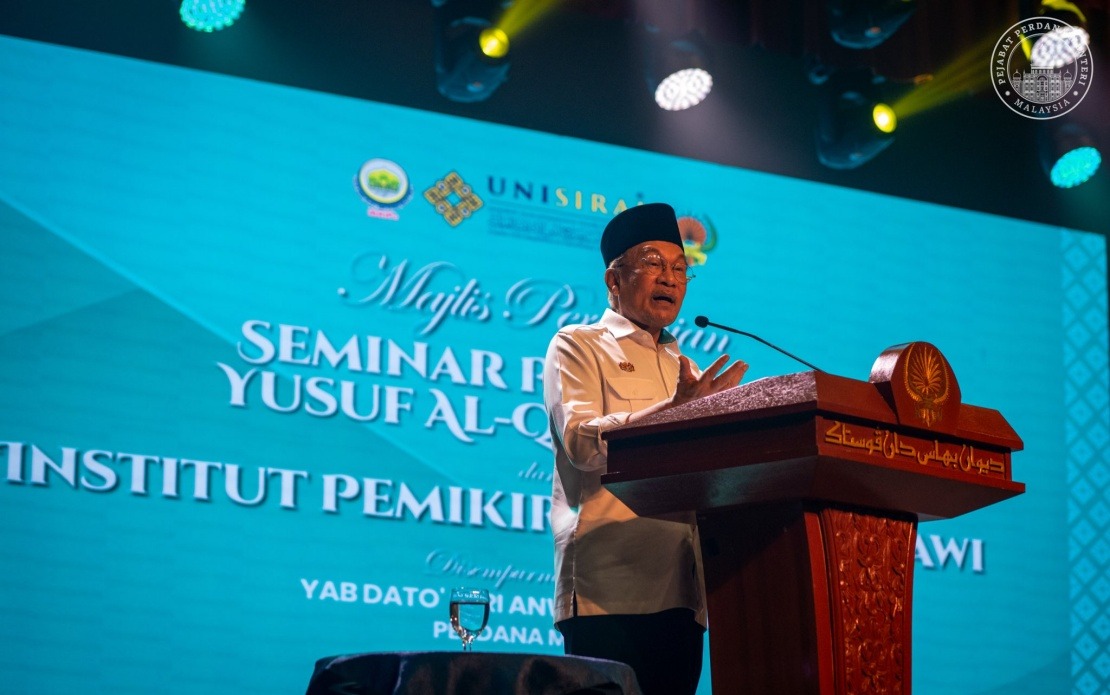
Prime Minister Datuk Seri Anwar Ibrahim has pledged RM2 million in public funding towards the Al-Qaradawi Thought Institute, marking a significant investment in advancing Islamic scholarship and research within Malaysia. The announcement came during the official launch of the Yusuf Al-Qaradawi Thought Seminar and the establishment of the institute at Wisma Dewan Bahasa dan Pustaka in Kuala Lumpur on July 21.
The contribution underscores the MADANI Government's commitment to fostering intellectual development in Islamic studies while promoting moderate and progressive interpretations of faith. By channelling resources into institutional research focused on Al-Qaradawi's extensive body of work, the government signals its intention to anchor Malaysia's approach to Islamic governance on scholarly foundations emphasizing intellectual rigour and contemporary relevance. The institute is designed to become a regional hub for studying the late scholar's influence on modern Islamic thought and practice.
Anwar conveyed his personal connection to Al-Qaradawi through a post on social media, revealing how the prolific Islamic intellectual shaped his own philosophical outlook. He credited the scholar with providing moral guidance, intellectual inspiration, and steadfast friendship grounded in shared principles of sincerity and ethical commitment. This candid acknowledgement illustrates the deep personal bonds that often exist between Muslim leaders and prominent Islamic thinkers who champion progressive reform.
The Prime Minister's relationship with Al-Qaradawi stretches back decades to his formative years as an activist with the Malaysian Islamic Youth Movement (ABIM), a platform where he engaged in grassroots Islamic advocacy and organizational leadership. During that period in the early 1980s, when Islamic revivalism was gaining momentum across the Muslim world, Al-Qaradawi sent written guidance to ABIM's leadership urging the movement towards moderation and internal intellectual pluralism. This advice proved instrumental in shaping institutional culture during a moment when many Islamic organizations were navigating tensions between ideological purity and pragmatic engagement with societal complexity.
Anwar characterized Al-Qaradawi as a transformative intellectual force—a catalyst whose thinking embodied openness and flexibility when confronting modern challenges. Rather than retreating into rigid dogmatism, the scholar exemplified how Islamic scholarship could evolve responsively while remaining grounded in foundational principles. The Prime Minister emphasized that Al-Qaradawi's counsel to embrace wasatiyyah, or the Islamic concept of moderation and balanced positioning, proved invaluable during an era when sectarian thinking and doctrinal exclusivism threatened to isolate Malaysia's Islamic movements from broader intellectual currents.
The establishment of the institute arrives at a juncture when Malaysia faces mounting pressures to articulate a distinctive model of Islamic governance that reconciles religious authenticity with pluralistic democracy and economic pragmatism. By institutionalizing the study of Al-Qaradawi's thought, the government positions itself to draw upon a rich legacy of Islamic jurisprudence that acknowledges context-specificity and acknowledges the validity of multiple interpretive approaches to religious questions. This methodological flexibility has long distinguished Al-Qaradawi's scholarship from more literalist schools of Islamic interpretation.
For Malaysian policymakers and Islamic scholars, the institute offers an intellectual resource for navigating contemporary challenges—from bioethics and environmental stewardship to financial regulation and family law reform—through an explicitly Islamic lens that remains engaged with modern realities. Al-Qaradawi's extensive writings on these subjects have circulated globally among Muslim intellectuals and policymakers, making him one of the most influential Islamic jurists of the past half-century. The institute's research agenda will likely prioritize translating and contextualizing his contributions for Southeast Asian Muslim communities.
The RM2 million commitment also reflects broader regional trends wherein Southeast Asian Muslim-majority nations are investing in Islamic institutional capacity and scholarly infrastructure. As geopolitical and economic competition intensifies, the establishment of well-resourced research institutes becomes strategically significant, allowing countries to cultivate soft power through intellectual and cultural influence. Malaysia's investment signals its aspiration to remain a centre of Islamic thought leadership within the region.
Anwar's decision to personally oversee the institute's launch demonstrates the MADANI Government's identification with Al-Qaradawi's legacy of progressive Islamic reform. By validating his intellectual contributions at the highest political level, the Prime Minister reinforces official endorsement of moderate Islamic governance models that reject extremism without abandoning religious conviction. This positioning carries implications for how Malaysia navigates internal religious debates and international perceptions of its Islamic identity during an era when stereotypes about Islam and governance remain contested globally.
Looking forward, the institute's success will depend on its ability to attract quality researchers, foster rigorous scholarship, and translate Al-Qaradawi's multifaceted intellectual output into frameworks applicable to contemporary Malaysian and Southeast Asian contexts. As the institute develops its research programmes and faculty, questions will naturally arise regarding its specific focus areas, international collaborations, and mechanisms for ensuring scholarly independence while maintaining alignment with government priorities. The balance struck in these dimensions will ultimately determine whether the institute becomes a genuinely influential centre of Islamic learning or primarily a commemorative institution.

