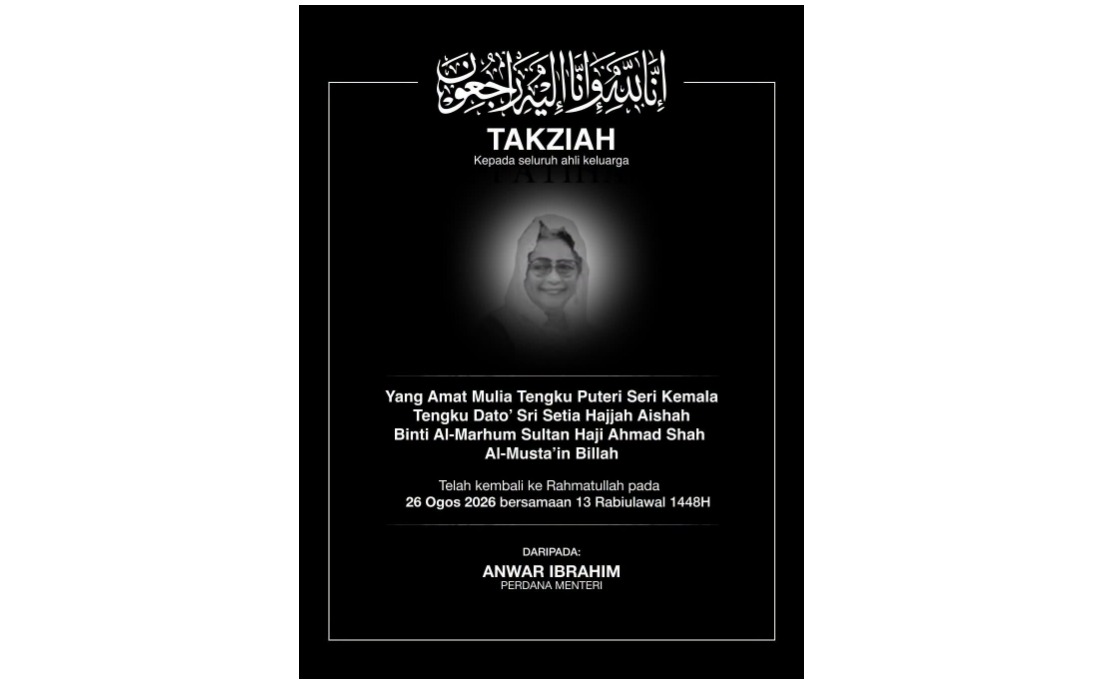
Prime Minister Datuk Seri Anwar Ibrahim has expressed his deep sympathies to Sultan Abdullah Ri'ayatuddin Al-Mustafa Billah Shah and members of the Pahang Royal Family following the death of the Sultan's elder sister, Tengku Puteri Seri Kemala Tengku Datuk Seri Aishah, whose passing occurred on August 26.
Anwar conveyed his condolences through a post on Facebook, offering prayers for the deceased and her grieving family. He invoked divine mercy upon Tengku Datuk Seri Aishah's soul, seeking forgiveness for any transgressions and requesting that she be granted a place among the righteous in the hereafter, according to Islamic tradition.
The Prime Minister also extended his sentiments to the reigning Sultan's spouse, Tengku Ampuan of Pahang Tunku Azizah Aminah Maimunah Iskandariah, and the wider royal household, praying that they would find the spiritual resilience needed to navigate their bereavement.
Tengku Datuk Seri Aishah breathed her last at a medical facility in Kuala Lumpur at 9:15 pm on August 26. As a member of the Pahang Royal Family, she held significance within Malaysia's constitutional monarchy framework, which grants the rulers of each state important ceremonial and administrative roles. The passing of such figures is typically marked by official recognition from the nation's political leadership, reflecting the protocol observed in Malaysia's system of government.
Following royal custom and Islamic burial practices, her remains were interred at the Pahang Royal Mausoleum situated in Pekan, the state capital, on August 27. This burial ground serves as the final resting place for members of the Pahang sultanate, and the timing of the funeral reflected the customary observance within Malaysia's Islamic framework, where internment traditionally occurs within 24 hours of death.
The gesture from the Prime Minister underscores the importance Malaysia's political establishment places on maintaining formal relations with the institution of the sultanate. As a constitutional monarchy with nine hereditary rulers, Malaysia's federal system grants significant authority and symbolic weight to the royal families. The death of a close family member to a reigning Sultan therefore constitutes a matter of national note, prompting responses from senior government officials.
Anwar's public acknowledgement through social media reflects contemporary communication practices within Malaysia's political sphere, where significant announcements regarding state affairs increasingly reach the public through digital platforms alongside traditional press channels. This dual approach ensures widespread dissemination of official messages to the diverse Malaysian population.
The Pahang sultanate, one of Malaysia's most historically significant kingdoms, has long maintained prominence within the federation. Sultan Abdullah, who assumed the throne in 2019, continues the lineage of rulers who have shaped the state's governance and contributed to broader Malaysian political discourse. The royal family's standing within the constitutional framework means that matters affecting its members are observed with appropriate ceremonial regard by the government.
Condolence messages from national leaders following deaths within royal families represent a consistent feature of Malaysia's political culture, reflecting both constitutional protocol and the bonds of respect that characterise relations between the executive branch and the monarchy. Such gestures, while formal in nature, carry significance in affirming the stability and continuity of Malaysia's institutional structures during moments of loss.

