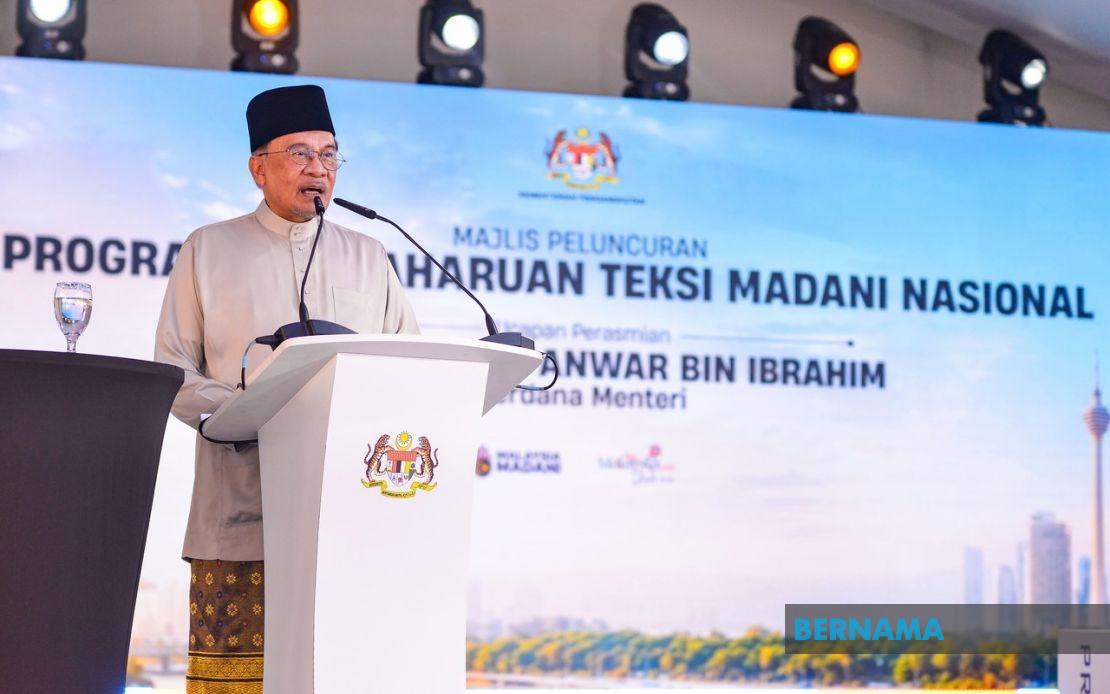
Prime Minister Datuk Seri Anwar Ibrahim has signalled the government's deepening commitment to revitalising Malaysia's taxi industry by unlocking an additional RM10 million for vehicle replacement initiatives, demonstrating that the sector remains a policy priority despite broader economic pressures. The announcement, made during the launch of the National MADANI Taxi Reform Programme at Dataran Merdeka on July 3, represents a doubling of the initial funding support and signals confidence that the industry's recovery trajectory is gaining momentum.
The decision to inject supplementary resources comes on the heels of unexpectedly strong uptake from the original RM10 million allocation unveiled in Budget 2026, suggesting that taxi operators and drivers have been waiting for exactly this kind of financial incentive structure. Anwar, who holds the dual role of Prime Minister and Finance Minister, framed the move as a direct response to grassroots demand, implying that the government has been monitoring the scheme's performance closely and is prepared to respond with agility when policy interventions prove effective.
A landmark component of the revamped programme involves a collaborative effort between the government, Proton, and the Transport Ministry to establish a bespoke financing arrangement specifically designed to help taxi drivers acquire the Proton S70. This partnership represents a strategic alignment between national industrial policy and urban mobility objectives, potentially supporting both the local automotive sector and the modernisation of Malaysia's ageing taxi fleet simultaneously. The Proton S70, as a domestically manufactured sedan, offers an accessible entry point for drivers seeking to upgrade from vehicles that may no longer meet modern safety and emission standards.
The taxi industry's challenges have been mounting for years. Rising operational costs, vehicle maintenance expenses, and competition from ride-hailing platforms have squeezed margins for traditional operators. An ageing fleet has compounded these difficulties, as older vehicles consume more fuel, require costlier repairs, and struggle to meet contemporary regulatory expectations around emissions and passenger comfort. For many independent drivers and small operator associations, the prospect of replacing vehicles has seemed financially insurmountable, effectively trapping them in a cycle of declining profitability and deteriorating service quality.
The matching grant mechanism represents a pragmatic policy design that splits the financial burden between government support and individual driver investment. Rather than subsidising vehicle replacement entirely, which would carry significant fiscal implications, the programme creates an incentive structure requiring skin-in-the-game from drivers themselves. This approach encourages serious participation while ensuring public funds are deployed efficiently and directing support toward operators with genuine commitment to modernisation.
Transport Minister Anthony Loke's presence at the launch underscores the cross-portfolio nature of taxi reform, bridging concerns around urban transport planning, labour welfare, and economic vitality. Loke has previously highlighted the importance of maintaining a competitive, well-functioning taxi sector as part of Malaysia's broader public transport ecosystem. The involvement of Minister in the Prime Minister's Department (Federal Territories) Hannah Yeoh indicates that Kuala Lumpur, as a national capital and primary economic hub, is a focal point for implementation, though the programme's scope likely extends beyond federal territories.
For Malaysian readers and regional observers, this funding announcement holds several implications. First, it signals that the government views the informal and semi-formal transport sector as worthy of continued investment despite competing fiscal priorities. Second, it demonstrates a willingness to use budgetary tools to support workers in industries disrupted by technological and market shifts, rather than allowing market forces alone to determine outcomes. Third, the Proton partnership illustrates how industrial policy and social policy can be interwoven—supporting both domestic manufacturing capacity and livelihoods simultaneously.
The broader Southeast Asian context matters here as well. Thailand, Indonesia, and the Philippines have all grappled with taxi sector challenges, including fierce competition from digital platforms, ageing fleets, and driver hardship. Malaysia's approach—combining direct government funding with private sector partnerships and financing innovation—offers a model that neighbouring countries may study. The emphasis on matching grants rather than outright subsidies reflects fiscal prudence while maintaining the state's active role in managing economic transitions.
The automotive financing component deserves particular attention. By negotiating a dedicated financing scheme with Proton rather than defaulting to conventional bank lending, the government has created a pathway for drivers who might struggle to secure conventional loans due to irregular income patterns or modest collateral. This tailored financial product recognises the unique cash flow challenges of taxi operations, where revenue fluctuates with passenger demand and fuel prices.
The immediate challenge now lies in implementation and uptake. The government must ensure that the application process remains accessible to drivers who may have limited formal education or digital literacy. Outreach and awareness campaigns will be crucial, as will clarity around eligibility criteria and the mechanics of claiming matching grants. Regional transport associations and taxi cooperatives will likely serve as vital intermediaries in channelling information and processing applications.
Another consideration involves the supply side: whether the Proton S70 and the financing scheme can scale to meet potential demand without creating bottlenecks in production or delivery. Should the programme succeed in driving substantial vehicle replacement, manufacturing capacity and dealer networks must be prepared to handle increased orders. Conversely, if take-up remains sluggish, the government will need to investigate whether financing terms remain too restrictive or whether other barriers—such as regulatory concerns or service quality issues—are deterring drivers.
Longer term, taxi reform cannot rest on vehicle replacement alone. Driver incomes, working conditions, and the competitive dynamics between licensed taxis and ride-hailing services require sustained attention. The National MADANI Taxi Reform Programme appears designed as a multi-faceted initiative, with fleet modernisation as one pillar. How effectively the government addresses complementary issues will ultimately determine whether this investment translates into a genuinely revitalised sector or merely postpones underlying tensions.
By committing an additional RM10 million and securing Proton's cooperation, Anwar has demonstrated that the government intends to walk alongside taxi operators and drivers through the transition to newer, more efficient vehicles. Whether this support package proves sufficient to reverse the sector's decline, however, will depend on execution, market response, and the government's willingness to address deeper structural challenges within Malaysia's urban mobility landscape.

