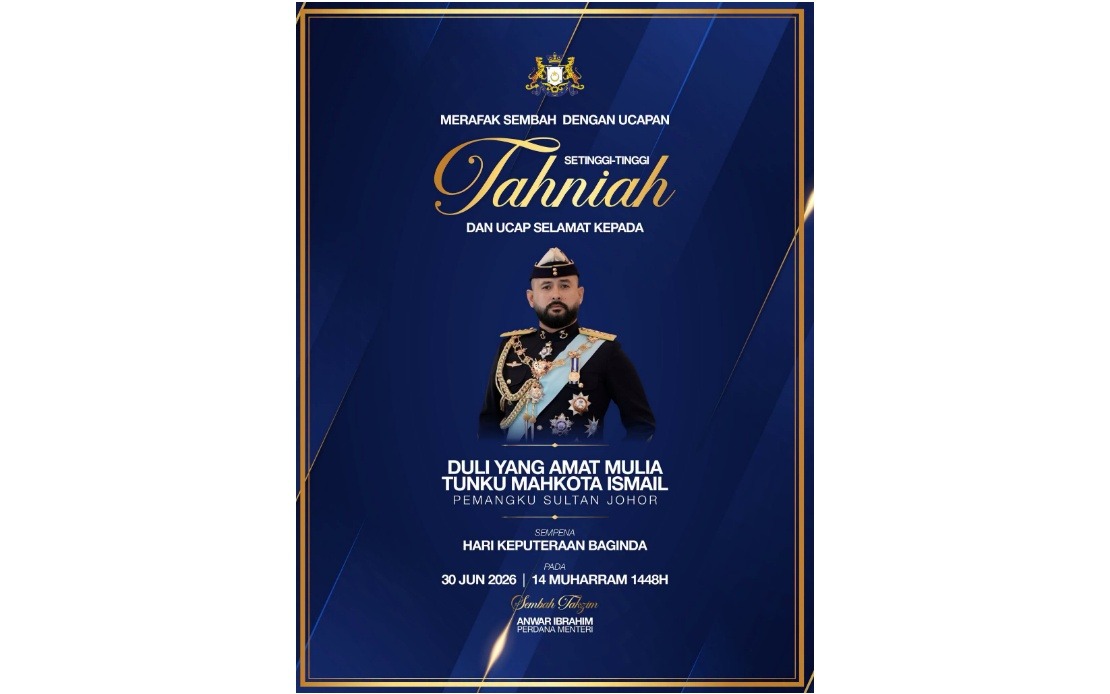
Prime Minister Datuk Seri Anwar Ibrahim has publicly celebrated the birthday of Tunku Mahkota Ismail, the Regent of Johor, extending warm wishes through a Facebook post that reflected the ceremonial courtesies expected between federal and state leadership. The gesture, delivered on June 30, underscores the importance of maintaining formal diplomatic relations between Putrajaya and Johor's royal institution, a relationship that carries particular weight given Johor's status as Malaysia's second-largest state by population and its significant economic influence within the region.
In his message, Anwar conveyed not merely congratulations but also spiritual invocations, requesting divine blessing upon the Regent's continued wellbeing and prosperity. The specific framing of such wishes—emphasizing good health, grace, and abundance—reflects the customary protocol through which Malaysian political figures acknowledge milestones involving members of the royal families. These ritualistic expressions, while ceremonial in nature, serve an important function in Malaysian governance by demonstrating respect for constitutional monarchical institutions and the federal-state power-sharing arrangements enshrined in the Malaysian Constitution.
Deputy Prime Minister Datuk Seri Dr Ahmad Zahid Hamidi similarly marked the occasion through his own social media address, employing similar language centered on prayers for health, divine protection, and the wisdom required to govern effectively. Zahid's contribution to the birthday acknowledgments holds particular significance given his portfolio and his historical political standing within the United Malays National Organisation, a party whose fortunes remain closely tied to its relationships with state-level administrations, particularly in traditional strongholds like Johor.
The dual acknowledgment from both the Prime Minister and his deputy reflects an institutionalized practice within Malaysia's political system whereby senior federal figures formally recognize important dates within the royal calendar. Such observances carry implicit messages about stability and continuity within the governmental structure, particularly in a state like Johor where the traditional Malay-Muslim establishment remains deeply embedded in both cultural and political frameworks. The explicit mention of the Regent's role in governing "Johor Darul Ta'azim and Bangsa Johor"—the state and its people—reinforces the constitutional position that the Sultan and his regent hold as custodians of Johor's interests and identity.
Tunku Mahkota Ismail has held increasing prominence within Malaysia's royal hierarchy and political landscape in recent years, with his public engagements and modernizing approach to royal functions garnering attention both domestically and internationally. His birthday acknowledgment by national leadership figures validates his position as a significant stakeholder in Malaysia's governance architecture, where state rulers and their heirs maintain considerable symbolic and, in specific constitutional matters, practical authority. The prominence given to his birthday by the federal government's top two officials suggests recognition of his importance beyond ceremonial functions.
The timing and nature of these birthday greetings also reflect the broader context of federal-state relations in Malaysia. Johor, under the Johor Darul Ta'azim (JDT) governance framework, has historically maintained a distinct political identity within the federation. Its royal house commands significant loyalty among the Johor populace, and maintaining cordial relations between Putrajaya's leadership and Johor's royal institutions remains strategically important for national political stability. The public nature of these congratulations, delivered through social media platforms accessible to the general populace, serves to broadcast these relationships to a wider audience beyond government circles.
The practice of senior politicians offering birthday wishes to members of the royal families is deeply embedded within Malaysian political culture, though the prominence and visibility of such gestures have evolved with the rise of social media. These platforms have transformed what were once confined to formal letters and private ceremonies into public performances of respect and allegiance, creating records that can be reviewed and analyzed by observers of Malaysian political dynamics. The choice to commemorate such occasions through Facebook, a platform widely used by Malaysian citizens across various demographics, demonstrates how traditional courtesies have adapted to contemporary communication methods.
For Malaysia's political landscape, maintaining strong relationships between federal government leadership and state-level royal institutions represents a cornerstone of institutional stability. The Johor royal family's historical significance in the formation of modern Malaysia, combined with its continued economic importance through various state-linked enterprises, ensures that its members remain central figures in discussions of governance and national direction. The birthday acknowledgments from Anwar and Zahid can therefore be understood not merely as polite gestures but as deliberate acts of political communication affirming the legitimacy and importance of constitutional monarchy within Malaysia's democratic framework.
These exchanges also carry implications for the broader question of how Malaysia's diverse power centers—the federal government, state rulers, and political parties—continue to negotiate their roles and relationships. In a system where the Sultan of each state remains the constitutional head of Islam within that state and holds various reserved matters under the Federal Constitution, demonstrating respect for these positions through high-profile acknowledgment serves important legitimacy functions. For a Prime Minister like Anwar, who has previously experienced periods of political difficulty, such demonstrations of fealty to constitutional institutions help reinforce his government's commitment to respecting Malaysia's established power structures and traditions.

