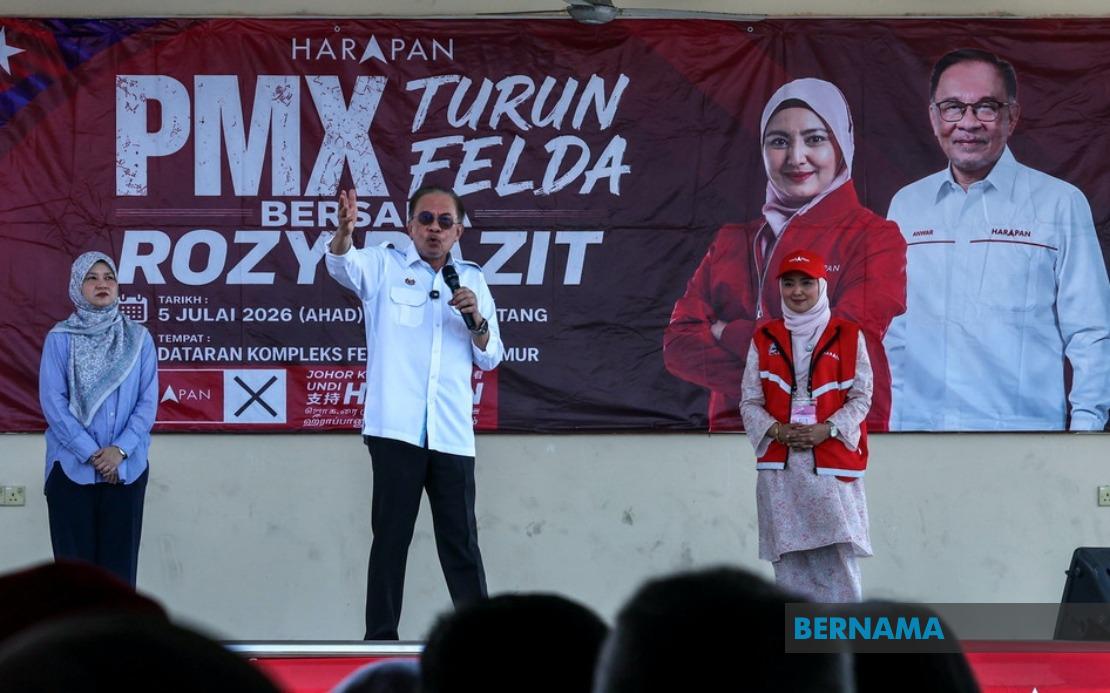
Prime Minister Datuk Seri Anwar Ibrahim has made a formal commitment to address a persistent housing crisis that has plagued the second generation of Federal Land Development Authority (FELDA) settlers for decades. Speaking at a public engagement in Segamat, Anwar outlined his administration's policy direction to guarantee housing site allocations for the children of original FELDA colonists, a constituency that has grown increasingly vocal about their limited land and property prospects within the scheme's established settlements.
The announcement carries significant political weight given FELDA's historical importance as a social safety net for rural Malaysians and its transformation into an electoral battleground. The organisation, established in 1956 to resettle rural poor and landless farmers, created a structured settlement model across multiple states. However, as the original settlers aged and their children came of age, the scheme faced a fundamental structural problem: insufficient land reserves to provide the same level of housing security the first generation received. This generational divide has festered as a grievance within FELDA communities, particularly in states like Selangor, Pahang, and Johor.
Anwar's explicit framing of the issue as a policy priority reflects recognition that FELDA voters remain crucial to the coalition's electoral fortunes, especially in rural constituencies where Barisan Nasional previously enjoyed dominance. The promise to resolve the matter during his tenure as Prime Minister signals urgency and personal ownership of the problem, distinguishing his government's approach from previous administrations that treated the issue as a long-term planning challenge rather than an immediate political imperative.
Crucially, Anwar acknowledged a substantial institutional constraint that has previously complicated resolution efforts. Land administration and basic infrastructure development—two essential components of any housing solution—fall within the constitutional jurisdiction of state governments, not federal authorities. This division of powers means that despite federal-level commitment, actual implementation depends on securing cooperation from state administrations with varying fiscal capacities and political priorities. In states governed by opposition coalitions, negotiating coordinated action becomes considerably more complex.
The acknowledgment of this federalism challenge reflects pragmatism, as it signals to both settlers and observers that rapid sweeping solutions are unlikely. Instead, the government appears to be positioning itself as a facilitating actor that will coordinate between federal resources, state land authorities, and FELDA administration to identify feasible pathways forward. Such coordination might involve securing state agreement to release additional land parcels, accelerating infrastructure development timelines, or exploring alternative housing models such as apartment complexes or consolidated township developments rather than individual plots.
The delegation present at the Segamat event underscores the cross-party and multi-ministerial nature of the initiative. Selangor Menteri Besar Datuk Seri Amirudin Shari, Education Minister Fadhlina Sidek, and Deputy National Unity Minister R. Yuneswaran's presence indicates that multiple government portfolios recognise the issue's scope. The inclusion of the education minister, while seemingly tangential, may reflect efforts to address the broader socioeconomic disadvantage experienced by second-generation FELDA members, many of whom have faced limited access to quality education and professional opportunities compared to urban counterparts.
For Malaysian stakeholders, particularly those with roots in FELDA communities, this commitment touches on fundamental questions of social mobility and intergenerational equity. The original FELDA settlers obtained land, housing, and steady income through government-sponsored schemes during a period of nation-building and rural development. Their children, however, have encountered a saturated system where traditional pathways to land ownership and agricultural livelihoods have largely closed. Rural-urban migration has diluted FELDA communities while simultaneously creating housing pressure within remaining settlements as families expand.
The second-generation housing problem also intersects with broader Southeast Asian trends of rural depopulation and agricultural sector contraction. As younger Malaysians increasingly pursue non-agricultural careers in cities, FELDA settlements risk becoming demographically strained, with ageing first-generation settlers and economically marginalised youth. Without addressing housing and land security for the younger cohort, these communities may experience accelerating decline. Conversely, successful resolution could stabilise these settlements and demonstrate a viable model for managing rural demographic transitions across the region.
From a regional perspective, Malaysia's approach to FELDA—whether it represents genuine commitment to rural welfare or electoral calculation—carries implications for how neighbouring Southeast Asian countries manage their own land distribution schemes and settler communities. Countries like Indonesia, Thailand, and the Philippines operate comparable rural development and land settlement programmes, and Malaysian policy innovations could inform or influence their strategies.
The practical mechanics of implementation remain unclear, particularly regarding funding mechanisms and timeline expectations. Whether the government envisions providing land directly, subsidising purchases, facilitating collective development projects, or some combination thereof has not been detailed. The cost of delivering housing sites to potentially hundreds of thousands of second-generation claimants across multiple states would be substantial, raising questions about budgetary feasibility during a period of fiscal consolidation.
Anwar's commitment also reflects shifting political demographics within FELDA constituencies themselves. Younger settlers and their families increasingly expect responsive governance and tangible solutions rather than traditional patronage politics. The willingness to acknowledge an intergenerational problem directly may signal the government's attempt to modernise its engagement with rural communities beyond conventional land and agricultural policies.
The coming months will reveal whether this commitment translates into concrete action through ministerial task forces, budget allocations, and formal negotiations with state governments. Success would likely consolidate Anwar's support within FELDA communities and demonstrate effective cross-level governance coordination. Failure or indefinite delays would reinforce perceptions that FELDA grievances remain peripheral to national priorities, potentially driving these constituencies toward opposition alternatives.

