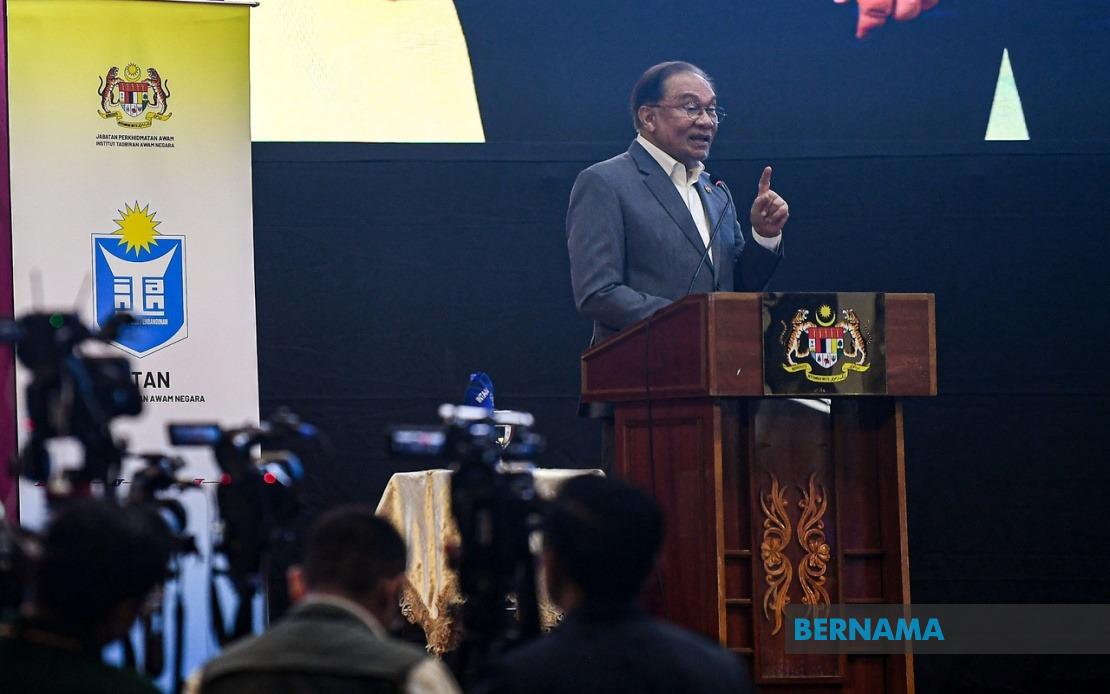
Prime Minister Datuk Seri Anwar Ibrahim has delivered a pointed critique of what he describes as a lingering colonial mentality among Malaysians, arguing that nearly seven decades after independence, the nation must consciously reject the assumption that Western models represent the gold standard for development across all spheres of life. Speaking at Universiti Islam Selangor during an address to civil servants from the Central Zone, Anwar contended that true independence extends far beyond the symbolic hoisting of flags and the formal severance of administrative ties with colonial powers. Instead, he positioned genuine sovereignty as an ongoing exercise in nation-building grounded in Malaysia's own values, cultural heritage, and indigenous strengths.
The Prime Minister identified a paradox that, in his assessment, continues to undermine Malaysia's self-determination: successive generations born after the country achieved independence in 1957 remain intellectually and culturally oriented toward Western frameworks. Anwar articulated this phenomenon with particular emphasis on the education sector, where he suggested that many Malaysians maintain an unconscious preference for English-medium instruction, Western pedagogical approaches, and Anglo-American models of scholarship. This preference, he implied, reflects not an objective evaluation of alternative systems but rather an internalized belief in Western superiority inherited from the colonial era. The Prime Minister's comments suggest growing frustration within government circles about what officials perceive as an insufficient pace of decolonization in Malaysian institutional thinking and cultural practice.
Anwar's framing of the issue extends beyond education to encompass economic systems, political structures, and governance frameworks. He pointed out that policy-makers and institutional leaders frequently look to Western economies and political models as templates for reform and development, often without adequately considering whether such frameworks suit Malaysia's particular demographic composition, historical trajectory, and social fabric. The implicit argument is that Malaysia's development challenges—from urban poverty to infrastructure gaps to regulatory inefficiency—require solutions tailored to Malaysian conditions rather than wholesale importation of foreign models, however successful those models may have proven elsewhere. This represents a significant rhetorical pivot within government discourse, suggesting that technocratic embrace of international best practices will henceforth need to be balanced against arguments for contextualization and cultural appropriateness.
The address to Central Zone civil servants carried particular weight given the audience. As the backbone of Malaysia's state apparatus, the civil service wields enormous influence over policy implementation, institutional culture, and the daily interactions between government and citizens. By directing his remarks toward this cohort, Anwar signaled that the rejection of colonial mentality must become operational doctrine within government agencies themselves. The presence of Chief Secretary to the Government Tan Sri Shamsul Azri Abu Bakar and Director-General of the Public Service Tan Sri Wan Ahmad Dahlan Abdul Aziz at the event suggested official endorsement of this messaging from the highest levels of public administration. The staging appeared designed to communicate that this is not peripheral rhetoric but rather a strategic reorientation of how Malaysia's government apparatus should approach its mandate.
For Malaysian readers accustomed to seeing their nation navigate between global integration and domestic identity, Anwar's comments reflect an ongoing tension that shapes policy across multiple domains. The education system, for instance, has long oscillated between English-medium and Malay-medium instruction, with periodic campaigns to strengthen local languages and indigenous knowledge systems alternating with pragmatic recognition that English proficiency enhances regional and global competitiveness. Similarly, Malaysia's economic development strategy has traditionally balanced attraction of foreign investment and adoption of international business practices against promotion of homegrown industries and indigenous entrepreneurship. Anwar's intervention suggests that the current government intends to tilt the balance more consciously toward the latter pole, at least in rhetorical terms.
The broader context of these remarks relates to Malaysia's ongoing efforts to define its post-colonial identity in an era of globalization. Unlike some Southeast Asian neighbors that experienced relatively straightforward colonial transitions, Malaysia's path to independence involved constitutional compromise between traditional rulers, emergent national leadership, and departing colonial administrators. This created a governance structure that blended Westminster parliamentary traditions with traditional monarchical authority and eventually, Islamic constitutional provisions. The resulting system reflects hybrid influences rather than pure adoption of any single model. Anwar's call for greater authenticity in Malaysian development approaches implicitly questions whether even this hybrid arrangement reflects sufficient emphasis on genuinely Malaysian innovation and problem-solving.
From a regional perspective, Anwar's comments resonate with broader conversations occurring across Southeast Asia about cultural preservation and authentic development paths. Nations throughout the region grapple with balancing modernization against cultural continuity, and with determining the extent to which Western institutional models should shape their governance, education, and economic strategies. Thailand, Indonesia, and Vietnam have all articulated variants of arguments for development approaches rooted in local conditions and values rather than external templates. Anwar's positioning of Malaysia within this regional conversation suggests that Southeast Asian nations are increasingly asserting greater agency in selecting which global practices to adopt and which to adapt or reject.
The practical implications of such rhetoric, however, remain somewhat ambiguous. Anwar has not specified which particular Western models Malaysia should abandon, nor has he detailed what Malaysian-rooted alternatives would entail in concrete policy terms. The call for building on Malaysian values invites the question of which values, since Malaysia's population encompasses diverse ethnic, religious, and cultural communities with sometimes competing visions of national identity. Implementation of these principles across government agencies will require navigation of complex questions about whose values should predominate and how institutional decisions should balance inclusivity against cultural particularity. The rhetoric thus establishes a general direction—toward greater Malaysian self-determination in development approaches—while leaving significant room for interpretation about specific applications.
Looking forward, Anwar's intervention suggests that Malaysian government agencies should expect greater scrutiny of their adoption of international best practices and foreign institutional models. Officials may face implicit or explicit pressure to justify why particular Western frameworks are being imported rather than developing distinctively Malaysian approaches to challenges like service delivery, regulatory efficiency, or anti-corruption efforts. This could prompt more intentional efforts to study and systematize Malaysian success stories, to identify indigenous practices that have proven effective, and to position Malaysia as a source of development innovation for the region rather than exclusively as an adopter of external models. Such reorientation would represent a significant shift in how Malaysia's government elite view their nation's role in global institutional conversations.

