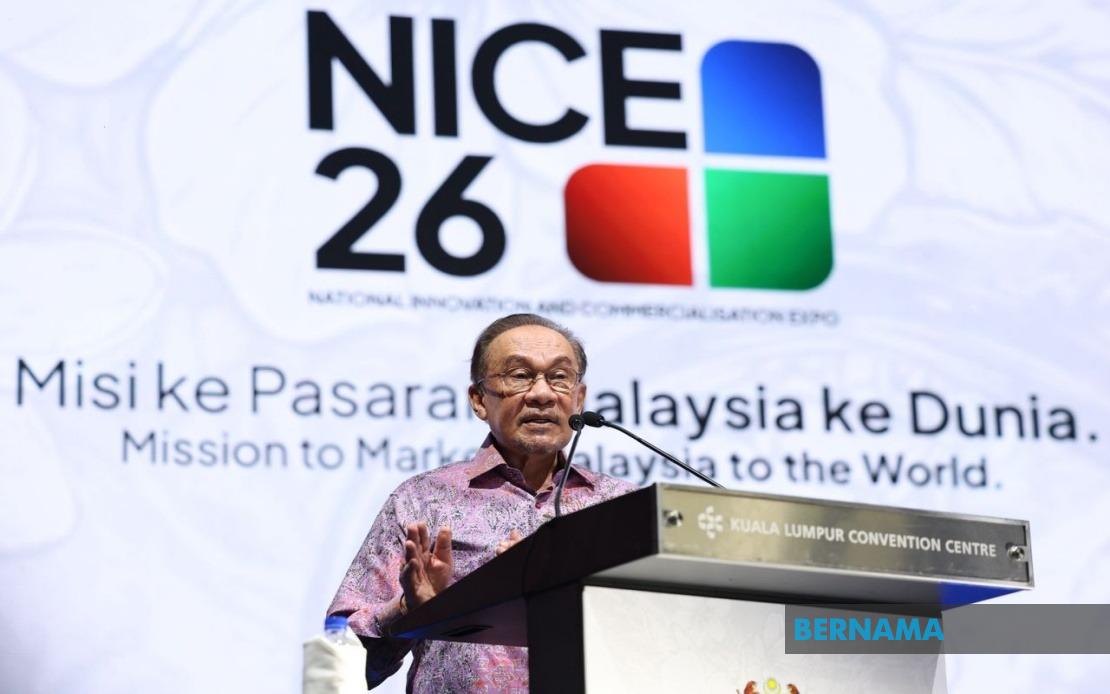
Prime Minister Datuk Seri Anwar Ibrahim has issued a forceful call for the dismantling of outdated bureaucratic structures that he argues are hampering Malaysia's ability to compete in the global innovation race. Speaking at the National Innovation and Commercialisation Expo (NICE) 2026 at the Kuala Lumpur Convention Centre, Anwar emphasised that traditional approval mechanisms are fundamentally incompatible with the speed and agility demanded by contemporary technology development and commercial deployment.
The core of Anwar's argument rests on a simple but significant premise: the world's innovation landscape operates at a pace that bears no resemblance to the leisurely timelines of conventional government administration. When breakthrough technologies emerge and companies race to commercialise them, delays measured in months or years can mean the difference between market leadership and obsolescence. Malaysia, as a developing economy aspiring to technological sophistication, cannot afford to let bureaucratic inertia rob it of competitive advantage in sectors such as artificial intelligence, biotechnology, and digital transformation.
To illustrate his point, Anwar cited a concrete example drawn from Malaysia's recent institutional reforms. The establishment of artificial intelligence faculties at several local universities was accomplished in just three months—a timeline that would normally require a full year or more under standard procedures. This achievement demonstrates that rapid progress is achievable when administrative constraints are relaxed and decision-making authority is concentrated. The Prime Minister used this success story to challenge the entrenched mindset within government agencies that continues to view lengthy approval chains, multiple senate meetings, and council deliberations as necessary safeguards rather than obstacles.
The inefficiency Anwar identified extends beyond mere inconvenience; it represents a systemic weakness that threatens Malaysia's position within the broader Southeast Asian technology ecosystem. Neighbouring countries and global competitors are increasingly demonstrating agility in establishing new academic programmes, approving research initiatives, and fast-tracking commercialisation pathways. When Malaysian institutions are forced to navigate bureaucratic labyrinths while their counterparts elsewhere operate with streamlined approval processes, the cumulative disadvantage becomes substantial. Talented researchers and innovative entrepreneurs may gravitate toward jurisdictions offering faster, more straightforward pathways to realisation.
Anwar's remarks were directed specifically at the Ministry of Science, Technology and Innovation (MOSTI) and other relevant government departments, framing his critique not as personal criticism but as urgent advocacy for systemic change. He characterised the current moment as a "post-normal world" where historical approaches to governance cannot be transplanted directly into contemporary contexts. The implication is that public institutions must fundamentally recalibrate their operating philosophy, replacing a compliance-first mentality with an innovation-first orientation that asks whether regulatory requirements genuinely serve public interest or merely perpetuate administrative tradition.
This tension between institutional caution and dynamic innovation sits at the heart of governance debates across Southeast Asia. Malaysia is not alone in grappling with this challenge; however, the Prime Minister's explicit acknowledgment that change is imperative signals readiness to confront powerful bureaucratic constituencies that benefit from the status quo. Long approval timelines create job security for administrative gatekeepers and provide comfortable predictability for institution managers. Dismantling these structures requires not just policy directives but sustained political will to resist inevitable resistance from entrenched interests.
The commercialisation dimension adds particular urgency to Anwar's argument. Research conducted within Malaysia's universities and institutes produces intellectual property and innovations that could generate economic value and employment. However, when the journey from laboratory discovery to market application stretches across years of regulatory navigation, competing jurisdictions capture the opportunity first. Technologies pioneered by Malaysian researchers may be commercialised abroad, with Malaysia receiving neither the jobs nor the economic returns. This leakage of value represents a form of national economic loss that transcends narrow bureaucratic concerns.
ANWAR's call also reflects broader governance challenges facing Malaysia as it attempts to position itself as a regional technology hub. Singapore, for instance, has built its reputation partly on administrative efficiency and regulatory clarity. Thailand and Vietnam are similarly investing in streamlined approval processes for technology enterprises. If Malaysia cannot match this competitive environment, foreign investors and talented professionals will make locational choices favouring jurisdictions with less friction. The cost of bureaucratic sluggishness thus extends to foreign direct investment, brain drain, and missed economic opportunities.
Implementing Anwar's vision will require more than rhetorical commitment. Government agencies typically resist rapid change because speed creates perceived accountability risks and challenges institutional hierarchies. Departments must be given explicit authority and protection to approve initiatives without waiting for multiple layers of review. Performance incentives must reward speed alongside safety. Training and cultural reorientation within public institutions will be essential. The Prime Minister's willingness to publicly champion this agenda suggests recognition that change will not occur spontaneously; it requires sustained executive pressure and visible leadership commitment.
The NICE 2026 platform serves as both venue and symbol for this broader agenda. Bringing together innovators, entrepreneurs, investors, and government representatives creates opportunity for direct dialogue about removing obstacles to commercialisation. Expo participants can provide real-world testimony about specific bottlenecks encountered. This feedback loop can inform targeted reforms addressing actual pain points rather than abstract bureaucratic streamlining. The event thus becomes a potential catalyst for translating Anwar's rhetoric into concrete institutional reform.
For Malaysian businesses and researchers, the Prime Minister's intervention offers encouragement that long-standing frustrations with administrative delays are finally receiving high-level attention. Whether this translates into meaningful change will depend on follow-up implementation and the political resolve of MOSTI and collaborating agencies to challenge their own conventional practices. The coming months will reveal whether Anwar's call for speed and flexibility represents transformative reform or merely another exhortation that bureaucratic inertia will ultimately absorb and neutralise.

