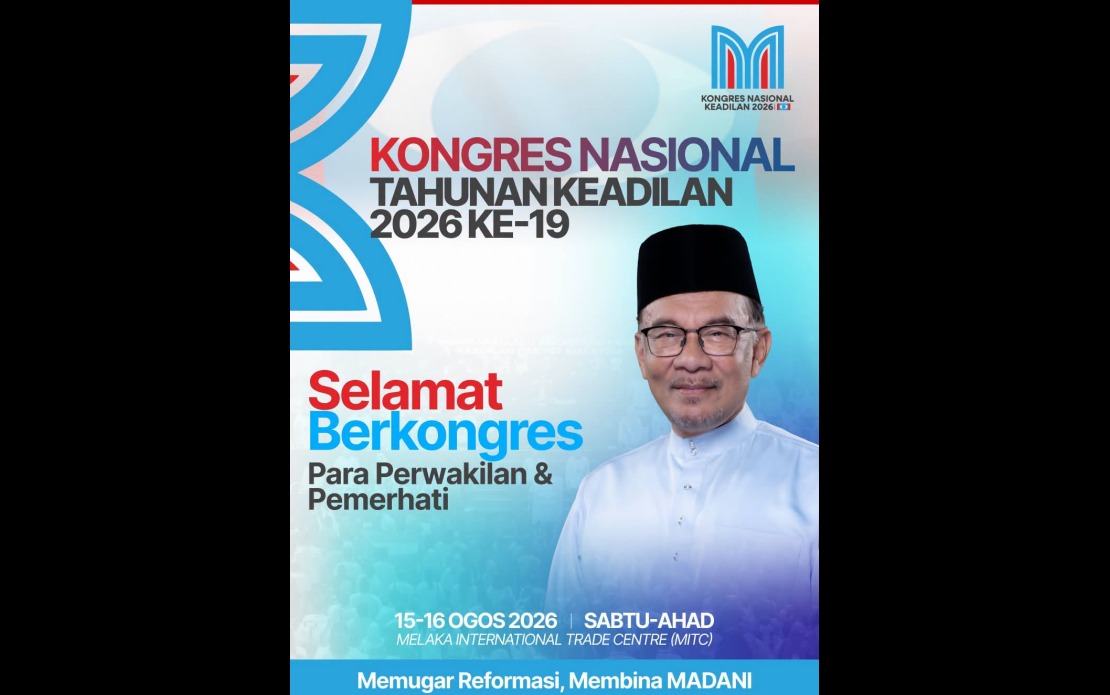
Prime Minister Datuk Seri Anwar Ibrahim has stressed that Parti Keadilan Rakyat must fundamentally remain a mass-based political movement anchored in principles of integrity, social justice, unity and public trust, rather than narrowing its identity to an electoral vehicle. Speaking through a Facebook post on August 14, Anwar articulated a vision for PKR that extends beyond the mechanics of winning votes and parliamentary seats, positioning instead the party's deeper commitment to nation-building and institutional accountability as central to its long-term relevance and legitimacy.
The Prime Minister's remarks arrive ahead of PKR's National Congress 2026, scheduled to convene for two days beginning August 15 at the Melaka International Trade Centre in Ayer Keroh. This gathering represents a significant moment for Malaysia's largest component of the Pakatan Harapan coalition to recalibrate its strategic direction and reinforce the foundational values that propelled the party's emergence during the Reformasi movement of the late 1990s. Anwar framed the congress as an essential opportunity for introspection, inviting delegates to examine what the party has accomplished and to recommit to advancing its historical mission.
Anwar's intervention carries particular weight given his own position as PKR's de facto ideological custodian and as the nation's sitting Premier. By publicly articulating expectations that transcend electoral calculus, he is attempting to steer the party's internal conversation away from mere power consolidation towards substantive governance values. His messaging suggests awareness that political parties, especially those claiming reformist credentials, risk losing moral authority and public confidence when perceived as prioritizing factional interests or electoral advantage over coherent policy platforms and ethical standards.
The congress theme, "Memugar Reformasi, Membina MADANI" (Revitalising Reformasi, Building MADANI), reflects an intentional threading of PKR's historical identity with the current government's development agenda. MADANI, the administration's overarching policy framework, emphasises prosperity, unity and cultural inclusivity. By linking party renewal to this national initiative, organisers are seeking to position PKR not as a faction demanding its share of patronage but as a serious instrument of national transformation. The timing of these emphases suggests internal management of expectations within the party structure itself.
PKR's trajectory since 1997 has been marked by cycles of organisational consolidation alternating with periods of internal fragmentation. The party has grown substantially in electoral strength, particularly following the 2018 general election, yet this growth has sometimes created tensions between its reformist ideological moorings and the pragmatic demands of coalition governance and ministerial portfolio distribution. Anwar's current message appears designed to reinforce that institutional discipline and principled governance must accompany electoral success, not be subordinated to it.
For Malaysian readers, these comments carry implications that extend beyond PKR's internal deliberations. As the largest single party in the ruling coalition and home to the Prime Minister himself, PKR's institutional health and strategic orientation influence the broader trajectory of Malaysian politics and governance. A PKR that prioritises factional competition or treats governance as transactional would create ripple effects across the coalition, potentially undermining stability or public confidence. Conversely, a PKR that genuinely embodies the reformist values its founding narrative invokes becomes a template for how other political parties might recalibrate their own institutional cultures.
Anwar's scheduled policy speech at the congress tomorrow is expected to articulate PKR's medium-term strategic agenda with specificity, outlining priorities that presumably align with the principles he has now publicly endorsed. This address will be closely examined by party members, coalition partners, political analysts and observers internationally, as it may signal whether PKR is repositioning itself on substantive policy grounds, internal governance reforms, or structural changes to how the party conducts its affairs. The substance of his remarks will either reinforce or complicate the ethical framework he has outlined in his preliminary statement.
The symbolism of holding the congress in Melaka carries its own resonance within Malaysian political culture. The state, historically associated with the Sultanate and classical Malay-Muslim civilisation, provides a backdrop that anchors PKR's claims to national rather than sectional legitimacy. This geographic choice, combined with the thematics of Reformasi and MADANI, constructs a narrative arc in which the party positions itself as heir to both historical struggle and contemporary developmental aspiration.
Southeast Asian political observers note that the challenge facing PKR is not unique. Across the region, parties that emerged from pro-democracy or anti-corruption movements have struggled to maintain internal cohesion and ideological clarity once assuming governmental power. The tension between maintaining revolutionary spirit and managing institutional complexity represents a recurrent pattern. Anwar's current intervention suggests PKR leadership recognises this danger and is attempting to inoculate the party against the institutional decay that has afflicted other regional movements once they entered formal power structures.
Looking ahead, the congress will likely feature deliberations on internal democratic processes, party discipline mechanisms, youth engagement strategies and the relationship between party structures and government ministries. How PKR navigates these conversations will partly determine whether Anwar's call for principle-based politics takes root institutionally or remains aspirational rhetoric. The gathering therefore merits close attention not merely as a party management exercise but as a test case in whether Malaysia's political system can evolve beyond patronage-driven models toward more transparent, merit-based and accountable governance.
Anwar concluded his Facebook message by invoking divine blessing for the party's efforts, framing PKR's institutional renewal as inseparable from the nation-building project itself. This invocation carries weight in the Malaysian political context, where religious and moral language frequently accompanies appeals for unity and ethical conduct. Whether the congress produces concrete institutional changes matching the philosophical scope of Anwar's vision remains to be determined when delegates convene at MITC Ayer Keroh.

