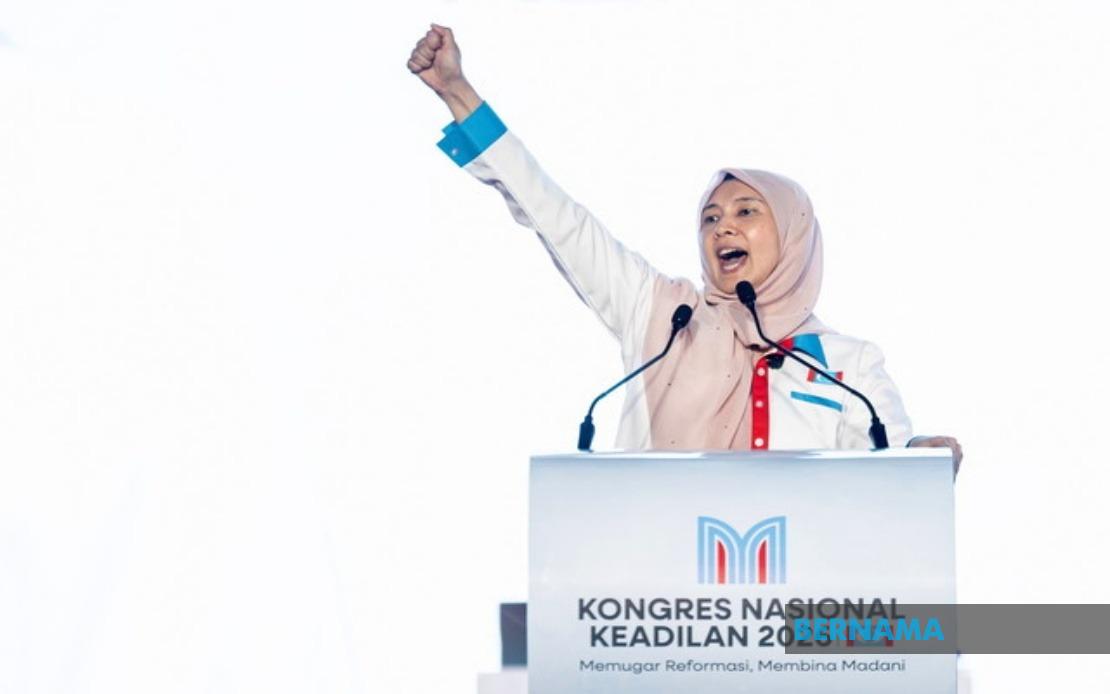
PKR deputy president Nurul Izzah Anwar has called on her party to sustain its commitment to systemic reform across government institutions and policymaking, arguing that the struggle which gave birth to PKR cannot simply end once the party wields executive authority. Speaking at the PKR 2026 National Congress in Melaka on August 16, she articulated a vision of continuous institutional change that extends beyond electoral victory, positioning reform as an ongoing generational responsibility rather than a political destination.
The party, Nurul Izzah emphasised, emerged from a historical moment defined by demands for democratic renewal and institutional accountability. That foundational energy should not dissipate upon gaining office, she contended, but rather become embedded in how PKR governs and shapes public administration. Her remarks reflect growing concern within reformist circles that parties pursuing power can gradually abandon the structural changes they once championed once those changes become politically inconvenient or administratively complex.
Nurul Izzah pointed to concrete achievements to illustrate the potential of sustained reform when political will exists. The repeal of the Universities and University Colleges Act (AUKU) 1971, a landmark victory for academic freedom that PKR had campaigned for extensively during opposition years, demonstrated what becomes possible when reform-minded parties transition into government. The legislation's removal after decades of student activism underscored how electoral victory can unlock previously blocked pathways for institutional transformation. Yet she implicitly warned that such victories should not breed complacency.
The deputy president identified economic structural reform as the next critical frontier for PKR's agenda. While the MADANI Government has achieved notable economic growth metrics, she argued that such expansion means little to ordinary Malaysians unless it translates into tangible improvements in their material circumstances. This distinction between aggregate national economic performance and household-level prosperity has become increasingly important in Malaysian politics, particularly as real wage stagnation and cost-of-living pressures persist despite favourable macroeconomic indicators.
She specifically highlighted the need to expand job creation pathways, strengthen the small and medium enterprise (SME) sector, and create meaningful economic participation opportunities for women and young people. These constituencies have historically felt excluded from Malaysian economic structures, facing barriers to capital access, labour market discrimination, and limited pathways into senior management or entrepreneurship. Genuine economic inclusion would require deliberately restructuring labour markets and removing institutional impediments rather than relying on general economic growth to benefit all groups equally.
Wage and salary structure reform emerged as particularly significant in Nurul Izzah's remarks, reflecting broader anxieties about whether Malaysian workers can sustain living standards as productivity increases but wage growth lags. Her call for salary structures to become progressively fairer and wage rates to move in line with productivity gains touches on a fundamental tension in Malaysia's development model: despite rising per-capita income, individual workers in many sectors have seen compensation growth significantly outpaced by economic expansion. Addressing this requires confronting employer behaviour, sectoral power imbalances, and potentially contentious questions about labour regulation.
Beyond specific policy recommendations, Nurul Izzah delivered a philosophical caution to PKR's leadership cadre about the psychological dangers of holding office. She warned against viewing political power as personal property to be exploited or accumulated, rather than as a temporary public trust requiring stewardship. This framing acknowledges a familiar pattern in Malaysian politics where parties transitioning from opposition to government sometimes shift their internal culture toward protecting incumbent interests rather than pursuing stated objectives.
Her observation that "positions change, titles fade, names will be silent rather than mentioned, but what remains is the work we leave behind and the values we uphold" carried implicit criticism of careerism and self-interested political behaviour. The statement suggests that PKR leaders should measure their legacies by institutional reforms and policy achievements rather than by titles held or personal advancement secured. In the Malaysian context, where political dynasties and patronage networks significantly shape party dynamics, this message carries considerable weight.
For Malaysian observers, Nurul Izzah's address raises important questions about PKR's trajectory as a governing party. The party entered government in 2018 as part of the Pakatan Harapan coalition with strong reformist credentials, but that government collapsed after just 22 months. The subsequent PKR-led coalition under Anwar Ibrahim's premiership has faced persistent criticism that it has prioritised political stability and consensus-building over the institutional reforms that motivated supporters during opposition years. Nurul Izzah's speech can be read partly as internal pressure to refocus governance on substantive transformation.
The timing of her remarks at a national party congress also matters significantly. Party congresses function as forums where leadership can gauge member sentiment and recalibrate strategic messaging. That Nurul Izzah chose to emphasise sustained reform commitment suggests PKR's grassroots membership may harbour concerns that the party is accommodating too readily to existing power structures rather than challenging them. This dynamic frequently emerges in Malaysian opposition parties once they assume government, as the complexities of administration and the political costs of pushing reforms can dampen revolutionary ardour.
For Malaysia's broader political development, the question Nurul Izzah's address implicitly poses concerns whether any political party in power can maintain the reformist discipline it demonstrated as an opposition movement. The contrast between reform rhetoric and governance reality has repeatedly frustrated Malaysian voters who invest hope in opposition parties only to see them moderate their ambitions upon taking office. Sustaining genuine structural reform requires ongoing political commitment, willingness to challenge entrenched interests, and acceptance that such changes often impose short-term costs on groups with political influence.
Looking forward, the success of PKR's reform agenda will depend on whether the party can translate Nurul Izzah's philosophical exhortations into concrete institutional mechanisms that sustain reform momentum regardless of individual leaders' commitment levels. This might involve establishing dedicated reform units within government, embedding reform metrics into ministerial performance evaluations, and creating mechanisms for grassroots members to hold leadership accountable to stated reform objectives. Without such structural supports, reform commitments tend to erode as administrative pressures and political self-interest accumulate.

