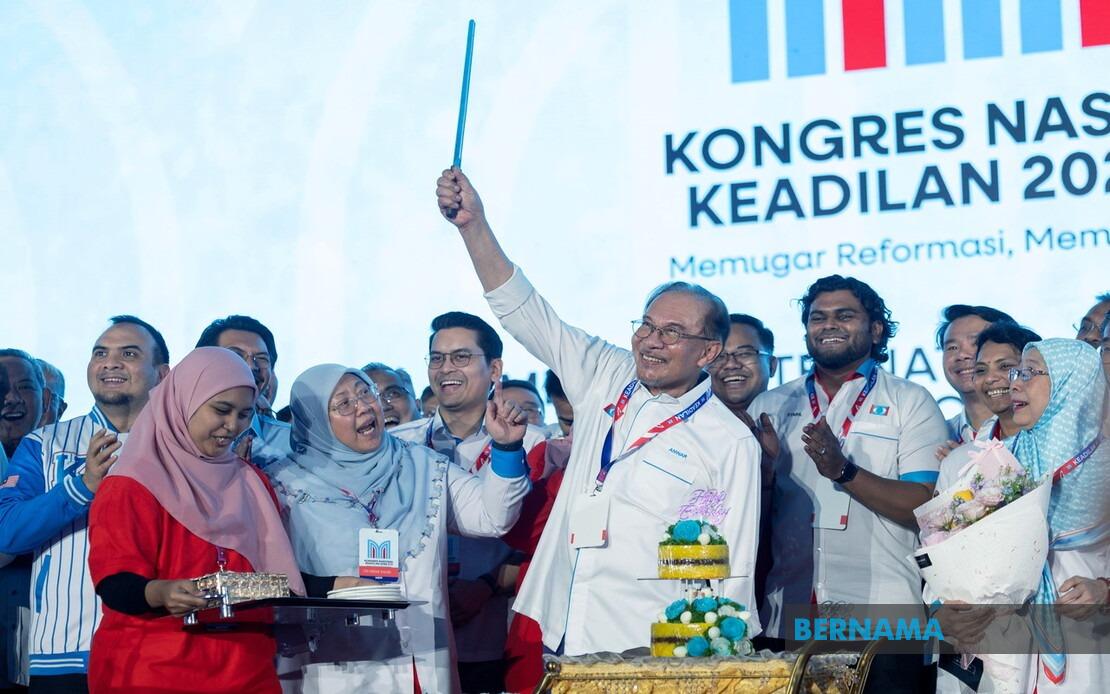
The PKR National Congress 2026 concluded in Melaka on Friday with the party reasserting its foundational commitment to political stability and advancing a comprehensive reform agenda—twin priorities that define its complicated position as both government partner and self-described reform movement. The two-day gathering served as a platform for the party to navigate the inherent tensions of governing within a broad coalition while maintaining the ideological principles that originally propelled it to prominence.
Party president Datuk Seri Anwar Ibrahim used his closing remarks to signal unwavering support for the Unity Government framework, which has governed Malaysia since November 2022. He pledged to continue championing the coalition arrangement, framing political cooperation as essential for ensuring economic growth and material improvements for ordinary Malaysians. His message carried implicit acknowledgment that maintaining this alliance remains a deliberate choice rather than an inevitable arrangement, underscoring how fragile such multi-party governments typically remain in the Malaysian context.
Crucially, Anwar acknowledged that the longevity and future direction of the Unity Government ultimately rest with coalition partners UMNO and Barisan Nasional rather than with PKR alone. This candid assessment reflects the mathematical reality of coalition politics in Malaysia, where no single party commands sufficient parliamentary numbers to govern independently. The statement also suggested potential unease about the stability of arrangements that depend on former political adversaries maintaining their commitment to cooperation beyond immediate electoral or factional pressures.
The Prime Minister issued a pointed warning against what he termed excessive or destabilising steps by any coalition member, implying concerns about the pressures and centrifugal forces that threaten multi-party arrangements. He characterised the Unity Government's foundation as grounded in political pragmatism and national interest rather than ideological alignment, a framing that attempts to elevate the coalition above partisan calculations. This distinction matters because it rejects the notion that the arrangement is merely transactional or temporary.
Deputy president Nurul Izzah Anwar emerged as a key voice on PKR's reform credentials, insisting that the party's transformative agenda cannot be shelved simply because it now participates in government. She contended that meaningful reforms across party structures, administrative systems, and policy frameworks remain both necessary and achievable within a governing context. Her intervention addressed a fundamental criticism from PKR's ideological base: that entering government represents a compromise of principle rather than an opportunity to implement long-cherished reforms.
The party highlighted the repeal of the Universities and University Colleges Act (AUKU) 1971 as tangible evidence that reform aspirations can materialise within a government setting. This decades-old legislation had restricted student political activity and assembly rights, becoming a potent symbol of authoritarian governance. PKR leveraged the repeal as validation that patient, insider advocacy could achieve what decades of opposition activism had not. Anwar additionally pledged that the government would resist replacing AUKU with alternative legislation that might impose comparable restrictions, and indicated Cabinet-level attention to this commitment.
The congress also underscored PKR's strategic positioning around emerging generational concerns. Angkatan Muda Keadilan, the party's youth wing, prioritised themes resonating with Generation Z and younger workers, including formal recognition and protection for gig economy participants, expanded social safety nets, structured skills development, mental health support, and broader workplace wellbeing initiatives. These priorities reflect calculations about which constituencies hold long-term political value and which policy areas distinguish PKR from rival coalitions.
Technology and inclusive economic participation featured prominently in the youth wing's agenda, particularly regarding Bumiputera involvement in artificial intelligence, semiconductors, and biotechnology sectors. This framing bridges concerns about demographic representation with forward-looking economic participation, suggesting PKR positions itself as simultaneously committed to traditional affirmative action frameworks and contemporary technological advancement—a delicate balance in Malaysian politics.
Education Minister Fadhlina Sidek, serving as PKR's Wanita chief, underscored the imperative for increased female representation in leadership and decision-making roles within both the party and broader government structures. She additionally stressed that party and government leaders must demonstrate receptiveness to criticism and a genuine commitment to governance improvement. Her remarks indicated PKR's understanding that maintaining the coalition's stability and legitimacy requires visible responsiveness to constituent concerns and perceived grievances.
The congress's emphasis on organisational readiness and political preparedness suggests PKR's leadership recognises the uncertainty inherent in Malaysian coalition politics. By calling for the party to remain operationally and strategically prepared regardless of political developments—and explicitly noting this preparedness should not depend on parliamentary dissolution or candidate announcements—PKR signalled awareness that stability assumptions could shift with limited warning. This prudent positioning balances continued commitment to Unity Government cooperation with contingency thinking.
The overall tenor of the congress reflected PKR's attempt to reconcile contradictory imperatives: defending a political arrangement that constrains its autonomy while maintaining its identity as a reform force; emphasising stability and continuity while preparing for potential disruption; claiming credit for achievements within government whilst preserving its oppositional credentials. This balancing act will ultimately determine whether PKR emerges from the Unity Government period strengthened or diminished.
For Malaysian observers and regional analysts, PKR's congress signals that the party intends to pursue a dual-track strategy: solidifying the coalition's foundations through demonstrated reliability and policy achievements, whilst gradually advancing reform initiatives and demographic outreach that position it for potential post-coalition scenarios. Whether this approach sustains Unity Government viability or merely prolongs an inherently unstable arrangement remains among the most significant questions in contemporary Malaysian politics.

