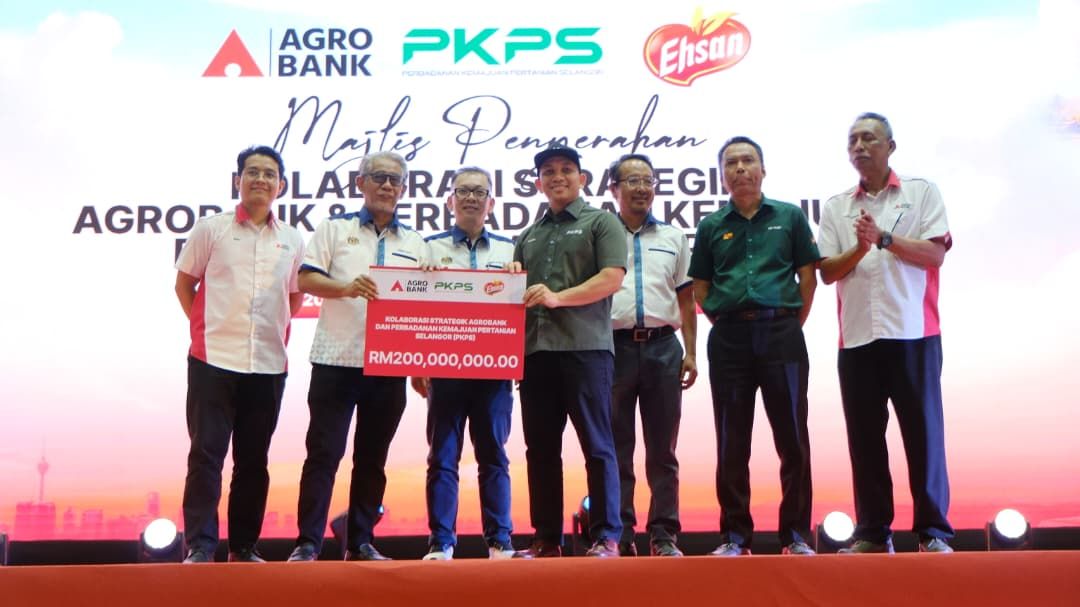
The Selangor Agricultural Development Corporation (PKPS) has established a pivotal RM200 million trade financing facility in partnership with Agrobank, marking a significant investment in bolstering the state's agricultural infrastructure and food supply resilience. The collaboration, formalised during the Malaysia Agriculture, Horticulture and Agrotourism Exhibition (MAHA) 2026 at the Malaysia Agro Exposition Park (MAEPS) Serdang on August 29, addresses critical gaps in Selangor's agrifood capacity whilst simultaneously providing working capital support to PKPS operations. This strategic alignment reflects growing recognition among Malaysian policymakers that comprehensive food security requires substantial infrastructure investment coupled with operational flexibility for agricultural enterprises.
The facility represents more than a conventional lending arrangement; it constitutes a structured commitment spanning multiple development dimensions. Agrobank group president and chief executive officer Datuk Tengku Ahmad Badli Shah Raja Hussin presented the funding commitment to PKPS group chief executive officer Datuk Dr Mohamad Khairil Mohamad Razi, with the ceremonial handover witnessed by Deputy Agriculture and Food Security Minister Datuk Chan Foong Hin. Though the formal activation occurs in March 2027, the framework addresses both capital infrastructure and operational requirements, demonstrating recognition that agricultural development requires sustained financial support beyond initial construction phases.
Selangor's planned halal food warehouse emerges as the cornerstone project under this facility, functioning as a centralised storage and logistics hub designed to optimise the state's food distribution network. This facility addresses a recognised vulnerability in Malaysia's agrifood chain—the absence of modern, centrally coordinated storage infrastructure that can bridge production zones with consumer markets whilst maintaining stringent halal compliance standards. For Malaysian consumers and businesses, such infrastructure development carries immediate practical implications, as improved storage capacity typically translates to reduced spoilage, more stable pricing, and enhanced availability of fresh agricultural products across urban and rural areas.
Beyond the warehouse, the facility finances construction of a halal chicken processing centre and an Ehsan product processing centre, both critical components of value-chain integration. These facilities represent deliberate efforts to shift Selangor's agricultural economy beyond primary production toward higher-value processing activities. Such vertical integration strengthens resilience against external market shocks whilst creating employment opportunities spanning technical, managerial, and skilled labour positions. The central distribution warehouses slated for construction and upgrading across Selangor's districts further demonstrate commitment to disaggregated logistics networks, ensuring food availability remains equitable across geographical areas rather than concentrated in major urban centres.
The financing arrangement incorporates structured disbursement protocols tied explicitly to project progression. Rather than providing lump-sum allocations, the facility employs milestone-based drawdowns ensuring disciplined cash flow management throughout the partnership period. This methodology protects both lending and borrowing institutions whilst maintaining transparency across fund utilisation—a governance consideration increasingly important as public entities and their private-sector partners navigate accountability expectations. Such mechanisms become particularly significant in Malaysian contexts where infrastructure financing has occasionally attracted scrutiny regarding project execution and budget management.
Operational and research dimensions extend the facility's scope beyond physical infrastructure. The commitment encompasses ready-to-eat and ready-to-heat food products marketed under the Ehsan brand, addressing contemporary consumer preferences toward convenience whilst supporting value addition within Selangor's agrifood ecosystem. Critically, the facility funds operations of the Ehsan Agricultural Research Centre, dedicating resources toward smart agriculture methodologies and modernised farming techniques. Simultaneously, the Ehsan Agricultural Training Centre receives support, recognising that infrastructure and technology require complementary human capital development to realise their full potential.
Agritourism development through the Ehsan Resort and Convention Centre represents an often-overlooked dimension of agricultural sustainability. By integrating visitor experiences with working agricultural operations, such facilities generate supplementary income streams whilst fostering public understanding of modern farming practices. For Malaysian tourism and agricultural sectors seeking diversification pathways, agritourism increasingly represents viable mechanisms for agricultural communities to capture value from experiential economies—particularly as domestic and regional tourism recovers.
This partnership alignment with MAHA 2026's theme of "Value Creation for Food Security" extends beyond promotional messaging into substantive strategic positioning. The collaboration reflects conscious prioritisation of sustainable investment, technological modernisation, and operational capacity strengthening throughout the production-to-distribution continuum. Rather than fragmented interventions targeting isolated components, this approach acknowledges that food security demands integrated ecosystem development encompassing storage, processing, distribution, research, and human development simultaneously.
For Southeast Asian agricultural policy observers, the PKPS-Agrobank partnership offers instructive perspectives on state-level food security strategies. Selangor's approach combines direct state enterprise involvement through PKPS with private financial sector participation through Agrobank, acknowledging that neither public nor private institutions alone possess sufficient resources or expertise for comprehensive agricultural system modernisation. This hybrid model potentially holds applicability across the region, particularly for states and provinces confronting similar infrastructure deficits and food supply volatility.
The facility's emphasis on halal certification and Ehsan-branded products reflects deliberate differentiation strategies within competitive regional agrifood markets. Malaysia's halal credentials remain internationally significant, yet maintaining and extending these advantages requires continuous infrastructure investment demonstrating commitment to certification integrity. By embedding halal compliance within core infrastructure design, PKPS positions Selangor's agricultural products advantageously within both domestic and export markets increasingly demanding transparent, verified production standards.
Longer-term implications extend toward Selangor's broader food self-sufficiency objectives. The state, hosting Malaysia's capital region yet relying substantially on imported or interstate agricultural products, faces structural vulnerabilities regarding supply disruptions and price volatility. Through coordinated infrastructure, processing, and distribution capacity development, PKPS pursues incremental reduction of these dependencies. Malaysian policymakers monitoring regional food security trends increasingly recognise that domestic production capacity, particularly within densely populated state economies, provides essential resilience against international supply chain disruptions—a lesson sharpened by recent pandemic experiences and ongoing global logistics challenges.
Implementation success will depend substantially on execution discipline, technical capacity, and sustained institutional coordination. The March 2027 activation date establishes concrete accountability benchmarks, though infrastructure projects characteristically encounter planning, procurement, or construction complexities. Monitoring the facility's deployment patterns—particularly whether disbursements align with projected timelines and whether completed projects achieve anticipated operational efficiency—will provide valuable evidence regarding public-private partnerships' effectiveness in Malaysian agricultural development contexts.
Ultimately, the PKPS-Agrobank facility represents pragmatic recognition that Selangor's food security cannot rely indefinitely on historical supply arrangements. By mobilising RM200 million toward integrated infrastructure, processing, research, and human development initiatives, the partnership establishes foundational capacity supporting long-term agricultural sustainability and supply chain resilience. For consumers across Malaysia and the broader region, such infrastructure investments translate eventually into more reliable, diverse, and competitively priced food availability—outcomes that justify continued attention to how agricultural financing mechanisms are structured and deployed.

