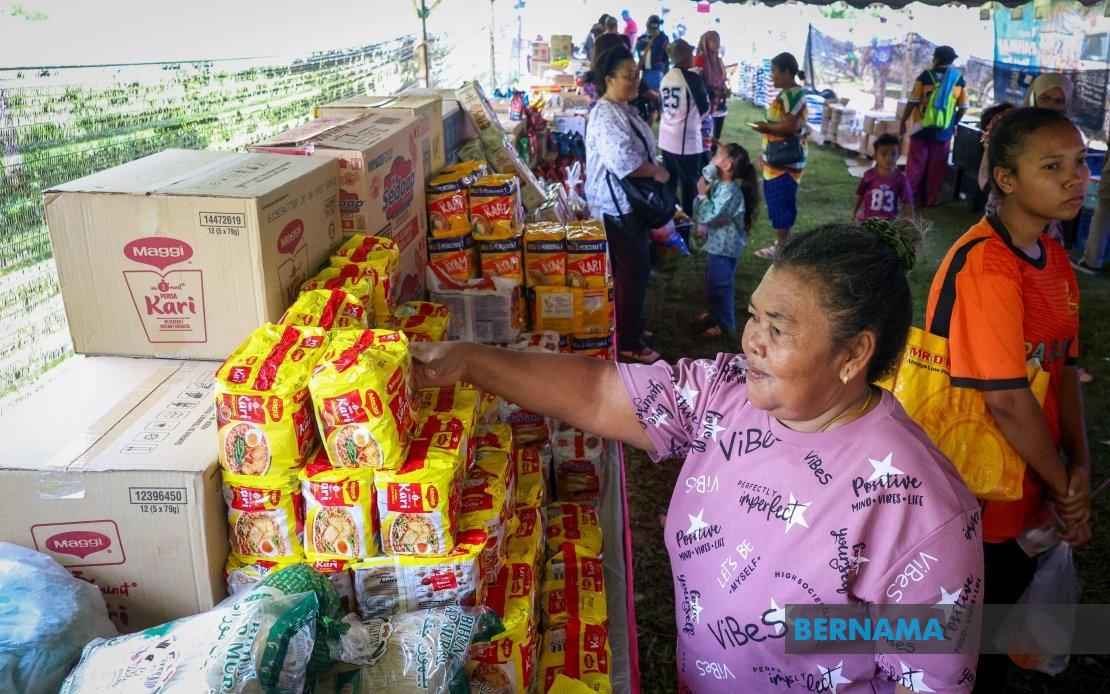
The Rahmah MADANI Sales Programme (PJRM) has extended its reach to the Pasik Resettlement Scheme (RPS) in Gua Musang, bringing price relief to over 1,000 Temiar Orang Asli inhabitants who previously endured arduous journeys and substantial costs to obtain basic household goods. The initiative represents a significant accessibility improvement for one of Peninsular Malaysia's most remote indigenous communities, demonstrating how targeted government programmes can address the particular vulnerabilities of marginalised populations in rural areas.
Residents previously had no choice but to travel to Kampung Jerek, requiring approximately two and a half hours of transit, to access PJRM's discounted stock. This expedition imposed considerable financial strain beyond the subsidised goods themselves—transportation costs alone consumed around RM600 per journey when accounting for vehicle rental, meals, and incidental expenses. For families already managing tight budgets in a subsistence economy, this friction cost rendered even subsidised prices effectively unaffordable, creating a barrier that negated the government's price support efforts.
The price differential demonstrates why extending PJRM to Pasik carries meaningful economic implications for residents. A nine-kilogramme bag of rice, typically priced at RM40 in village shops, dropped to RM29 through the programme—a 27 per cent reduction that compounds across a household's monthly purchases. When multiplied across staples like cooking oil, sugar, and other provisions that form the backbone of household budgets in lower-income communities, these savings accumulate into substantial relief. Ramli Chimbong, a Kampung Ayong resident, articulated precisely this calculation: the programme eliminates both the travel burden and the associated costs, enabling residents to redirect limited resources toward other necessities.
SMS Maju Solution, the operator managing the Pasik RPS distribution point, mobilised substantial inventory to service the initial demand. The company delivered 100 varieties of essential goods including 300 bags of rice, 300 trays of eggs, and 300 chickens, with residents queuing from 9 am to make their purchases. The strength of uptake signals both the genuine need and the effectiveness of removing access barriers—residents who previously could not feasibly participate now actively engaged with the programme. Owner Sabariah Mohamed Sayuti noted that many households retained substantial balances in their Rahmah Basic Contribution (SARA) credit accounts, with typical remaining balances ranging between RM300 and RM800, suggesting that lack of credit had not been the constraint but rather simple accessibility to redemption points.
Operating in Pasik's challenging geography presented logistical difficulties that underscore the difficulties of serving dispersed indigenous settlements. The rocky and muddy road infrastructure caused vehicle damage during supply transportation, illustrating infrastructure constraints that perpetually complicate service delivery to remote communities. Such practical obstacles explain why comparable programmes have historically concentrated in more accessible locations, effectively creating a geography of exclusion where the most remote and vulnerable populations face the highest friction costs in accessing government support.
Nenggiri assemblyman Mohd Azmawi Fikri Abdul Ghani contextualised the initiative within broader cost-of-living pressures facing rural communities throughout Malaysia. As inflation erodes purchasing power, families in remote areas experience compounded disadvantage: they face identical or higher prices for goods due to distribution inefficiencies, yet earn significantly lower incomes than their urban counterparts, with fewer economic opportunities for supplementary income. Government programmes like PJRM function as necessary counterweights to these structural inequalities, though their effectiveness depends entirely on reaching the populations most in need.
The assemblyman advocated for expanded rollout of comparable programmes across other Orang Asli settlements, recognising that Pasik, while illustrative, represents merely one location among numerous indigenous communities scattered across the peninsula's interior regions. Scaling such initiatives requires sustained investment in supply chains, operational staffing, and regular scheduling that extends well beyond metropolitan areas. The financial case for expansion rests on distributional justice—ensuring government subsidy programmes reach those facing the greatest hardship—rather than efficiency metrics that might prioritise more densely populated areas.
For Malaysian policymakers and regional observers, the Pasik PJRM deployment illustrates both the necessity and the feasibility of targeted interventions addressing service gaps in indigenous and remote communities. The programme operates as a practical acknowledgement that market mechanisms alone leave vulnerable populations systematically underserved. Where private retailers cannot profitably serve dispersed populations, and where residents cannot easily reach centralised distribution points, government programmes must fill the resulting gap. The success in Pasik suggests that such interventions, when properly resourced and thoughtfully designed, can meaningfully improve living standards without requiring residents to undertake economically ruinous journeys.
The initiative also reflects broader Southeast Asian patterns regarding indigenous communities and development. Throughout the region, Orang Asli and comparable populations inhabit marginal lands with limited market integration, creating persistent poverty cycles. Malaysia's approach through programmes like PJRM demonstrates one policy pathway: rather than attempting wholesale community relocation or economic restructuring, targeted service provision can improve welfare incrementally. However, such programmes function as supplements rather than solutions—genuine development requires addressing underlying issues of land access, educational opportunity, and economic diversification that determine long-term prosperity for indigenous populations.
Moving forward, the data emerging from Pasik implementation will prove instructive for programme administrators. Monitoring actual uptake patterns, tracking usage of remaining SARA credit balances, and assessing which goods prove most critical will inform more precise future deployments. Similarly, addressing the infrastructure constraints encountered—the vehicle damage reflecting deteriorating road conditions—requires coordination between programme operators and local government infrastructure authorities. These operational details separate programmes that merely exist on paper from those generating genuine household benefit.

