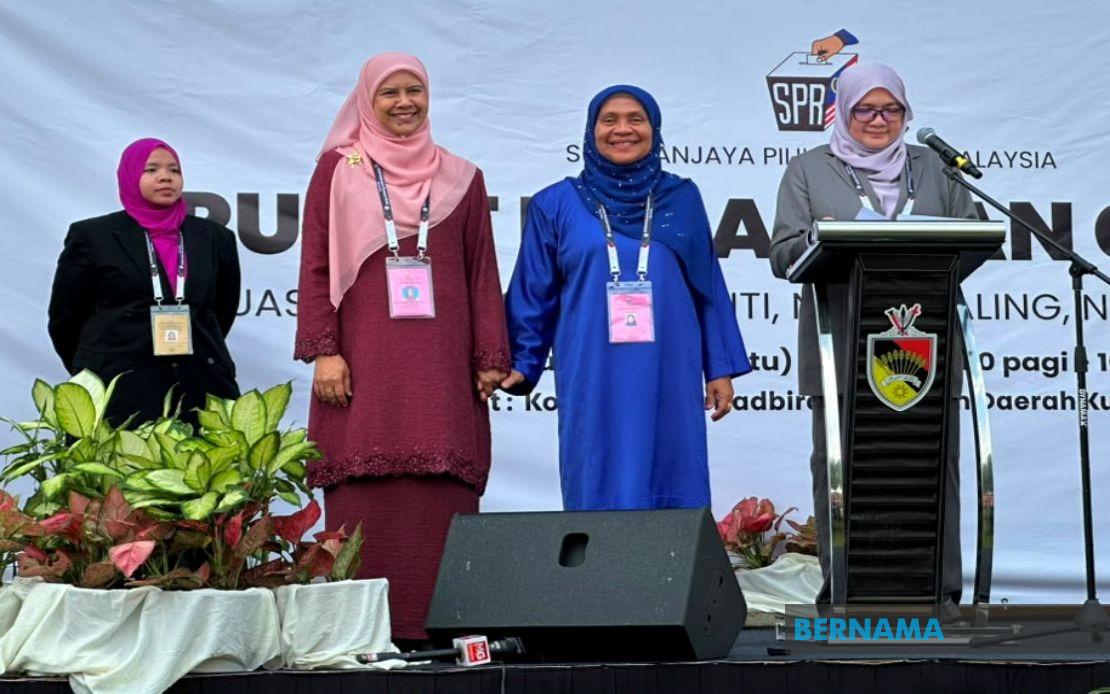
The Pilah state seat in Negeri Sembilan will stage a head-to-head contest between two women candidates when voters go to the polls for the 16th Negeri Sembilan State Election, marking a significant moment in the state's political landscape. Incumbent Datuk Noorzunita Begum Mohd Ibrahim, representing Pakatan Harapan, will face off against Barisan Nasional's S. Leza Md Yasin after both candidates successfully filed their nomination papers on July 18. The announcement came from Kuala Pilah returning officer Nawal Mohammed Amin following the close of the nomination window, with Noorzunita Begum submitting her forms at 9.03 am and S. Leza following at 9.09 am.
The all-female showdown in Pilah reflects an emerging pattern of increased representation of women candidates across Malaysia's electoral contests, though such straight fights remain relatively uncommon at the state level. Noorzunita Begum's retention of her seat will depend on her ability to consolidate Pakatan Harapan's voter base and mobilise support among constituencies historically receptive to the coalition's platform. S. Leza, meanwhile, enters the race as a challenger tasked with reclaiming ground for Barisan Nasional, which has faced significant electoral headwinds in recent state contests across the peninsula.
Beyond Pilah, the Negeri Sembilan state election is shaping up as a competitive affair with several multi-cornered contests emerging across different constituencies. The Johol state seat will feature a two-candidate battle between Pakatan Harapan's Mohd Zailan Mohd Munawar and incumbent Datuk Saiful Yazan Sulaiman of Barisan Nasional, preserving a traditional rivalry between the two major coalitions. This contest underscores the persistent bifurcation of Malaysian electoral politics, where straight fights between major blocs dominate rural and semi-urban constituencies.
Three-cornered contests will characterise the electoral environment in Juasseh, Seri Menanti, and Senaling, introducing complexity that typically favours incumbents and better-resourced campaigns. In Juasseh, Pakatan Harapan's Mohd Aidil Abdullah will challenge incumbent Datuk Ismail Lasim of Barisan Nasional, with Bersatu's Mohd Zuhami Md Yusof also entering the fray. The presence of Bersatu as a third force in multiple seats signals the party's continued effort to remain relevant in state-level politics following its mixed fortunes in recent electoral cycles. In Seri Menanti, the three-way contest involves Pakatan Harapan's Mohd Kamarul Arifin Mohd Wafa, incumbent Muhammad Sufian Maradzi of Barisan Nasional, and Bersatu's prominent figure Datuk Seri Megat D. Shahriman Zaharuddin, suggesting that Seri Menanti may emerge as a crucial battleground where the third force could tip the balance.
Senaling completes the trio of three-cornered contests with Mohd Hanis Mohd Alimin representing Pakatan Harapan, Mohamad Qayyum Abd Jalil for Barisan Nasional, and Mohd Izzafi Khan for Bersatu. These multi-candidate races introduce unpredictability into vote-splitting dynamics, particularly where Bersatu candidates could either fragment the opposition vote or attract fence-sitters disillusioned with both Pakatan Harapan and Barisan Nasional. The distribution of three-cornered contests across different regions of Negeri Sembilan suggests that Bersatu views the state as strategically important for demonstrating grassroots appeal beyond its core Malay-Muslim constituencies.
The nomination process drew significant attendance from senior national figures, underscoring Negeri Sembilan's importance within the broader Malaysian political ecosystem. PKR Wanita chief Fadhlina Sidek, who serves as Education Minister, accompanied Pakatan Harapan candidates during their nomination submissions, providing visible endorsement from federal leadership. Dr Mohammed Taufiq Johari, Angkatan Muda Keadilan's vice-chief and Youth and Sports Minister, similarly demonstrated the coalition's commitment to mobilising party machinery. The presence of Sim Tze Tzin, Deputy Investment, Trade and Industry Minister and Bayan Baru MP, further illustrated how Pakatan Harapan is leveraging federal government positions to amplify campaign momentum.
Barisan Nasional's nomination team similarly commanded high-level representation, with Deputy Home Minister and UMNO Supreme Working Council member Datuk Seri Dr Shamsul Anuar Nasarah coordinating candidate submissions. Datuk Seri Saarani Mohamad, the Perak Menteri Besar and Perak UMNO chairman, accompanied candidates, signalling cross-state mobilisation efforts within the Barisan framework. Such high-profile attendance at nomination ceremonies reflects the premium both coalitions place on Negeri Sembilan, a state where electoral outcomes can shift control of state government and regional influence within the greater Klang Valley sphere.
The electoral timeline established by the Election Commission provides campaigns with a compressed but focused schedule for voter engagement. Early voting is scheduled for July 28, while polling day falls on August 1, compressing the inter-nomination and voting period to just two weeks. This abbreviated campaign window means that candidates must rapidly establish their ground presence, articulate clear platforms, and mobilise supporters through both traditional canvassing and digital outreach. In contemporary Malaysian electoral contests, this timeframe typically favours incumbents with established machinery and well-oiled party structures.
For Pakatan Harapan, the Negeri Sembilan election represents an opportunity to consolidate control in a state where the coalition currently holds government. Retaining seats, particularly high-profile contests like Pilah with its female incumbent, would reinforce Pakatan Harapan's narrative of progressive governance and inclusive representation. Conversely, Barisan Nasional views the contest as a platform to demonstrate electoral recovery and relevance at the state level, having faced sustained losses in peninsular state elections since 2018. The presence of Bersatu across multiple constituencies introduces a complicating variable that could either splinter the anti-Pakatan Harapan vote or, conversely, consolidate a broader opposition coalition if informal electoral pacts are in place.
The concentration of multi-cornered contests in specific constituencies suggests distinct regional dynamics within Negeri Sembilan's nine state seats. Areas featuring three-way contests may reflect either strong local Bersatu organisation or constituencies where the party views winning prospects as feasible, while straight fights dominate regions where traditional coalition loyalties remain entrenched. These geographical variations underscore how Malaysian state elections, despite national significance, ultimately turn on localised factors including community demography, incumbent performance records, and candidate credibility within specific constituencies.
The Pilah all-female contest epitomises broader conversations about women's political participation in Malaysia, where state-level elections frequently feature fewer female candidates than desirable and representation remains skewed toward male-dominated legislative bodies. Noorzunita Begum's incumbency provides continuity and a track record to defend, while S. Leza's candidacy represents Barisan Nasional's effort to counter Pakatan Harapan's female representation narrative. Regardless of the electoral outcome, the contest demonstrates that Malaysian women candidates can compete effectively for substantive elected positions rather than remaining confined to consultative roles within party structures.
Looking ahead to August 1, Negeri Sembilan voters will determine not only which candidates represent individual constituencies but also broader questions about coalition viability, incumbent performance evaluation, and emerging political alternatives. The state election occurs within a context of persistent competition between Pakatan Harapan and Barisan Nasional for peninsular state control, with intervening variables such as Bersatu's positioning and local voter sentiment toward federal and state governance. The results will provide important indicators of electoral momentum heading into any potential federal elections and signal shifting preferences within Malaysia's crucial Klang Valley region and broader Peninsular heartland.

