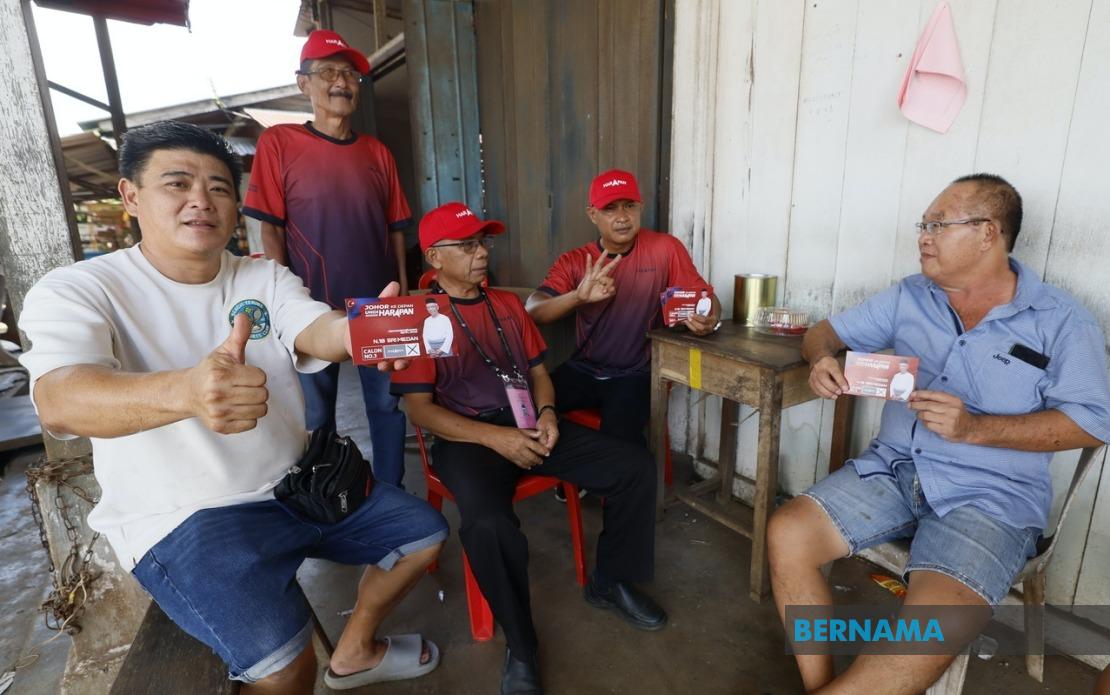
In a bid to capture the Sri Medan seat from the Barisan Nasional, Pakatan Harapan candidate Hishamudin @ Misrin Ishak is taking to the streets of Batu Pahat with a campaign centred on addressing the everyday needs of ordinary residents. The former mathematics educator, popularly known as "Cikgu Misrin", has adopted a listening-first approach as he walks through neighbourhoods, meeting constituents and documenting their grievances for potential action should he win the seat in the 16th Johor State Election scheduled for July 11.
The chronic flooding that periodically inundates parts of Sri Medan ranks high among concerns Hishamudin has encountered during his campaign trail. Rather than making sweeping promises, he has committed to tackling infrastructure challenges with pragmatic solutions, signalling that his administration would prioritise practical improvements to residents' daily lives over rhetorical flourishes. This emphasis on action over words—summed up in his principle of "work first, talk later"—attempts to differentiate his candidacy in a constituency traditionally dominated by the ruling coalition.
Hishamudin's background as a village head has provided him with hands-on experience in managing community matters ranging from administrative functions to welfare delivery and local development projects. He views this experience as foundational to his candidacy, arguing that his familiarity with grassroots governance makes him well-positioned to serve as an effective intermediary between constituents and state government apparatus. His stated intention is to ensure that no segment of Sri Medan's population falls through the cracks as the state modernises, a concern that resonates particularly in constituencies where rural and urban zones coexist.
Infrastructure equity forms a cornerstone of his platform. Hishamudin has explicitly committed to balanced development across urban centres, semi-urban zones, and rural pockets of the constituency, recognising that resource allocation often skews toward densely populated areas. By pledging to extend quality facilities and services uniformly across these geographic divisions, he is positioning himself as an advocate for overlooked rural communities that frequently lag behind in development spending. This targeted messaging addresses a historical grievance in Malaysian state politics where rural constituencies feel marginalised by urban-centric development priorities.
Youth employment and skills development represent another pillar of his campaign platform. Hishamudin has signalled his intention to organise Technical and Vocational Education and Training (TVET) programmes and digital literacy courses should he assume office, recognising that young people in Sri Medan require practical pathways to economic independence. The emphasis on TVET is particularly significant in Malaysian political discourse, as vocational education has historically received less political attention than university-level credentials, despite acute labour market demand for skilled tradespeople and technical professionals. By championing these programmes, Hishamudin is tapping into legitimate frustrations among parents and youth seeking alternatives to overcrowded university pathways.
Small and medium enterprise support features prominently in his economic platform. Beyond simple assistance, Hishamudin has identified market access expansion as a critical bottleneck constraining Sri Medan's business community. Many local entrepreneurs remain trapped serving only their immediate geographic market, unable to scale operations or access larger commercial opportunities. His commitment to facilitating broader market connections suggests an understanding of how government intervention at the state level can unlock economic potential without requiring massive budget allocations. This approach appeals to the merchant class while also promising downstream employment effects for constituents.
Hishamudin's insistence that he will serve all residents regardless of their political leanings carries particular weight in a constituency where Barisan Nasional has entrenched support. By explicitly decoupling service delivery from partisan considerations, he is attempting to neutralise the administrative advantage that typically accrues to ruling parties. This messaging convention has become standard in Malaysian electoral politics, yet it remains effective in appealing to swing voters and opposition sympathisers who fear that changing government might result in resource deprivation.
The candidate characterises his campaign reception through the first three days as encouraging, though Sri Medan remains widely regarded as a Barisan Nasional stronghold—a significant caveat that suggests the ground remains challenging terrain for Pakatan Harapan. As a relative newcomer to state-level politics and a fresh political face lacking the name recognition or network advantages of incumbent Datuk Zulkurnain Kamisan, Hishamudin faces substantial structural disadvantages. The presence of a third serious contender in Perikatan Nasional's Ahmad Rosdi Bahari further fragments the anti-incumbent vote, potentially benefiting the defending coalition.
Yet Hishamudin's framing of his outsider status as a strategic asset is noteworthy. He has cast his lack of connection to established political machinery as evidence of authenticity and independence, suggesting that long-serving politicians become ensnared in patronage networks that prevent them from prioritising constituent welfare. This anti-establishment framing has resonated in Malaysian electoral contests where voter frustration with entrenched political classes occasionally produces unexpected results, though such upsets remain rare in rural and semi-rural constituencies.
The Johor state election represents a mid-term assessment of Pakatan Harapan's performance at state level following the 2022 general election. Candidates like Hishamudin are testing whether the coalition can expand beyond traditional urban strongholds into constituencies traditionally held by Barisan Nasional. The outcome in seats like Sri Medan will indicate whether Pakatan Harapan has successfully translated federal legitimacy into state-level traction, or whether Johor remains a firewall for the ruling coalition despite recent political realignments across Malaysia.
Early voting commences on July 7, with the main election day following on July 11. The competition in Sri Medan exemplifies broader dynamics reshaping Malaysian electoral politics: the challenge facing established ruling parties to defend seats against revitalised opposition movements, the importance of candidate credibility and accessibility in local contests, and the enduring structural advantages that incumbency and administrative capacity confer in state-level elections.

